
3D-ADD SH, Self-Heal temperature-targeted repair additives for 3D printing resins
Product description
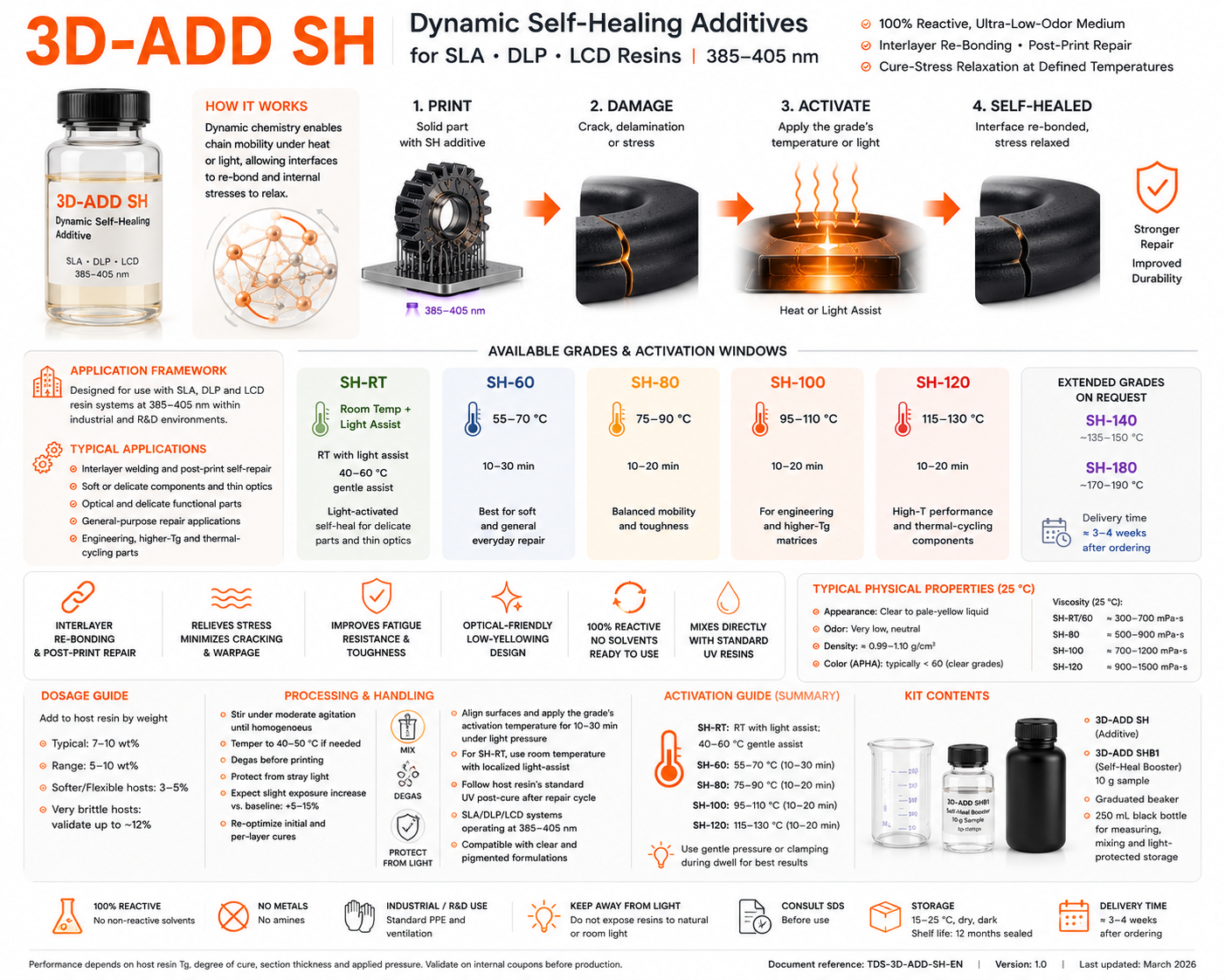
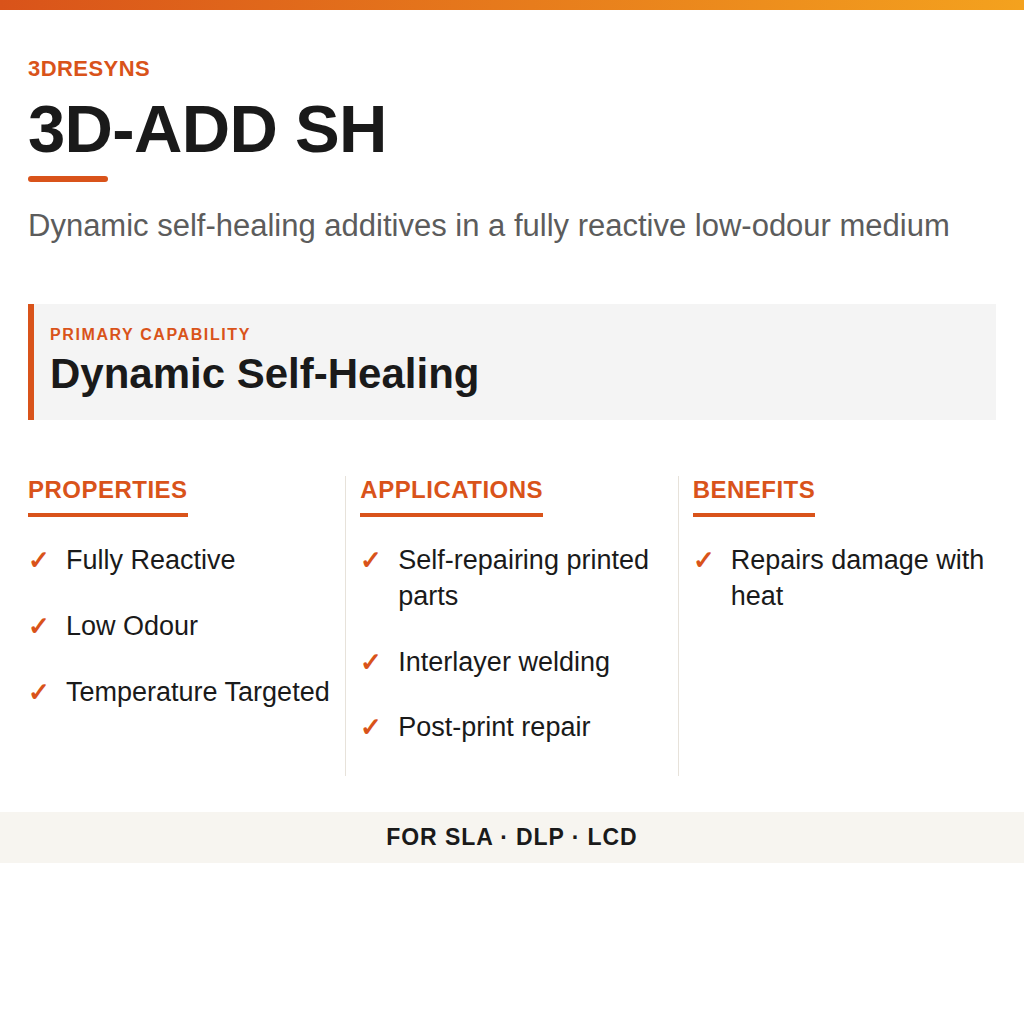
3D-ADD SH are dynamic self-healing additives supplied in a 100% reactive, ultra-low-odor medium for SLA, DLP and LCD resins at 385–405 nm. They enable interlayer re-bonding, post-print repair, and cure-stress relaxation at defined activation temperatures.
Each grade is tuned so designers can select the right balance of mobility and toughness for their resin system. Available grades are SH-RT, SH-60, SH-80, SH-100 and SH-120, with extended grades SH-140 and SH-180 available on request.
Application framework
Designed for use with SLA, DLP and LCD resin systems operating at 385–405 nm within industrial and R&D environments. Suitable for soft, delicate, optical, engineering and high-performance printed components requiring interlayer welding, post-print self-repair and stress relaxation.
Typical applications
- Interlayer welding and post-print self-repair of SLA, DLP and LCD printed parts
- Soft or delicate components and thin optics
- Optical and delicate functional parts
- General-purpose repair applications
- Engineering, higher-Tg and thermal-cycling parts
Measured physical properties
- Appearance: Clear to pale-yellow liquid
- Odor: Very low, neutral
- Viscosity (25 °C): SH-RT/60 ≈ 300–700 mPa·s
- Viscosity (25 °C): SH-80 ≈ 500–900 mPa·s
- Viscosity (25 °C): SH-100 ≈ 700–1200 mPa·s
- Viscosity (25 °C): SH-120 ≈ 900–1500 mPa·s
- Density (25 °C): ≈ 0.99–1.10 g/cm³
- Color (APHA): typically < 60 (clear grades)
- SH-RT activation: RT with light assist; 40–60 °C gentle assist
- SH-60 activation: 55–70 °C (10–30 min)
- SH-80 activation: 75–90 °C (10–20 min)
- SH-100 activation: 95–110 °C (10–20 min)
- SH-120 activation: 115–130 °C (10–20 min)
- Shelf life ≈ 12 months sealed
- Storage: 15–25 °C, dry and protected from light
- Delivery time is around 3–4 weeks after ordering
Functional performance characteristics
- Heat- or light-assisted interlayer welding and post-print self-repair
- Releases internal stress, minimizing micro-cracking and warpage
- Improves fatigue resistance and toughness in brittle matrices
- Optical-friendly at recommended use levels
- Low-yellowing design at typical loadings
- 100% reactive (no non-reactive solvents)
- Ready to use
- Mixes directly with standard UV-curable resins
Processing and handling performance
- Dosage: 5–10 wt% into the host resin (typical 7–10%)
- For softer/flexible hosts, 3–5% may suffice
- For very brittle hosts, validate up to ~12%
- Stir under moderate agitation until homogeneous
- Temper to 40–50 °C if needed
- Degas before printing
- Protect from stray light
- Expect a slight increase in exposure vs. baseline; typical +5–15%
- Re-optimize initial and per-layer cures
- Align surfaces and apply the grade’s activation temperature for 10–30 min under light pressure
- For SH-RT, use room temperature with localized light-assist to lock the interface
- Follow the host resin’s standard UV post-cure after the repair cycle
- SLA/DLP/LCD systems operating at 385–405 nm
- Compatible with common 3D-resin matrices including rigid-tough, tough-clear, engineering clears and flexible systems
- Compatible with clear and pigmented formulations, verify in opaque/filled systems
- Use standard PPE (gloves, goggles, lab coat) and adequate ventilation
- Avoid prolonged exposure to strong light during mixing
- Consult the SDS for detailed handling information
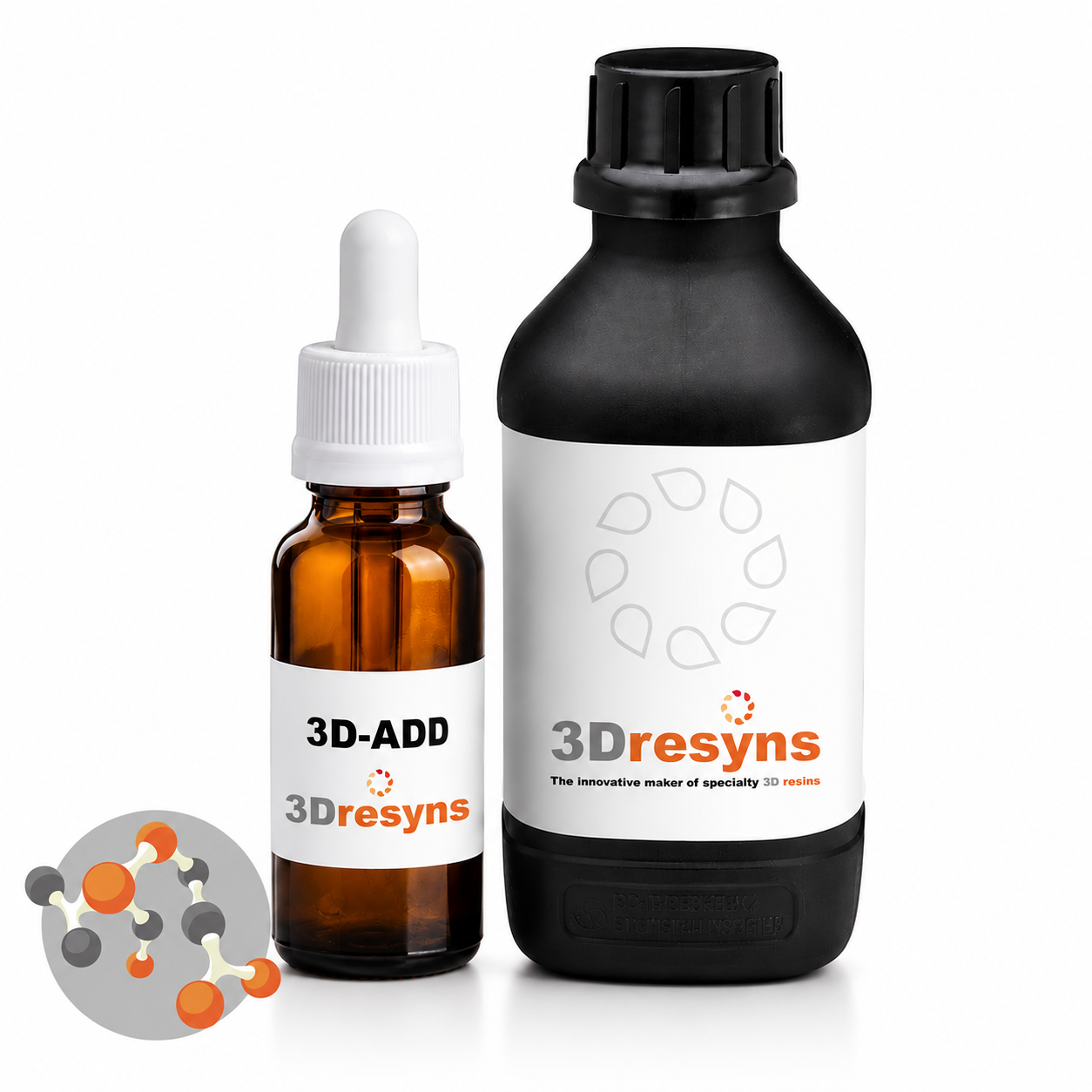
- It is supplied as a kit, which contains the product and a 10 gram sample of 3D-ADD SHB1 Self-Heal Booster, one graduated beaker and one empty 250 mL black bottle to measure, mix, keep and protect the 3D resins from daylight
- Please do not expose any 3D resins to natural or room light to prevent their curing
Chemical and safety characteristics
- 100% reactive
- Ultra-low-odor medium
- Added metals/amines: None
- For industrial and R&D use only
- Not evaluated for implantable, pharmaceutical, or food-contact applications unless stated in writing
Testing & processing disclaimer
Exact activation depends on host Tg, degree of cure, section thickness, and applied pressure. Validate on internal coupons. Use gentle pressure/clamping during dwell.
Disclaimer
This material is supplied as a professional manufacturing material and is not marketed as a finished medical device. Final part performance and suitability must be validated by the user according to the intended application.
This technical datasheet should be used together with the relevant processing, calibration, safety and workflow documentation available in the 3Dresyns® Resources section.
Document reference: TDS-3D-ADD-SH-EN | Version: 1.0 | Last updated: March 2026
Choose options