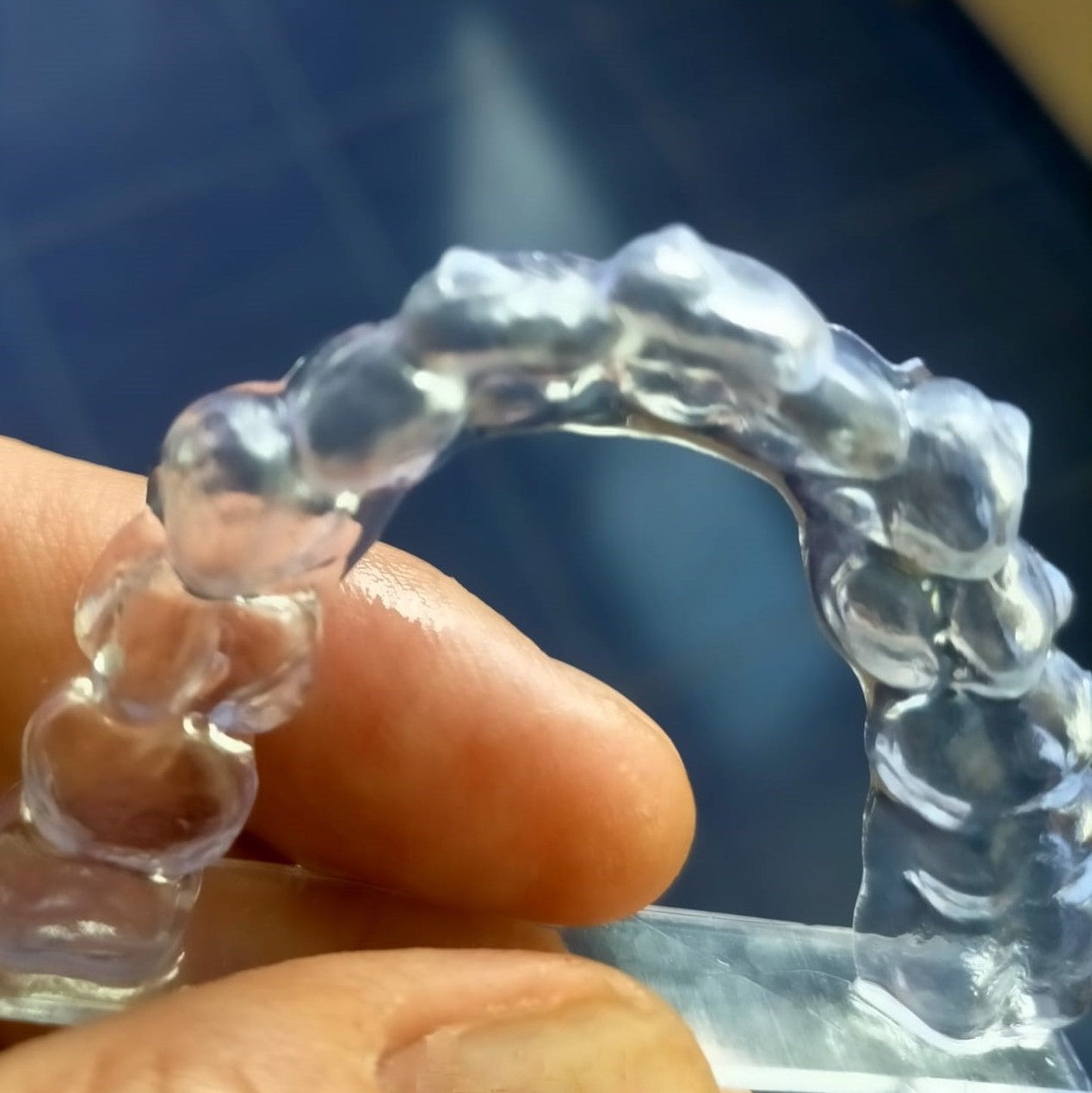
Dental photopolymer systems for orthodontic, restorative, guide, model and laboratory manufacturing workflows.
3Dresyns® dental materials are engineered for professional additive manufacturing where fit, surface quality, mechanical behaviour and workflow consistency are critical.
Navigate by: dental application, required stiffness or laboratory workflow.
Select an application route to navigate directly to the most relevant part of the collection table.
Workflow-oriented dental material logic
These materials span from rigid and high-strength grades to flexible and elastic systems.
Selection should be made according to intended application, stiffness requirement, comfort, fit and validated laboratory workflow.
Quick selection by application
Dental navigation
Choose your workflow
Use the application links below to jump directly to the most relevant materials in the dental table.
Application routes
Selection logic
Selection logic
How to choose the right dental material
Select the material family according to the primary clinical or laboratory requirement.
Decision guide
-
Rigid guides / high-strength → D85–D90 systems
-
Tough / foldable appliances → D60–D70 systems
-
Flexible appliances → D60–D70 flexible systems
-
Rubber-like / soft components → A90–A35 systems
-
Models and prototyping → CD / CD Pro / Soya / OD UHR / OD HT
-
Casting workflows → dedicated castable systems
Dental material comparison table
Mobile: scroll horizontally to view all columns. The first column remains visible while scrolling.
* OD-Clear CV1 MF Bio is a surface coating; bulk structural values are not characterized the same way as for part-forming resins.
Workflow note
Model and appliance logic
Dental model selection depends on the downstream laboratory task
Not all model resins solve the same problem. Some routes are optimized for lower-cost routine models, others for higher performance, and OD UHR specifically adds a more ultra-hard, rigid and thermally resistant route for demanding laboratory model workflows.
Where vacuum thermoforming is critical, higher rigidity, dimensional stability and thermoforming resistance become more important than simply choosing a general model resin.
Regulatory framework
Regulatory framework
Professional manufacturing materials for dental laboratory workflows
3Dresyns dental materials are supplied as professional manufacturing materials for additive manufacturing workflows in dental laboratory environments.
They are not marketed as finished medical devices unless explicitly stated for a specific product and jurisdiction. The regulatory classification and compliance of any final medical device manufactured using these materials remain the responsibility of the legal manufacturer of that device in accordance with Regulation (EU) 2017/745.
These products should be selected according to the intended dental application, laboratory process, mechanical requirement and validated manufacturing workflow. Final suitability depends on calibration, printer compatibility, post-processing and the exact use case.
Biocompatible 3D Printing: System-Level Performance
Biocompatibility in vat photopolymerization is not defined by the liquid resin alone. Final safety and performance depend on formulation design, residual species control, printing conditions, post-processing and application-specific validation.
3Dresyns® biocompatible systems are engineered to support controlled manufacturing workflows where extractables, polymer conversion and surface chemistry are managed at system level.
Key technical principle
Photopolymer conversion is never complete. Residual species may remain within printed parts and can influence extractables and biological response depending on processing conditions.
Monomer Free (MF) formulation strategy
3Dresyns Monomer Free (MF) resin systems are designed to reduce the presence of reactive residual species at the formulation level, contributing to improved control of extractables when processed under validated workflows.
Why workflow control matters
- printing parameters influence polymer conversion and internal structure
- geometry affects light penetration and curing uniformity
- post-processing defines residual species removal
- application conditions determine extractable behavior
Final performance must always be evaluated as a material–printer–process–post-processing system, not as an isolated resin property.
Technical documentation and guidance
For technical guidance or workflow validation support contact info@3dresyns.com