Otoplastics Applications
3Dresyns® photopolymer systems are used for otoplastics applications where dimensional accuracy, surface quality, mechanical behavior and controlled biocompatibility are critical requirements.
Otoplastics applications typically involve customized, patient-specific devices produced through digital workflows that combine scanning, design, additive manufacturing and post-processing.
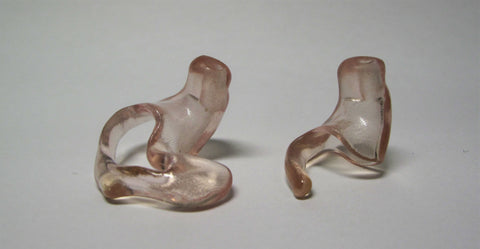
Special thanks to Cotu for kindly sharing many of the photographs presented on this page, illustrating otoplastics applications printed with 3Dresyns materials. Unless otherwise stated, the images shown are authentic photographs of real printed parts. None has been AI-generated, AI-modified or digitally enhanced using Photoshop.
Unlike many illustrative images used in the additive manufacturing industry, the photographs presented on this page depict actual printed parts produced with 3Dresyns materials under real manufacturing conditions.
Scope of otoplastics use cases
Otoplastics applications may include hearing aid shells, earmolds, ear protection devices and other custom-fit components intended for prolonged contact with the external ear.
These applications require high geometric fidelity, smooth surfaces and consistent material behavior to ensure comfort, functionality and reliable fit.
Process- and workflow-dependent performance
The performance of otoplastic devices depends on multiple interacting variables. These include resin formulation, selected material version, printer technology, printing parameters, orientation, washing procedures, post-curing conditions and finishing steps.
Mechanical properties, surface quality and biocompatibility outcomes are therefore determined by the complete workflow rather than by the liquid resin alone.
Material systems for otoplastics applications
Otoplastics applications are produced using dedicated photopolymer systems within the 3Dresyns portfolio, designed to support accuracy, durability and suitability for skin-contact applications when processed according to the recommended Instructions for Use.
Different system configurations may be selected to balance flexibility, toughness, surface finish and processability depending on the specific otoplastics application.
From digital design to personalized devices
The examples presented illustrate the integration of 3D printing into modern digital otoplastics workflows, from data acquisition and design to printing, post-processing and final device finishing.
By combining appropriate material systems with qualified workflows and controlled post-processing, reliable and repeatable results can be achieved for customized otoplastic applications.
Governing principle
Examples presented on this page represent typical outcomes obtained under specific printing, post-processing and finishing conditions. Device performance and biocompatibility are not intrinsic material constants and may vary depending on material selection, workflow and processing variables.
This principle promotes a transparent interpretation of the otoplastics examples presented here, consistent with a system-based and process-aware approach to additive manufacturing.