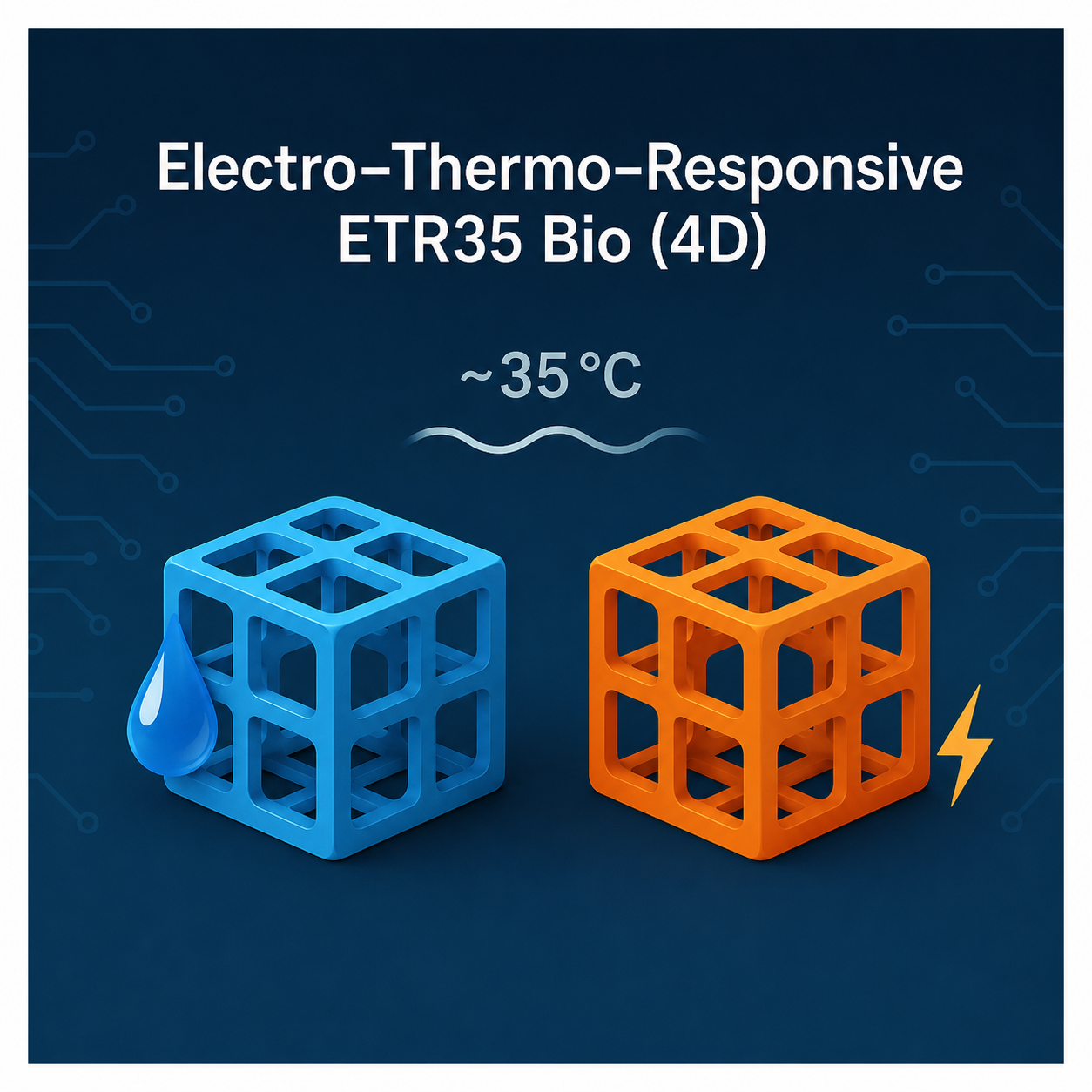
4D printing resins organized for stimuli-responsive materials, time-dependent behavior and advanced functional systems in SLA, DLP and LCD/MSLA workflows.
This collection supports comparison of materials designed for shape change, actuation and dynamic response under external stimuli.
Navigate by: stimulus type, shape-change behavior, actuation mechanism or research application.
Select the material according to functional response and validate the final resin choice for the intended stimulus conditions, geometry and application.
Stimuli-responsive material platform
This collection is structured for materials exhibiting time-dependent or stimulus-triggered behavior such as deformation, recovery or actuation.
It supports advanced research workflows in 4D printing, soft robotics and responsive systems design.
Quick selection by functional behavior
Material navigation
Choose your responsive system
Use the routes below to access the most relevant 4D printing application.
Typical routes
Key features & benefits
Material profile
4D printing photopolymer systems
These materials are designed for dynamic behavior, enabling controlled response over time or under external stimuli.
Main advantages
- Stimuli-responsive and time-dependent material concepts
- Shape-change and actuation positioning (grade-dependent)
- Advanced functional behavior tuning
- Research-focused material systems
- Support for next-generation printing workflows
- Compatible with SLA, DLP and LCD/MSLA processes
Typical uses
Typical applications
These resins are relevant for advanced research and development workflows where dynamic material response is required.
Application examples
- 4D printing research
- Soft robotics concepts
- Deployable structures
- Shape-memory demonstrations and responsive prototypes
Collection overview
Products in this collection
Products in this collection are shown below.
This collection includes materials positioned for responsive systems, actuation concepts and time-dependent functional behavior.
Selection logic
Decision guide
How to choose the right 4D printing resin
Select the most suitable material according to stimulus type, deformation behavior, response time and application requirements.
Decision guide
-
Need shape-memory behavior → choose materials with controlled deformation and recovery
-
Need actuation capability → select systems optimized for external stimulus response
-
Need deployable structures → prioritize reversible or programmable geometry change
-
Need responsive prototypes → choose materials aligned with experimental functional behavior
Workflow principle
Function depends on stimulus and environment
Final performance depends on the interaction between material, geometry, external stimulus and environmental conditions.
These materials should be interpreted as advanced research systems requiring validation under real operating conditions.
These materials are intended for research and advanced functional prototyping. Final behavior depends on stimulus conditions, processing parameters and application environment.
These products should be understood as experimental 4D materials rather than standard structural polymers. Final validation is required depending on the intended functional behavior and application.