
Adhesion promoters
Interfacial control additives for improving adhesion, substrate compatibility and advanced formulation behaviour in vat photopolymerization.
3Dresyns® Adhesion Additives are engineered formulation additives designed to improve bonding to difficult substrates and to support advanced composite, hybrid and dynamic network systems.
Navigate by: functional objective, system chemistry or substrate challenge.
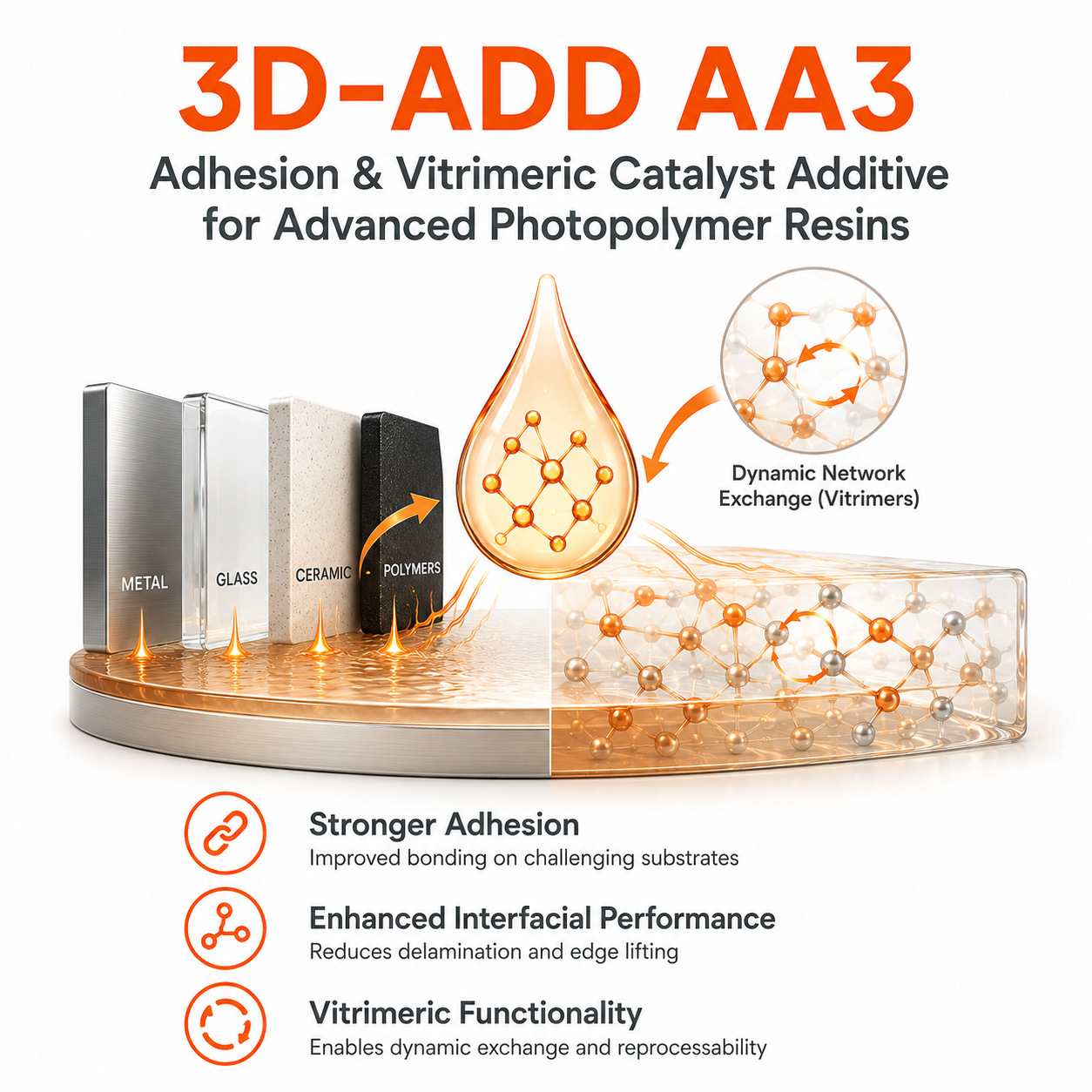
These additives improve adhesion on difficult substrates such as metals, glass, ceramics and engineered polymers, while also supporting advanced formulation design in composites, hybrids and dynamic network systems.
They allow structured tuning of adhesion and compatibility without changing the full resin backbone.
Quick selection by objective
Choose your additive route
Use the routes below to identify the most relevant additive family for your formulation challenge.
Adhesion additive selection guide
Select your additive according to substrate polarity, formulation type and functional objective.
- General adhesion improvement → AA1 / AA2
- Biocompatible adhesion improvement → AA2
- Advanced adhesion + vitrimeric catalytic function → AA3
- Hydrophilic / polar systems → AA1
- Hydrophobic / biocompatible systems → AA2
- Advanced hybrid / vitrimer / composite systems → AA3
- Metals / glass / ceramics → AA1, AA2, AA3
- Filled composites → AA2, AA3
- Dynamic networks / reprocessable systems → AA3
Decision tree summary
Choose the additive first by system chemistry and functional objective, then optimize concentration and validate final adhesion on the intended substrate.
- Need biocompatibility → AA2 or AA3
- Hydrophilic / polar resin system → AA1
- Hydrophobic / more universal adhesion → AA2
- Need vitrimer catalysis / advanced composite optimisation → AA3
Adhesion additives improve interfacial bonding, but final performance still depends on substrate surface chemistry and cleanliness, surface roughness and pretreatment, resin composition and filler content, cure conditions and conversion level, and additive dosage and dispersion quality.
For this reason, additive selection should always be followed by practical validation under the intended substrate, exposure and post-processing conditions.
Adhesion additive comparison table
| Additive | Description | System profile | Main function | Key features | Best for |
|---|---|---|---|---|---|
| AA1 | Hydrophilic adhesion additive for difficult substrates. | Hydrophilic / polar systems | General adhesion promotion | Improves bonding on metals, glass and polar inorganic substrates. Very low viscosity. | General adhesion improvement in non-biocompatible or polar systems. |
| AA2 | Biocompatible hydrophobic adhesion additive. | Hydrophobic / biocompatible systems | Biocompatible adhesion promotion | Improved adhesion with increased biocompatibility. Ultra low viscosity. Reduced migratables profile. | Biocompatible systems requiring adhesion on challenging substrates. |
| AA3 | High-performance adhesion promoter with vitrimeric catalytic functionality. | Advanced hybrid / vitrimer / composite systems | Advanced adhesion + catalytic activation | Improves adhesion on metals, glass, ceramics and composites. Supports dynamic bond exchange in vitrimeric networks. | Advanced structural systems, composite resins, hybrid builds and reprocessable photopolymers. |
Mobile: scroll horizontally to view all columns. The first column remains visible while scrolling.
Structured formulation principle
Adhesion additives should be evaluated within a structured workflow combining substrate and formulation selection, controlled dosing and mixing, curing validation, dimensional verification and application-specific adhesion testing.
Sort by
Filters
From prototyping to industrial production, performance depends on materials, calibration and process control