
3D-ADD AA3, Adhesive & Interfacial Promoter for Difficult Surfaces
Product description
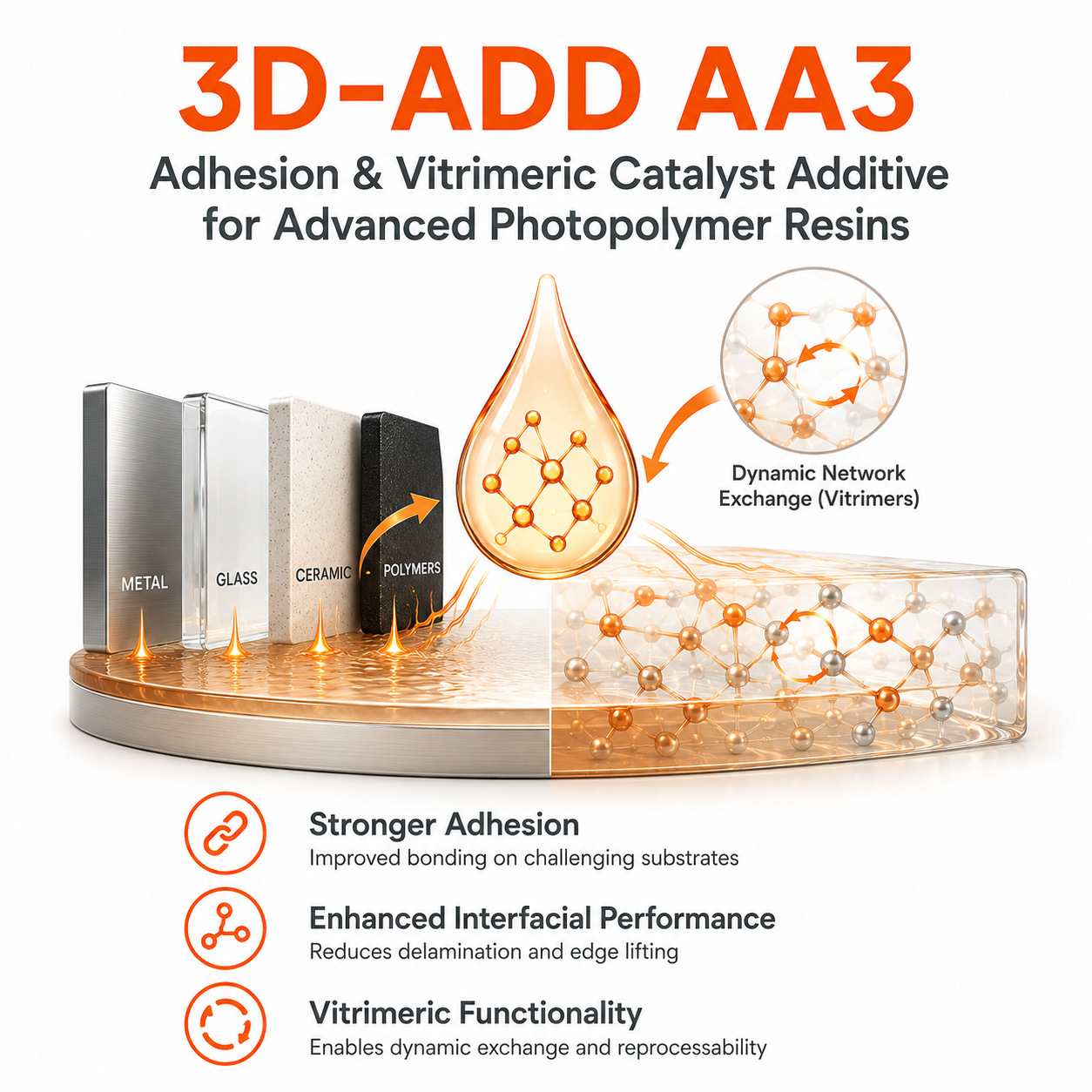
3D-ADD AA3 is a high-performance adhesion-promoting additive with vitrimeric catalytic functionality, designed for advanced photopolymer formulations used in SLA, DLP and LCD 3D printing systems.
The material is engineered to enhance interfacial bonding on challenging substrates such as metals, glass, ceramics and engineered polymers, while simultaneously enabling dynamic network exchange in vitrimer-based systems.
This formulation combines adhesion promotion with latent catalytic activity, supporting improved mechanical integrity, reduced delamination and enhanced reprocessability in advanced resin systems.
Application framework
Designed for incorporation into photopolymer resin systems used in vat photopolymerization (SLA, DLP and LCD), within professional and industrial environments requiring enhanced adhesion and/or dynamic network behavior.
Typical applications
- Adhesion improvement on metal, glass and ceramic substrates
- Composite and highly filled resin systems
- Vitrimeric and reprocessable photopolymers
- Multi-material and hybrid 3D printing workflows
Measured physical properties
- Form: liquid additive
- Viscosity: ~1,300 cps at 25 °C
- Color (APHA): ≤14
- Molecular weight (GPC): ~1,860 g/mol
- Refractive index (nD²⁵): ~1.467
- Acid value: ≤300 mg KOH/g
Formulation guidelines
- Recommended loading: 1–10 wt% (depending on base resin and substrate)
- Typical range for standard resins: 1–5 wt%
- Typical range for filled composites: 3–8 wt%
- Typical range for vitrimer systems: 3–10 wt%
- Start at low loading and adjust based on adhesion and curing performance
Functional performance characteristics
- Improved adhesion on inorganic and low-reactivity substrates
- Enhanced interfacial bonding in composite systems
- Reduction of delamination and edge lifting
- Latent catalytic activation for dynamic network exchange (vitrimers)
- Supports stress relaxation and reprocessability in thermally activated systems
Processing and handling performance
- Compatible with SLA, DLP and LCD printing technologies
- Incorporates into radical, hybrid and dual-cure systems
- Minimal impact on cure depth at optimized loadings
- May slightly moderate cure kinetics due to acidic functionality
- Requires formulation adjustment of photoinitiator system if needed
Chemical and formulation characteristics
- Adhesion-promoting functional additive
- Latent catalytic component for vitrimer systems
- Compatible with standard photopolymer chemistries
- Suitable for hybrid and advanced network architectures
Testing & processing disclaimer
Material performance depends on formulation composition, photoinitiator system, exposure conditions, printer type and post-processing workflow. Adhesion and curing behavior must be validated within the final resin formulation and application.
Disclaimer
This product is supplied as a formulation additive for professional use in photopolymer engineering and additive manufacturing workflows. It is not a standalone printable material. Final performance and suitability must be validated by the user according to the intended application and formulation.
This technical datasheet should be used together with the relevant processing, calibration, safety and workflow documentation available in the 3Dresyns® Resources section.
Document reference: TDS-3DADD-AA3-EN | Version: 1.0 | Last updated: March 2026
Choose options