
3D-ADD Self-Heal Seal — Optic · Thermal-Weld · BioGen
Product description
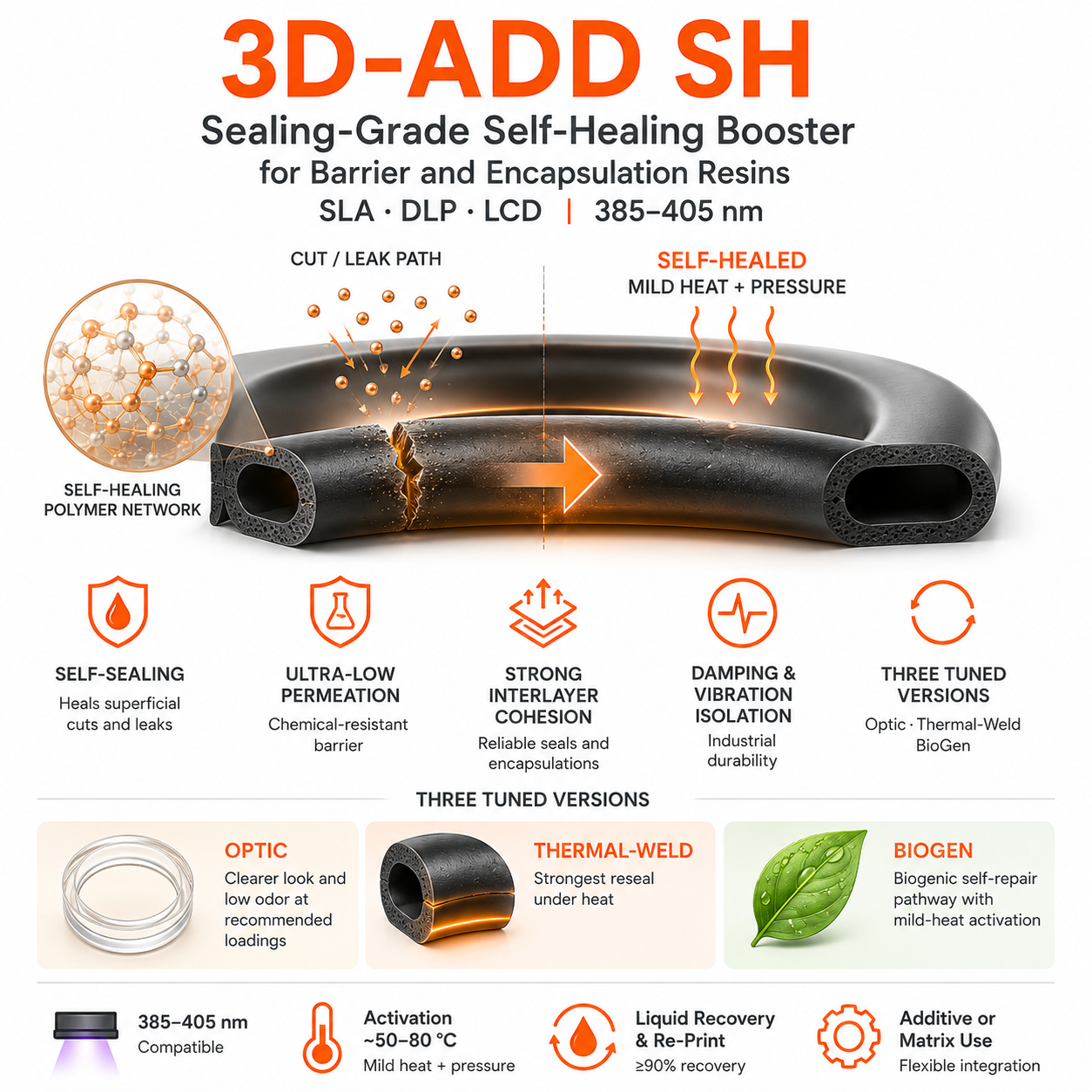
Sealing-grade self-healing booster for barrier and encapsulation applications in SLA, DLP and LCD resins at 385–405 nm.
It upgrades flexible bases to ultra-low-permeation, chemical-resistant materials that can re-close superficial cuts under mild heat and pressure. Three tuned versions are described: Optic, Thermal-Weld and BioGen.
Application framework
Designed for use in SLA, DLP and LCD resin systems operating at 385–405 nm for barrier, encapsulation and sealing applications. Suitable for flexible, barrier-oriented photopolymers in clear and pigmented systems.
Typical applications
- Custom gaskets and O-rings
- Sealing lips and flanges
- Chemical-resistant bellows and boots
- Encapsulation and barrier geometries
- Fluid management components
- Leakage-mitigation interfaces
Measured physical properties
- Appearance: amber to dark amber, high-viscosity liquid
- Odor: technical, low volatility
- Viscosity (25 °C): ~2000–5000 mPa·s
- Density (25 °C): ~1.40–1.55 g·cm⁻³
- VOC: extremely low
- Additive mode: 20–30 wt% into a flexible base
- Matrix mode: ~50 wt%
- Activation guide: Optic ~50–80 °C with mild pressure
- Activation guide: Thermal-Weld ~50–80 °C targeting firmer reseal
- Activation guide: BioGen ~50–80 °C with mild pressure
- Storage: 5–25 °C, dry, protected from light
- Shelf life: 12 months unopened
Functional performance characteristics
- Self-sealing behavior for superficial cuts and micro-leak paths
- Ultra-low gas/liquid permeation and chemical resistance
- Improved interlayer cohesion for printed seals and encapsulations
- Strong damping and vibration isolation
- Low bleed-out
- Industrial durability
- Optical-friendly variants available
- Optic version: clearer look and low odor at recommended loadings
- Thermal-Weld version: strongest reseal under heat
- BioGen version: biogenic self-repair pathway with mild-heat activation
Processing and handling performance
- Blend under low light until uniform before printing
- Print on 385–405 nm systems
- Opaque/darker tones may require slightly longer layer exposures
- Cool in contact to lock the interface
- Follow the host resin’s standard post-cure
- Designed for flexible, barrier-oriented photopolymers operating at 385–405 nm
- Suitable for clear and pigmented systems
- In highly filled or opaque matrices, verify exposure settings and activation windows on internal coupons
- Industrial/R&D use only
- Use standard PPE (gloves, goggles, lab coat) and adequate ventilation
- Avoid prolonged exposure to intense light during mixing and handling
- Consult the SDS for this additive and for the host resin
- Additive, one graduated beaker, and one empty 250 mL black bottle to measure, mix, and protect the resin from daylight are included in the kit
- Keep resins away from natural or room light to prevent unintended curing
Chemical and safety characteristics
- VOC: extremely low
- Low volatility
Testing & processing disclaimer
Activation guide and exposure settings must be validated on internal coupons. In highly filled or opaque matrices, verify exposure settings and activation windows on internal coupons.
Disclaimer
This material is supplied as a professional manufacturing material and is not marketed as a finished medical device. Final part performance and suitability must be validated by the user according to the intended application.
This sealing-grade self-healing booster is supplied as a reactive additive for integration into flexible, barrier-oriented SLA, DLP and LCD photopolymers. Applications that require a dedicated barrier, encapsulation or sealing formulation, or specific permeation, chemical-resistance, mechanical or optical targets beyond what the additive provides on its own, can be addressed through a custom-designed material.
For these cases, 3Dresyns develops customized resin and additive systems according to customer specifications through the Customization Services program: Customization Services.
This technical datasheet should be used together with the relevant processing, calibration, safety and workflow documentation available in the 3Dresyns® Resources section.
Document reference: TDS-3D-ADD-SH-SEALING-GRADE-EN | Version: 1.0 | Last updated: March 2026
Choose options