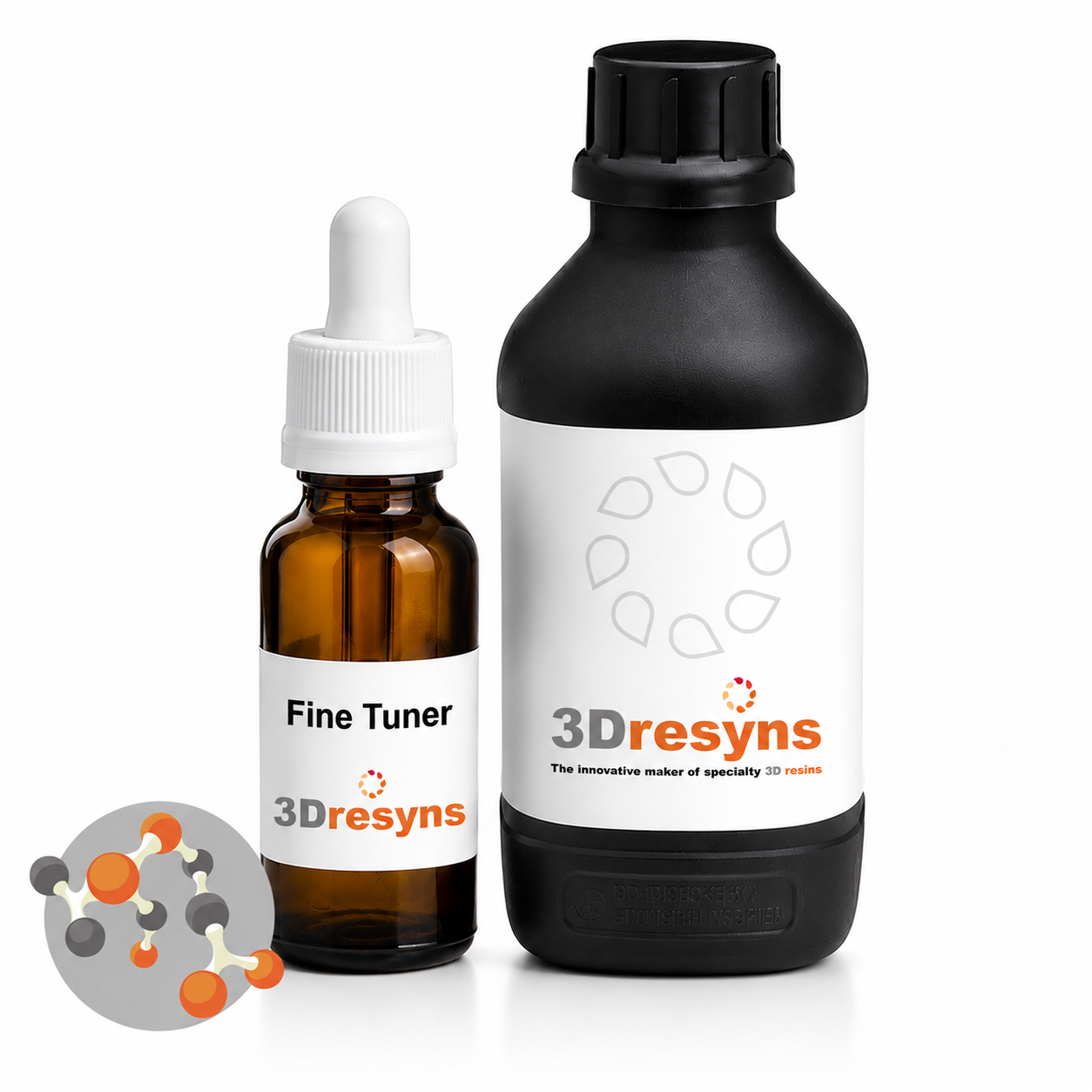
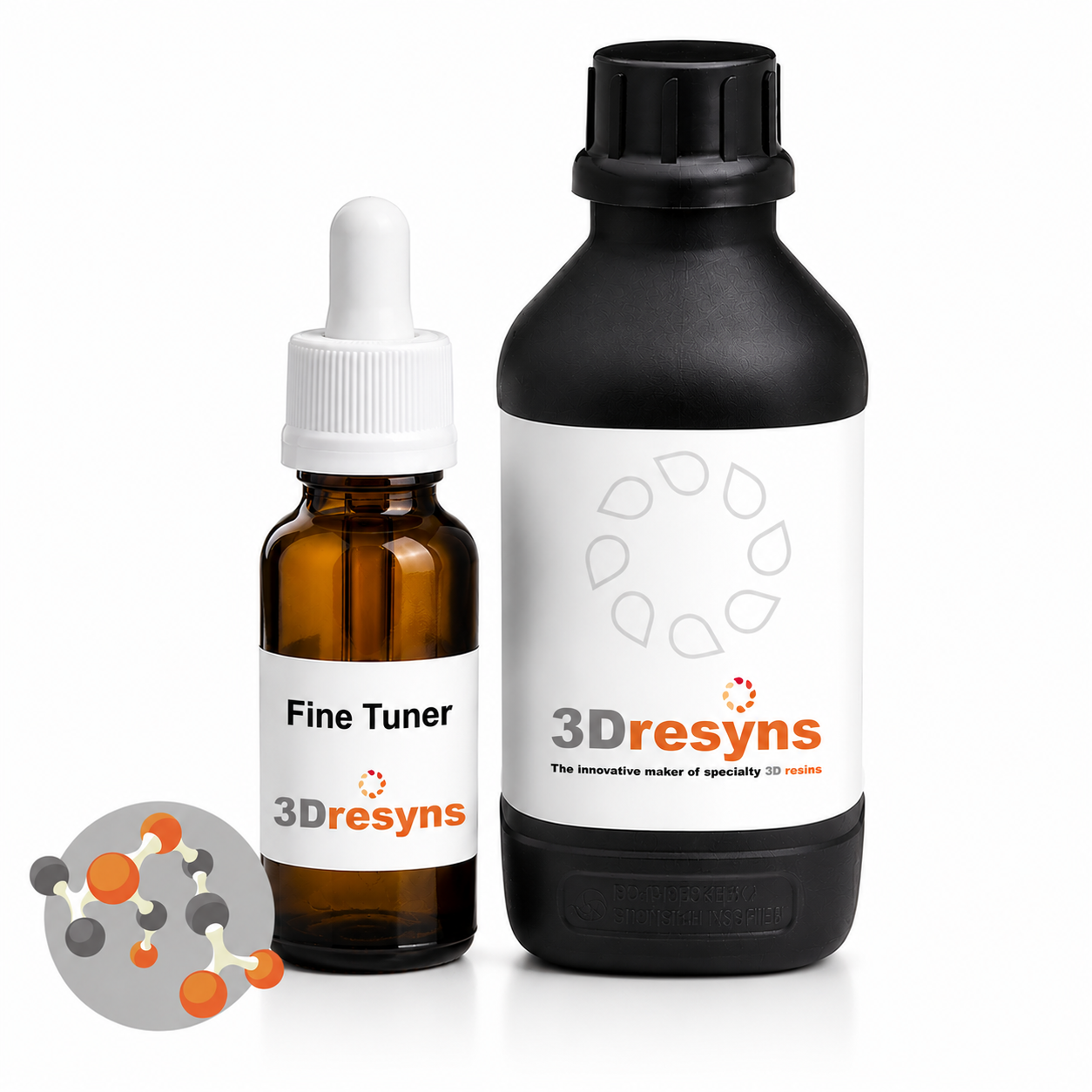
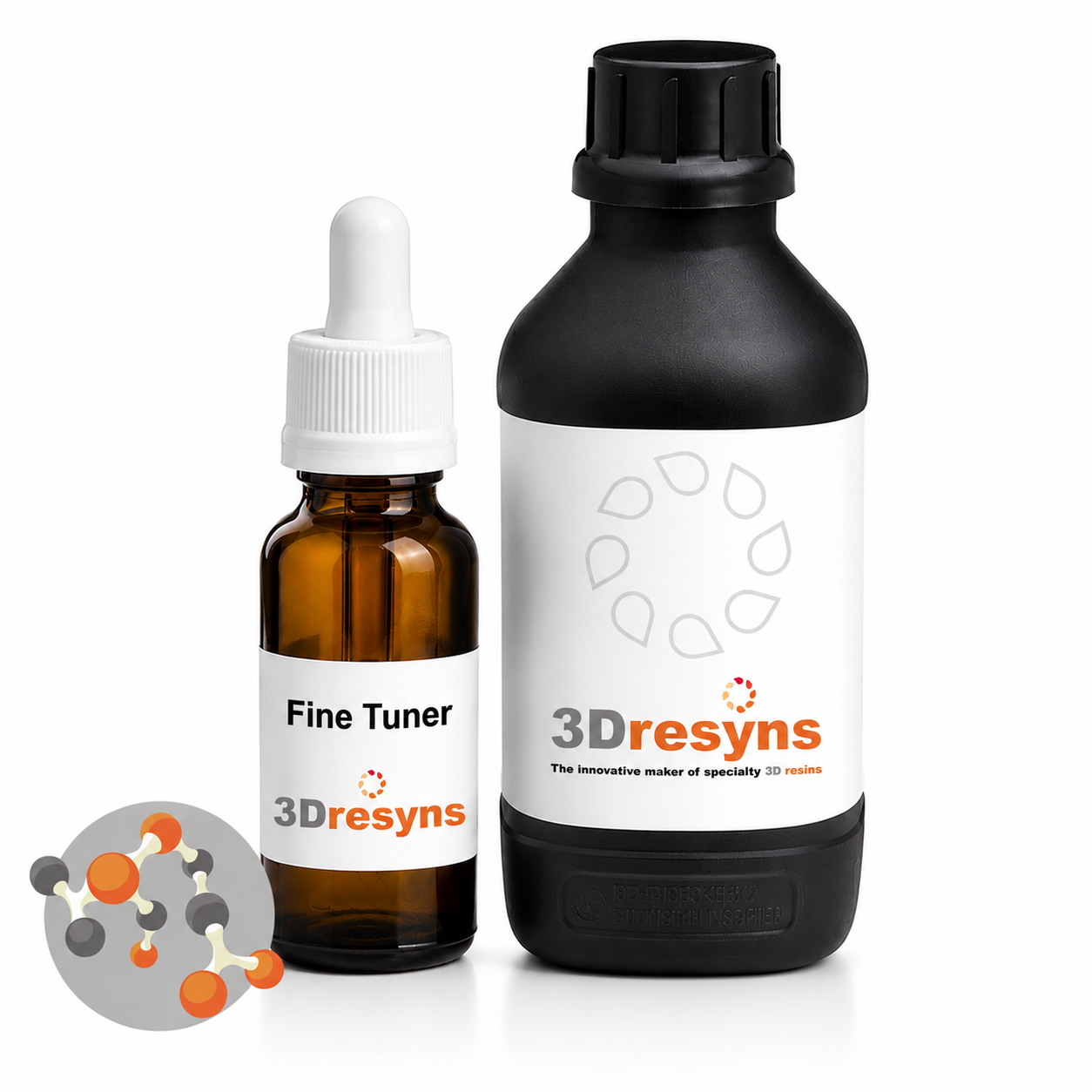
Photo-accelerants, photoreactivity modifiers and light blockers organized for curing-rate control, resolution tuning and optical management in advanced photopolymer formulations.
This collection supports comparison of formulation additives used to modify curing kinetics, reactivity, cure depth and feature definition in SLA, DLP and LCD/MSLA workflows.
Navigate by: curing speed, cure-depth control, photoreactivity tuning, light attenuation or formulation optimization strategy.
These products are formulation additives and not ready-to-print resins. Proper formulation design, compatibility evaluation and experimental validation are required before use.
Control photopolymerization as an engineering variable
This collection is structured for users who need to tune curing speed, resolution, light penetration and overall process behavior by modifying the optical and photochemical balance of a resin system.
Depending on the additive selected, the formulation can be accelerated, attenuated, sharpened or balanced to achieve the required printing response for a specific printer, wavelength and geometry.
Quick selection by function
Functional navigation
Choose your formulation-control route
Select the additive strategy according to the main processing limitation or objective in your photopolymer system.
Typical routes
Key features & benefits
Additive profile
Photopolymerization tuning through optical and kinetic modifiers
These materials are designed to adjust how a photopolymer system reacts to light, controlling the balance between speed, cure depth, voxel definition and process stability.
Main capabilities
- Acceleration of curing kinetics and polymerization rate
- Control of light penetration and cure depth
- Adjustment of system sensitivity to specific wavelengths and light sources
- Reduction of overcuring, light bleeding and loss of fine-feature definition
- Balancing between resolution, curing speed and final mechanical performance
- Support for custom resin development, printer matching and advanced process optimization
Typical uses
Typical applications
These additives are relevant for formulation-development workflows where curing behavior must be tuned rather than accepted as fixed.
Application examples
- Custom photopolymer formulation development
- Optimization of printing speed and exposure time
- High-resolution and micro-feature printing
- Microfluidics and fine internal channel control
- Adaptation of formulations to specific wavelengths and printer optics
- R&D of filled, viscous or specialty photopolymer systems
Collection overview
Products in this collection
Products in this collection are shown below.
This collection includes photo-accelerants, photoreactivity modifiers, light blockers and resolution modifiers used to tune the curing and optical behavior of advanced photopolymer systems.
Functional families
Function 01
Photo-accelerants
Designed to increase curing speed and improve polymerization efficiency under a given light source.
Best for
- Reducing exposure time
- Improving productivity
- Enhancing sensitivity under limited optical power
- Supporting more demanding resin systems
Function 02
Photoreactivity modifiers
Designed to adjust how a formulation responds to light, including sensitivity, cure profile and interaction with the photoinitiator system.
Best for
- Matching formulations to specific wavelengths
- Rebalancing curing profiles
- Improving process stability
- Tuning reactivity in specialty formulations
Function 03
Light blockers and cure-depth modifiers
Designed to limit light penetration, reduce effective cure depth and sharpen printed features through controlled attenuation.
Best for
- Reducing z-overcure
- Improving fine-feature definition
- Controlling voxel height
- Limiting light penetration in transparent systems
Function 04
Resolution modifiers
Designed to reduce light bleeding and improve feature sharpness, especially in precision and micro-scale applications.
Best for
- High-resolution printing
- Microfluidics
- Microfabrication
- Balancing optical control with printability
Selection logic
Decision guide
How to choose the right additive
Select the additive according to the actual limitation in the resin system rather than by using a generic modifier approach.
Decision guide
-
Need faster curing and shorter exposure times → use photo-accelerants
-
Need higher resolution and less overcuring → use light blockers or resolution modifiers
-
Need wavelength-specific tuning → use photoreactivity modifiers
-
Need balanced behavior between speed and precision → combine reactivity and attenuation strategies carefully
Engineering rule
Speed, depth and resolution are interdependent
Increasing curing speed can reduce process window and increase bleed if not balanced correctly. Increasing light blocking improves feature definition but reduces cure depth and may slow the process.
These interactions must always be optimized in the context of the full resin formulation, printer optics, light intensity, layer thickness and application geometry.
Final performance depends on the complete resin composition, including monomers, oligomers, photoinitiators, pigments, fillers and additive concentration, as well as wavelength, optical power and exposure strategy.
These products should be understood as formulation tools for controlling photopolymerization and optical curing behavior. They require technical knowledge, controlled use and experimental validation within a defined resin system.