
Texturing additives
Texturing additives for photopolymer 3D resins, developed to create controlled surface texture, modify tactile response and introduce micro- or macro-scale surface structure in printed parts.
This collection focuses on additives that go beyond gloss or friction control, enabling engineered surface textures ranging from subtle tactile finishes to visible structured effects.
Navigate by: micro-texture route, macro-texture route and surface-structure control strategy.
This collection includes texturing additives designed to introduce controlled surface irregularity, tactile response and engineered finish in photopolymer 3D prints. These materials are particularly relevant in applications where the surface itself is part of the functional or aesthetic design.
Key features & benefits
Choose your texturing route
Select the appropriate strategy depending on the required level of surface texture and visual impact.
- Controlled surface texture creation.
- Tactile response engineering.
- Visual surface differentiation beyond gloss or color.
- Compatibility with SLA, DLP and LCD resin workflows.
- Flexible integration into custom resin formulations.
Typical applications
Typical use scenarios
- Ergonomic surfaces: improving grip and tactile feedback.
- Design-driven textures: adding visual and surface identity.
- Functional textures: modifying contact behavior.
- Consumer product mockups: simulating real surface finishes.
- Surface differentiation: separating functional zones in a part.
Why choose this collection
How to choose the right texture
- Need subtle tactile variation → micro-texture route
- Need visible or structural texture → macro-texture route
- Need controlled surface engineering → validate particle size and loading
Products in this collection
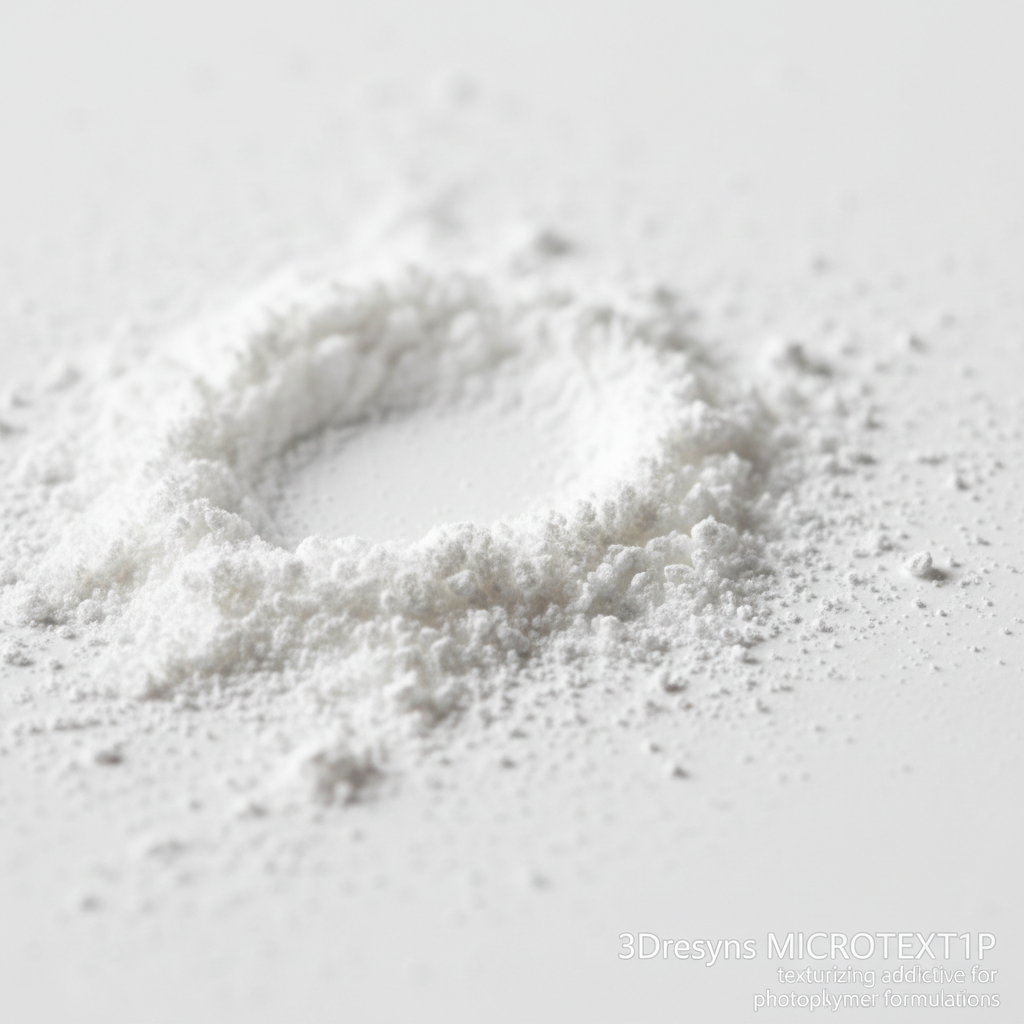
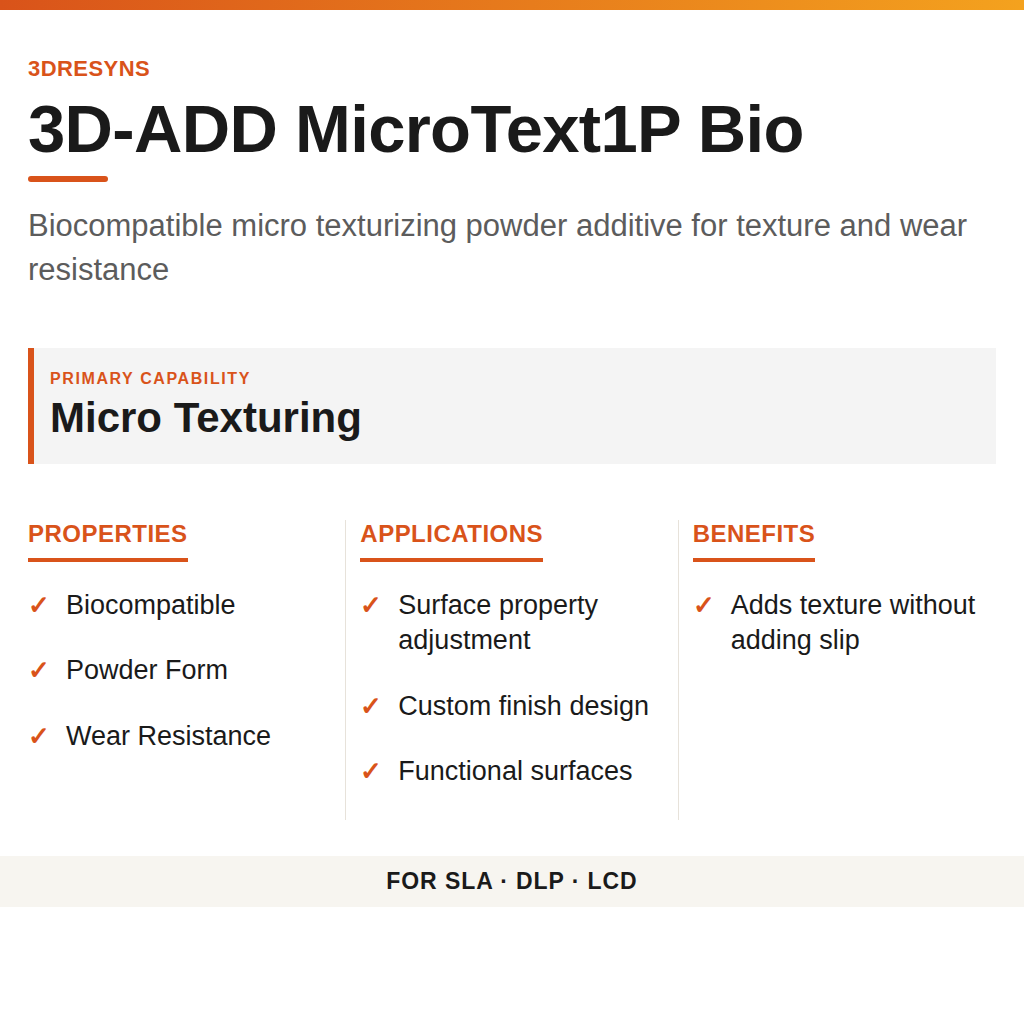
Fine texture additive
Designed for subtle tactile enhancement without strongly affecting geometry.
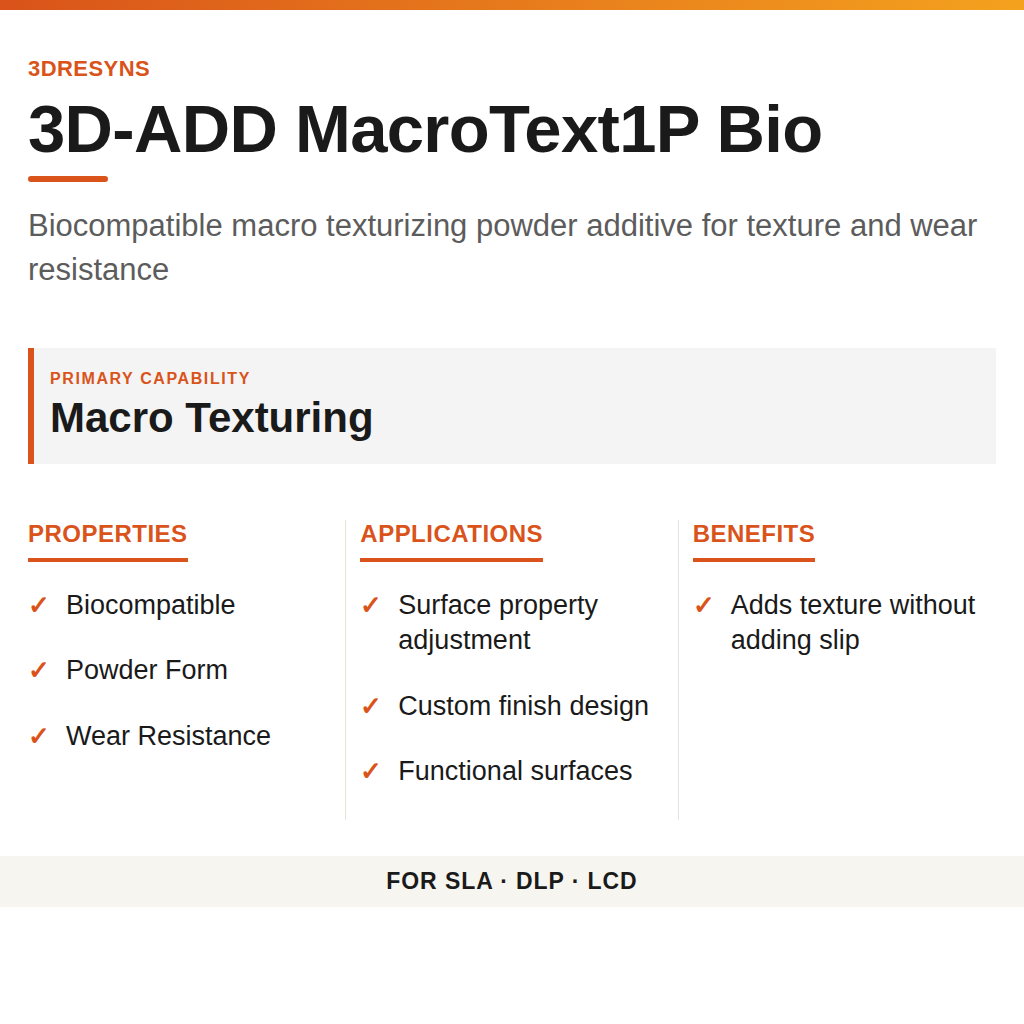
Structured texture additive
Designed to introduce visible and more pronounced surface structures.
Technical overview table
| Material | Role | Texture type | Effect | Typical use | Workflow |
|---|---|---|---|---|---|
| 3D-ADD Texture1 | Texturing additive | Micro texture | Subtle tactile variation | Ergonomics, soft-touch surfaces | SLA / DLP / LCD |
| 3D-ADD Texture2 | Texturing additive | Macro texture | Visible structured finish | Design surfaces, visual identity | SLA / DLP / LCD |
Mobile: horizontal scroll enabled with sticky first column.
Final CTA
Define your surface texture strategy
Select the appropriate texturing route, validate additive loading and confirm the final surface behavior under your specific resin and printing conditions.
Related surface-modification routes
Explore closely related 3Dresyns collections
Use these links to move between closely related material, process or formulation families in the 3Dresyns catalogue.

From prototyping to industrial production, performance depends on materials, calibration and process control