Functional modifiers organized for controlled tuning of viscosity, rigidity, hardness, softness, flexibility and formulation balance in advanced photopolymer systems.
This collection is currently structured around the modifier families that are visibly active in the product grid or directly complementary to it: reactive diluents, rigidity and hardness adjusters, softness and flexibility adjusters, and non-reactive bioplasticizers.
Navigate by: thinning strategy, rigidification, softening, flexibility tuning or non-reactive plasticization.
These products are formulation modifiers and not ready-to-print resins. Proper compatibility testing, concentration control and workflow validation are required before use.
Real formulation tuning by active modifier family
This collection is useful because the visible product families map real formulation bottlenecks: excessive viscosity, insufficient stiffness, brittleness, lack of flexibility or the need to fine-tune curing and mechanical balance without redesigning the full matrix.
Selection should therefore start from the actual limitation of the base resin rather than from a vague idea of “improving properties.”
Quick selection by modification route
Modifier navigation
Choose your formulation route
Select the modifier family according to the change you need to introduce in the resin.
Typical routes
Key features & benefits
Collection logic
Each modifier family solves a different formulation problem
These products should not be treated as interchangeable. Reactive diluents target viscosity and processability while also affecting cure and final mechanical profile, hardness adjusters target stiffness and structural response, softness adjusters target compliant behavior and flexibility, and non-reactive bioplasticizers target controlled softening and deformation response without acting as reactive thinning routes.
Main capabilities
- Reduction of viscosity and tuning of formulation flow
- Increase of rigidity and hardness in controlled form
- Introduction of softness, flexibility and compliant response
- Non-reactive plasticization for softer and more deformable systems
- Adjustment of curing behavior together with mechanical balance when reactive routes are used
- Availability of biocompatible, bio-based and monomer-free routes depending on product
- Support for engineering, medical and dental-oriented formulation development
Collection overview
Products in this collection
Products in this collection are shown below.
This collection currently shows visible product families for reactive diluents, rigidity and hardness adjusters, softness and flexibility adjusters, and is now complemented here with the associated non-reactive bioplasticizer family.
Modifier families and technical roles
Family 01
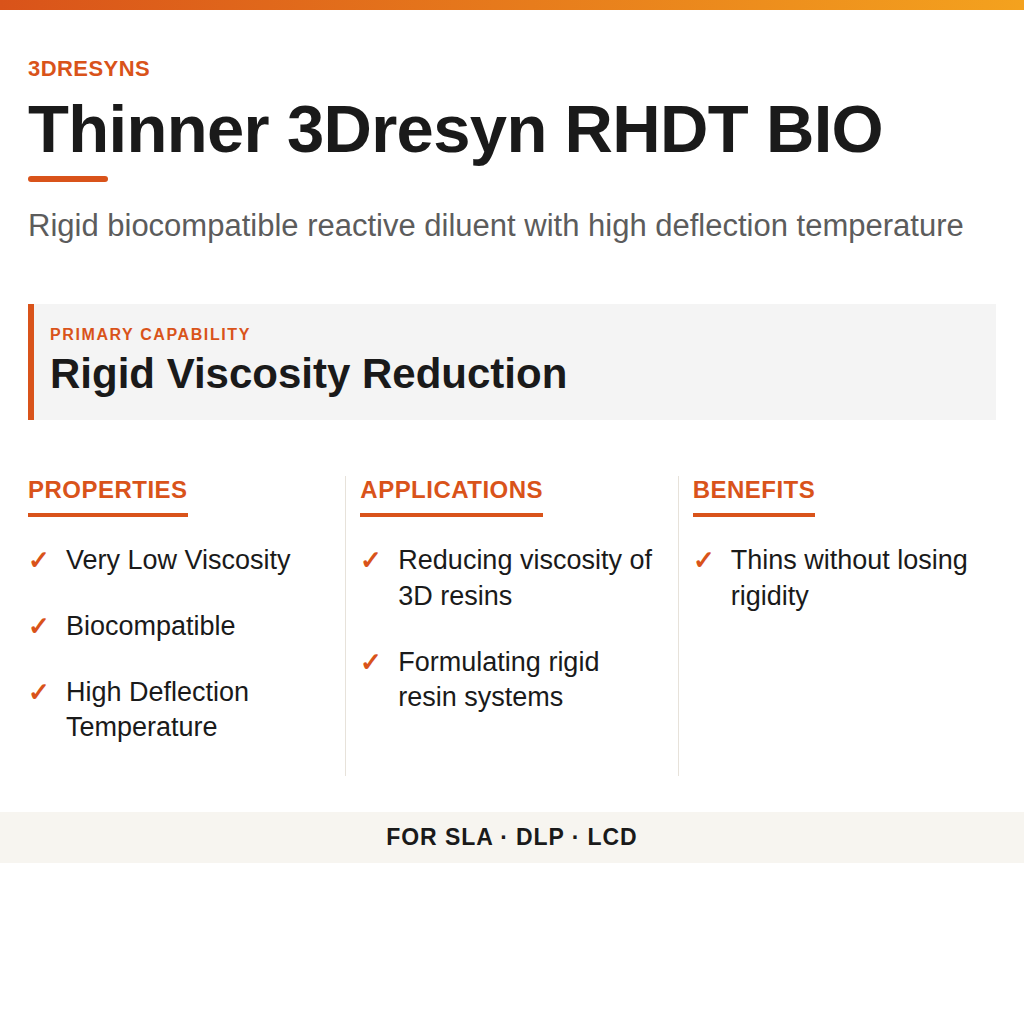
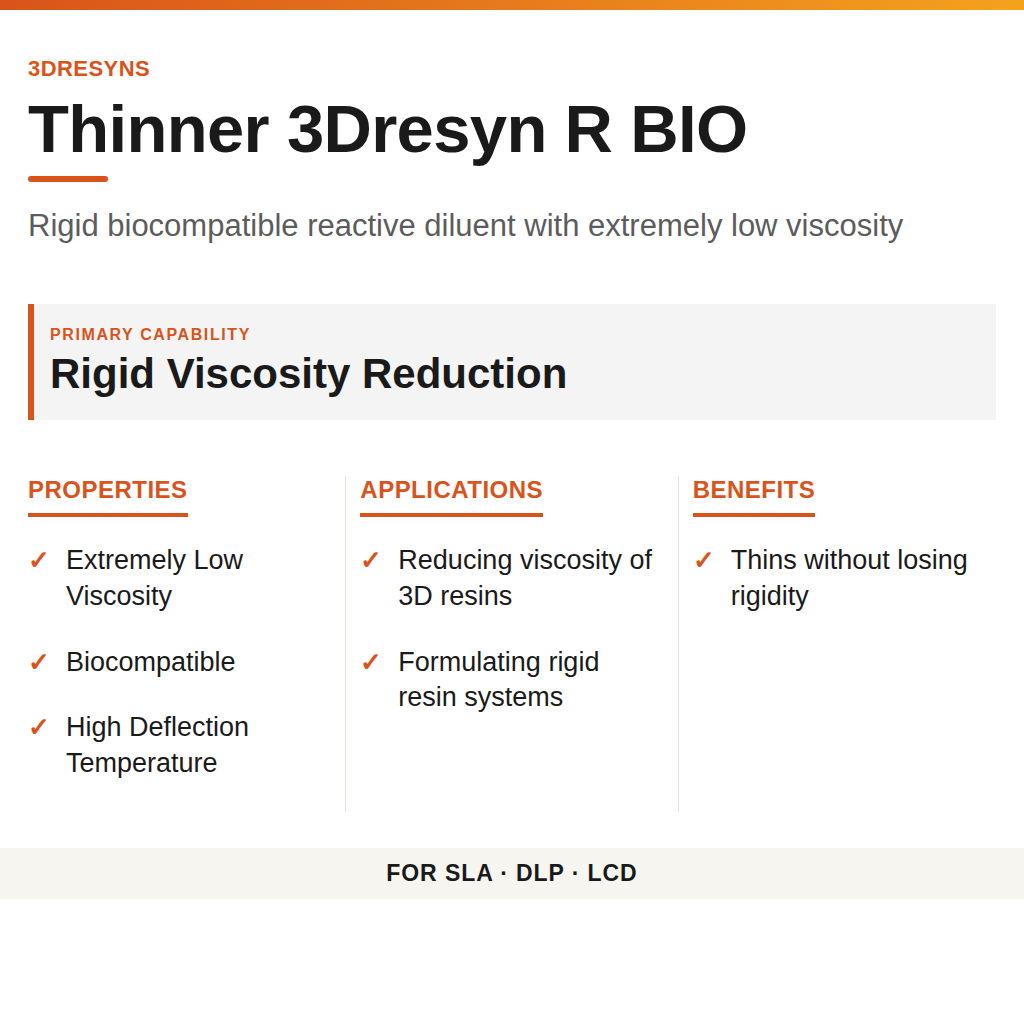
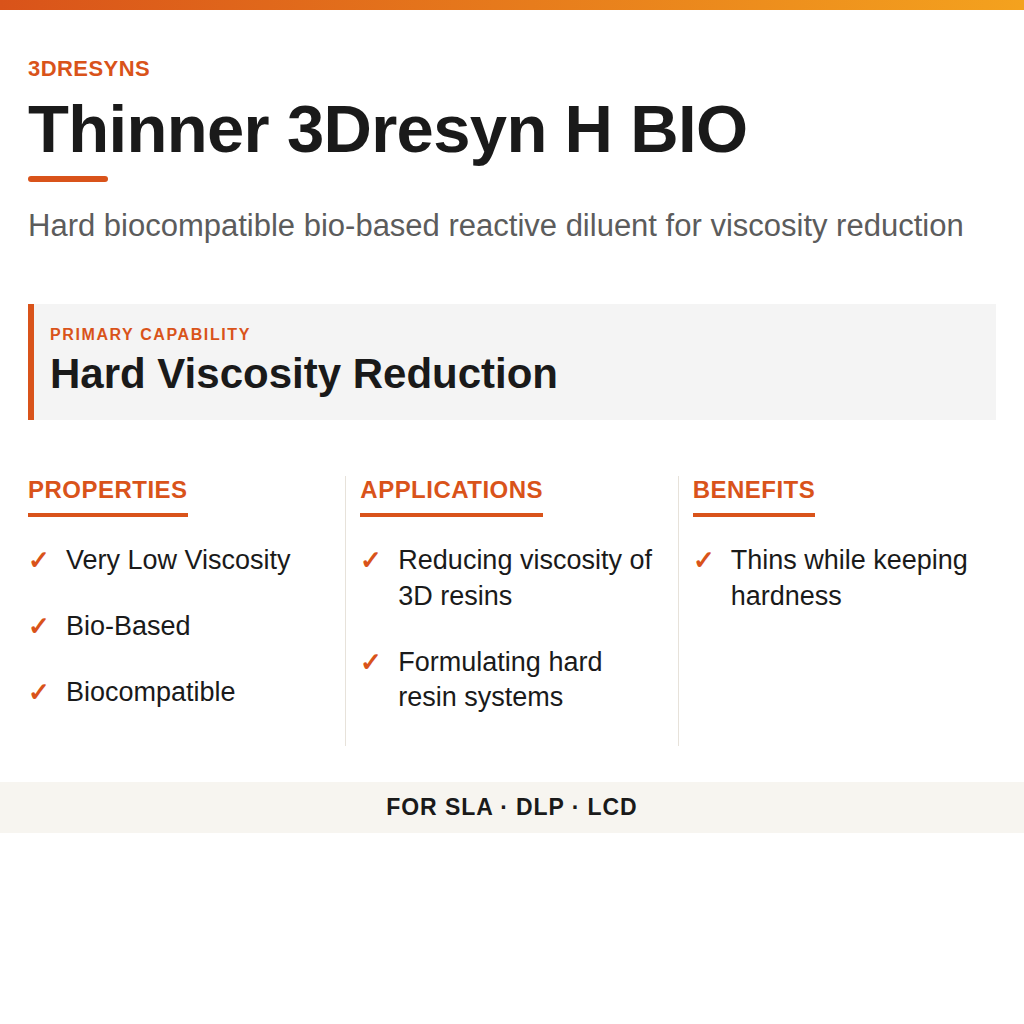
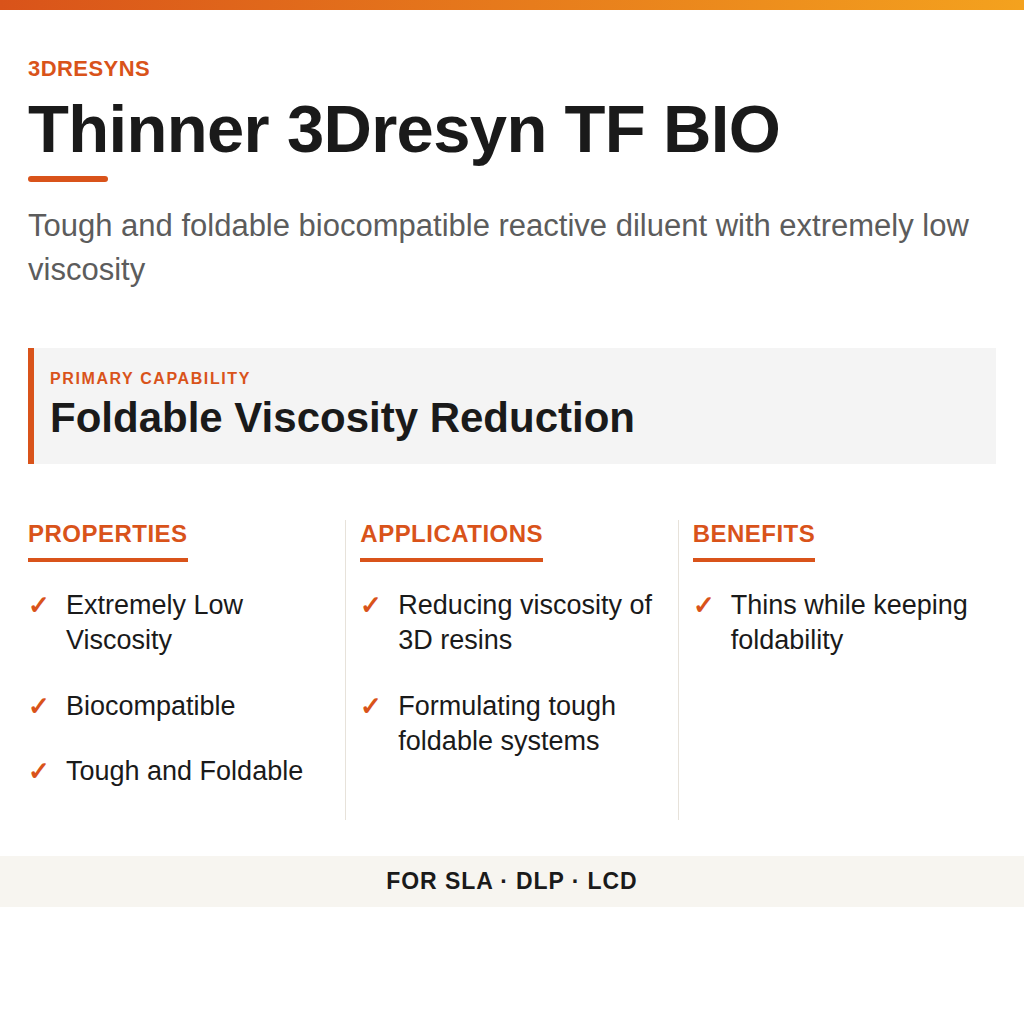
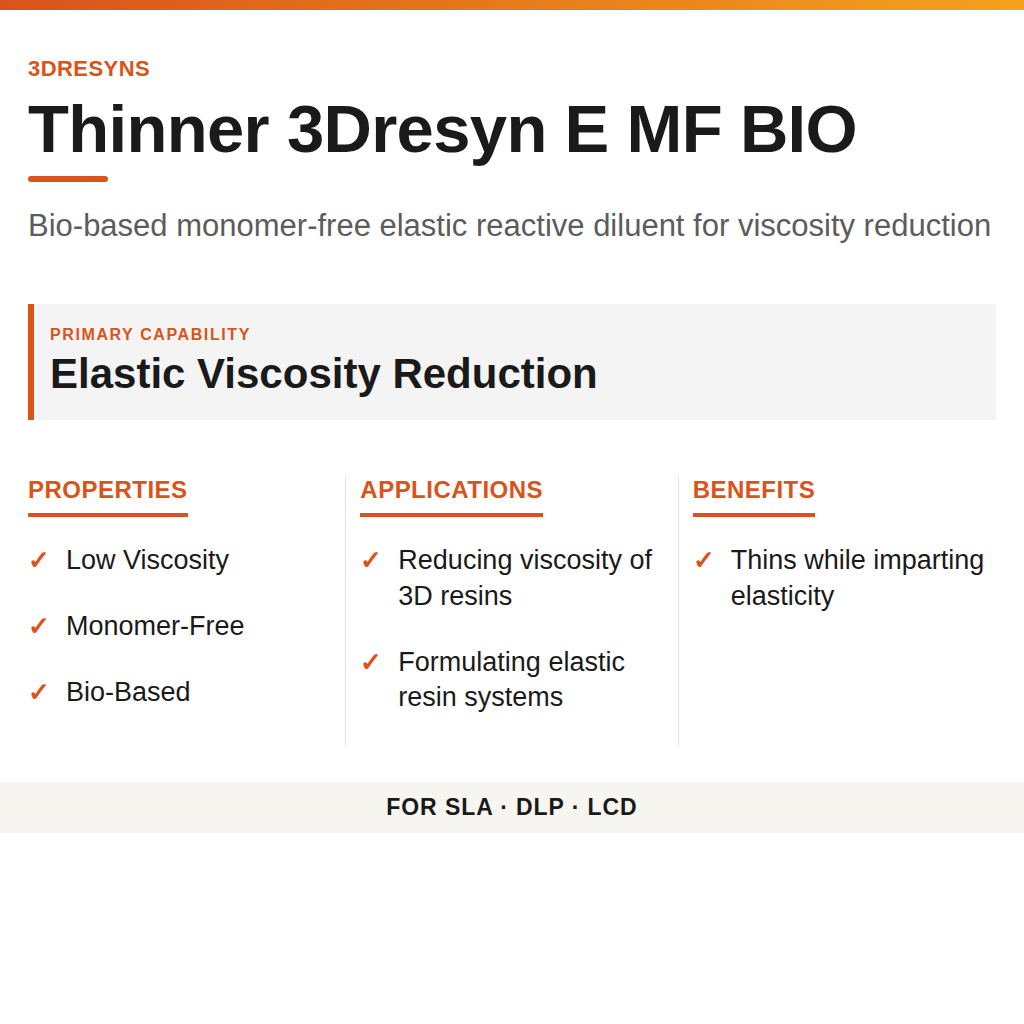
Reactive diluents and thinning modifiers
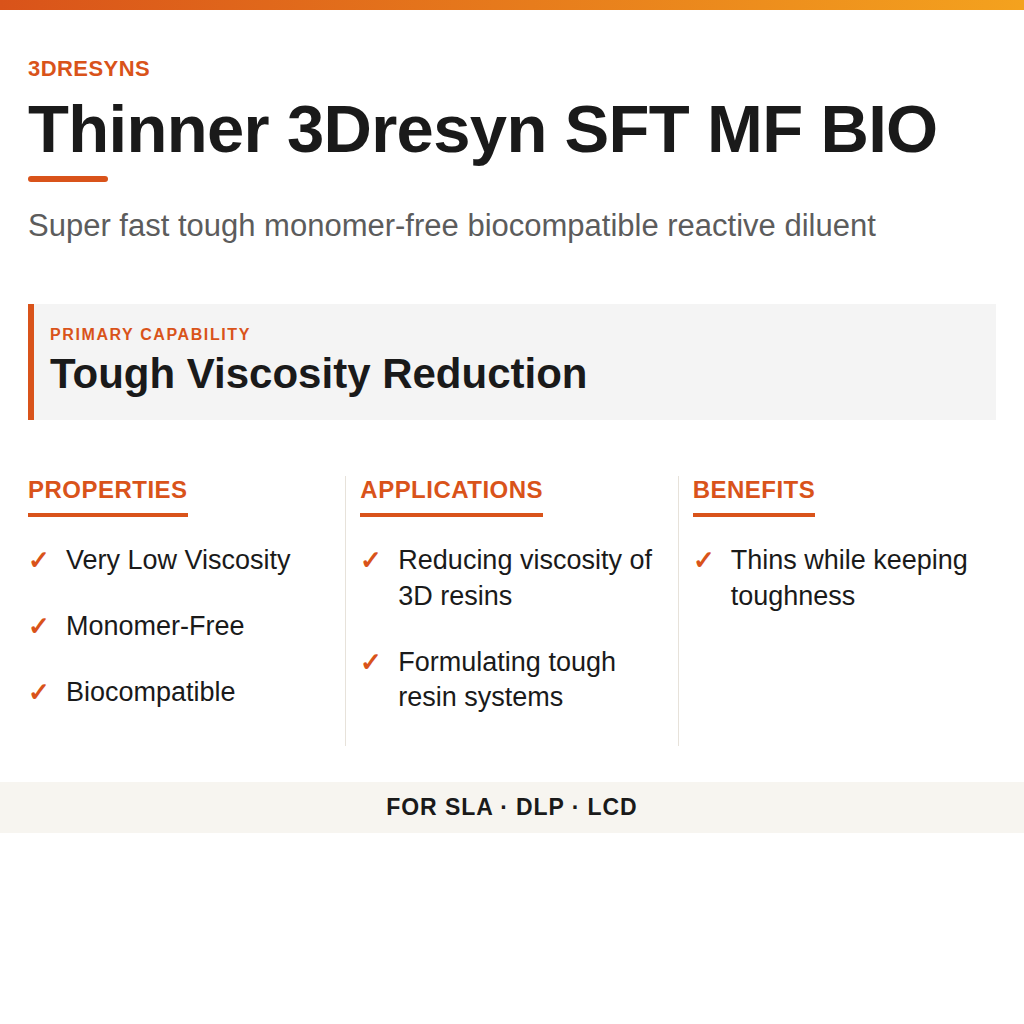
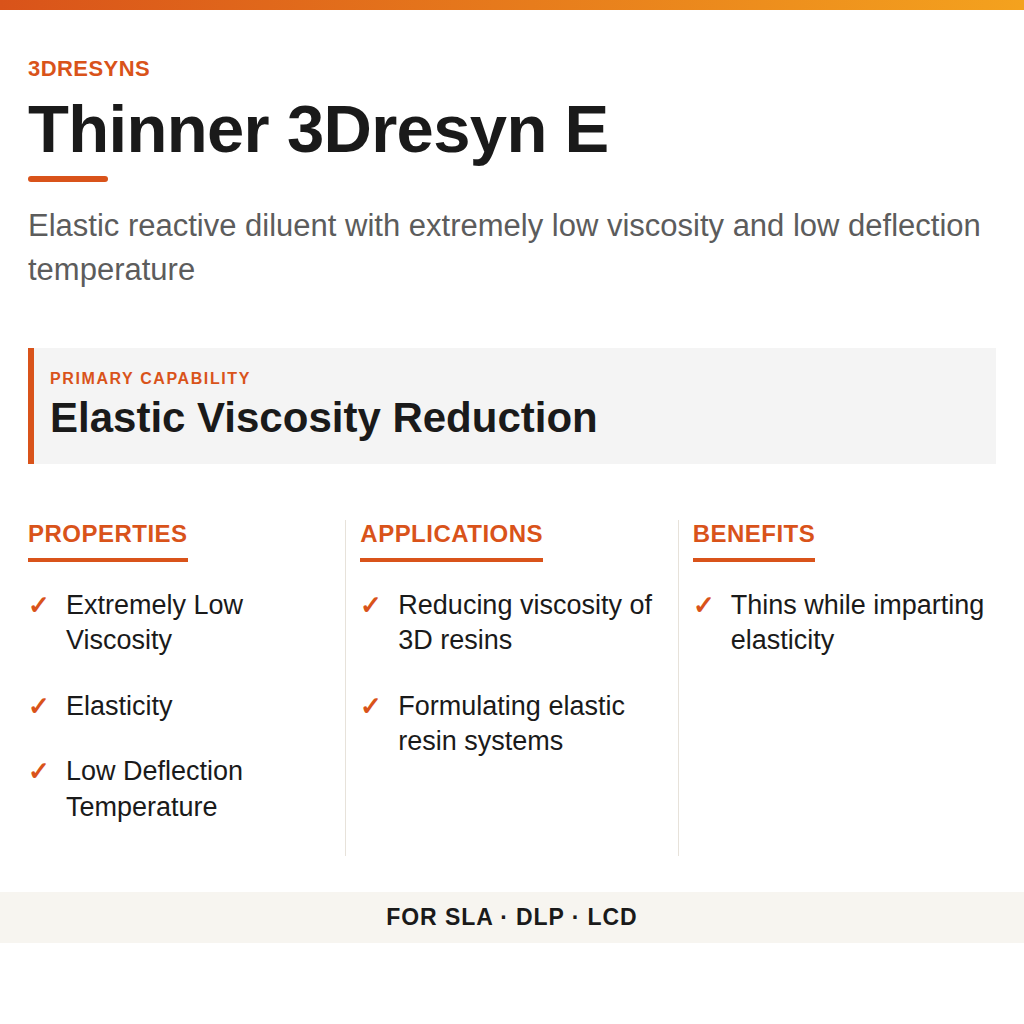
This family is explicitly structured around reactive diluents, not passive solvents. That means they do more than thin the resin: they also affect curing behavior and final mechanical balance.
Existing products in this route
What this really means
- Not all diluents thin the formulation in the same way
- The family already separates rigid, hard, tough-foldable, super-fast tough and elastic outcomes
- Some routes are also differentiated by safety positioning, such as monomer-free and biocompatible variants
- The modifier selected influences both printability and final behavior
Best for
- Reducing viscosity without losing formulation intent
- Adjusting printability while preserving a target mechanical profile
- Tuning fast-curing or biocompatible systems
- Building lower-viscosity variants of otherwise difficult formulations
Family 02
Rigidity and hardness adjusters
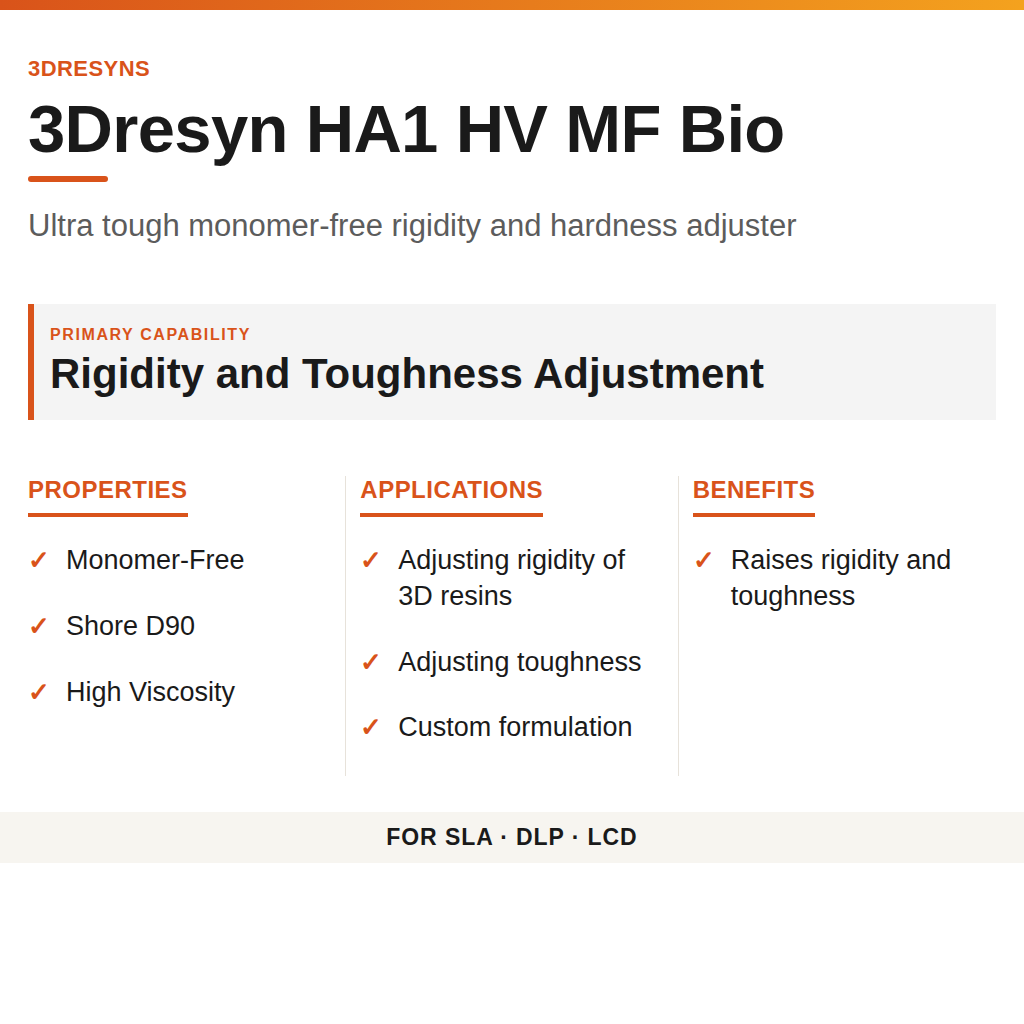
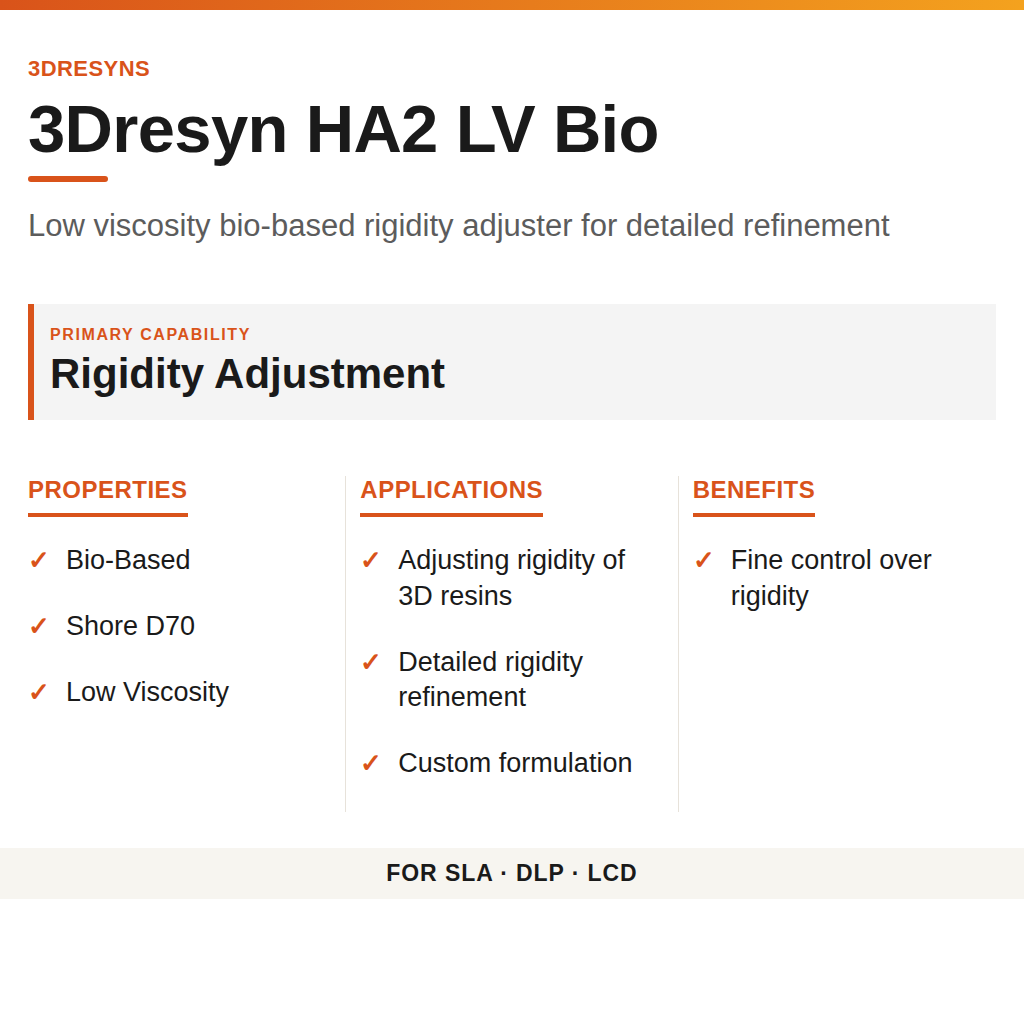
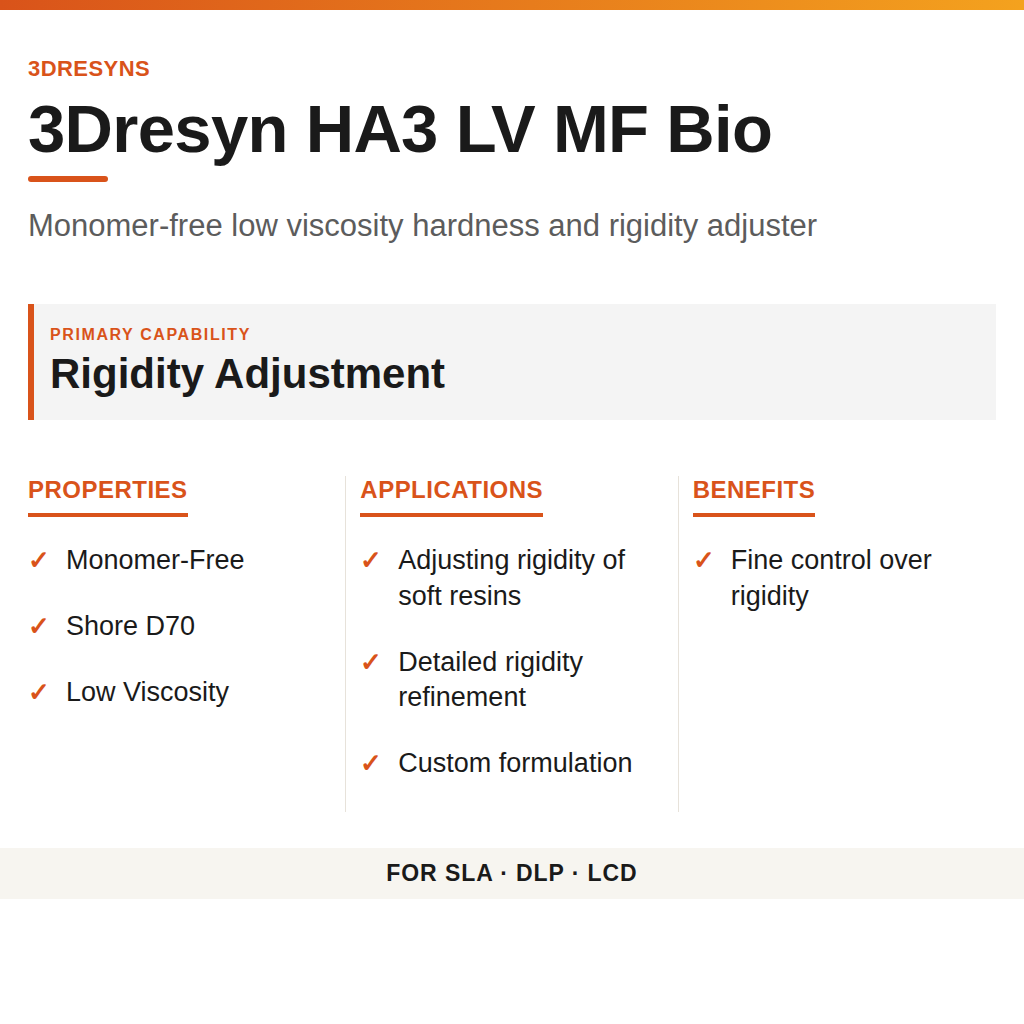
This family is positioned specifically for increasing stiffness and hardness, including both high-viscosity and low-viscosity routes.
Existing products in this route
What this really means
- This is not one hardness modifier but several routes with different viscosity and safety positioning
- You can choose between high-viscosity structural adjustment and lower-viscosity integration routes
- The family explicitly supports bio-based and monomer-free strategies, not only mechanical tuning
Best for
- Increasing stiffness in flexible or under-rigid systems
- Hardening biocompatible formulations
- Balancing structural behavior against printability constraints
- Refining rigid resin families without redesigning the full matrix from scratch
Family 03
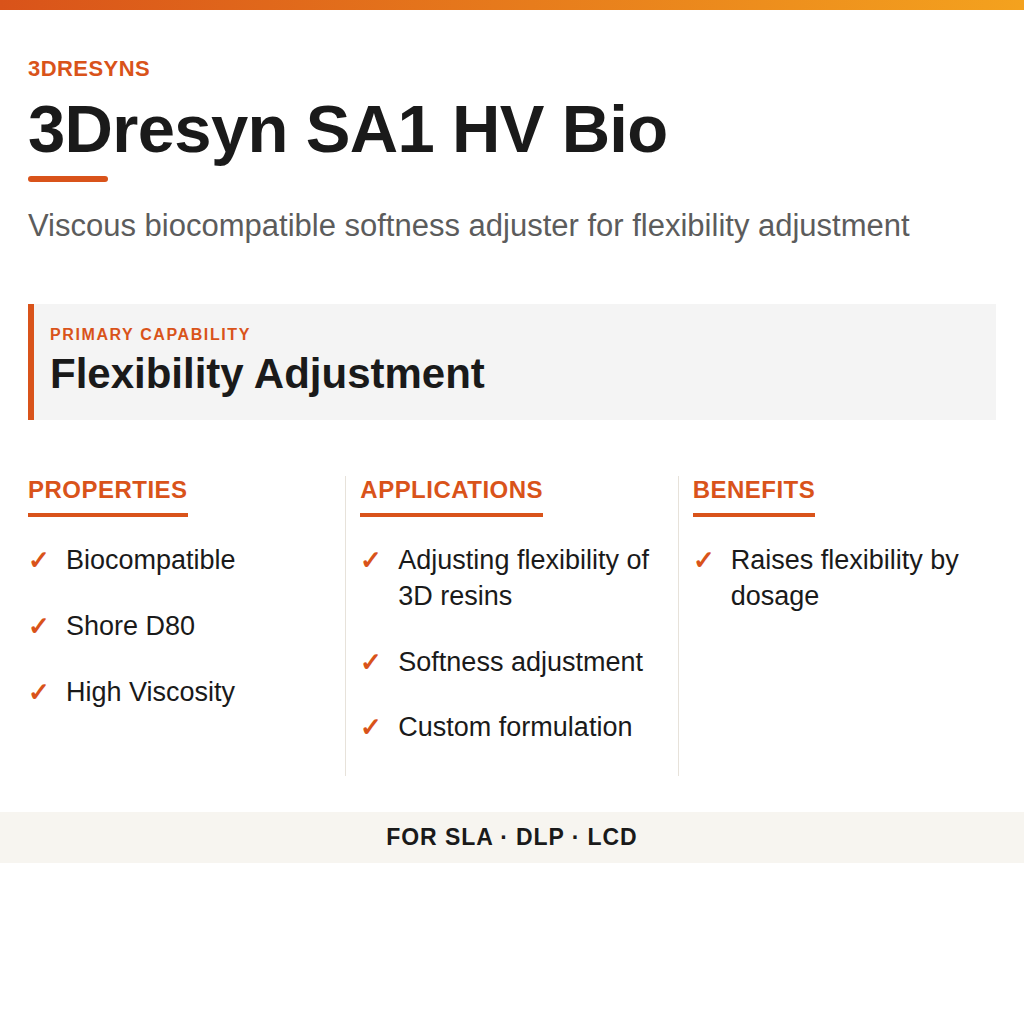
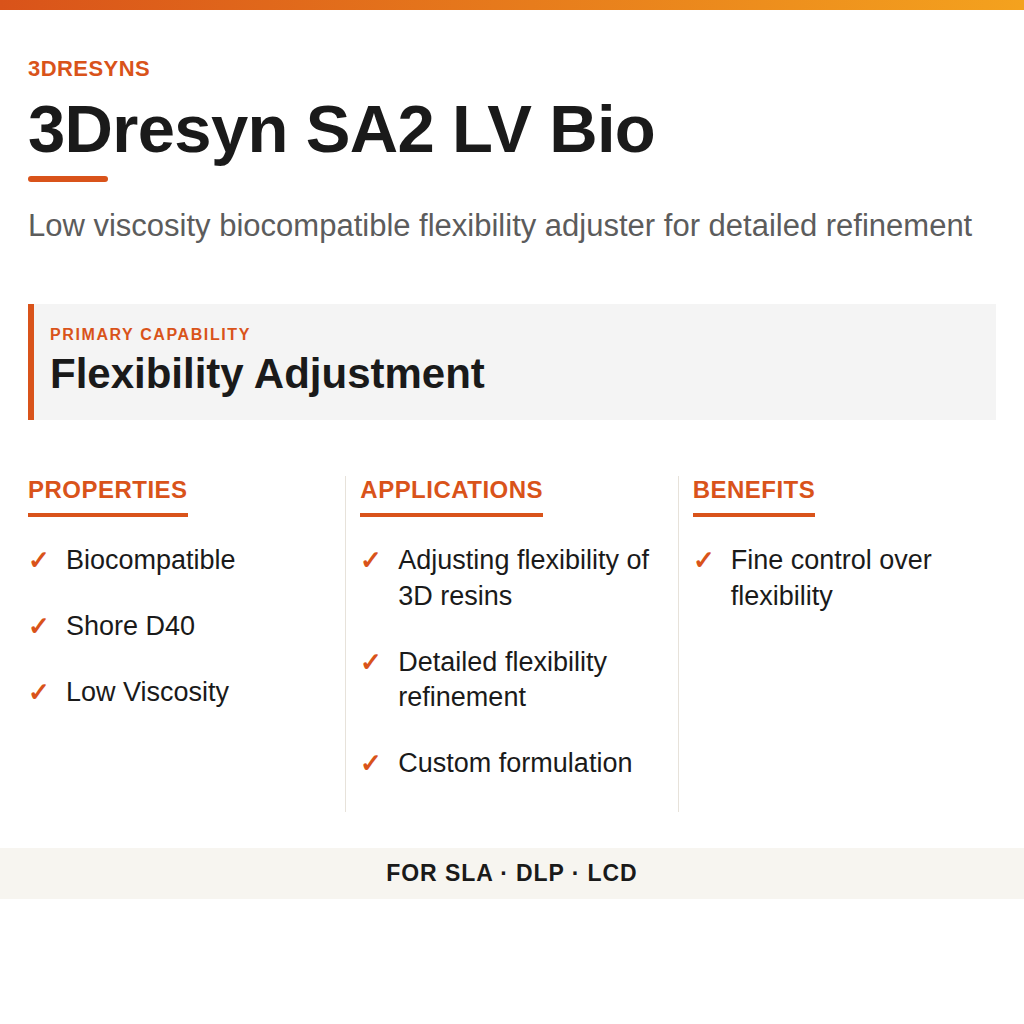
Softness and flexibility adjusters
This family exists to move a formulation toward more compliant behavior, not merely to reduce modulus slightly.
Existing products in this route
What this really means
- The family separates strong flexibility shifts from more detailed, fine-control flexibility adjustment
- High-viscosity routes are aimed at more substantial response changes
- Low-viscosity biocompatible routes are better suited to fine-tuning without overly disturbing printability
Best for
- Softening brittle systems
- Increasing flexibility or foldability
- Reducing excessive rigidity
- Fine-tuning compliant behavior in soft-part or medical-oriented systems
Family 04
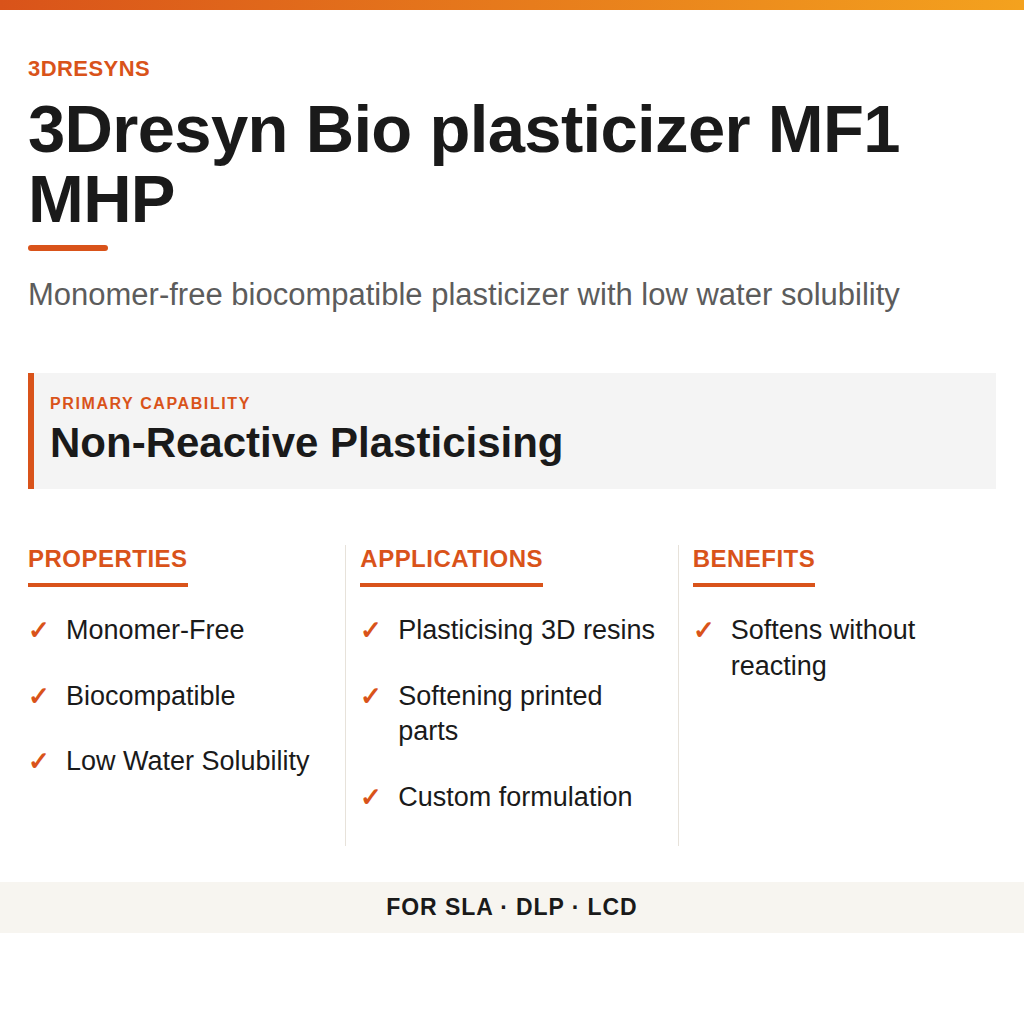
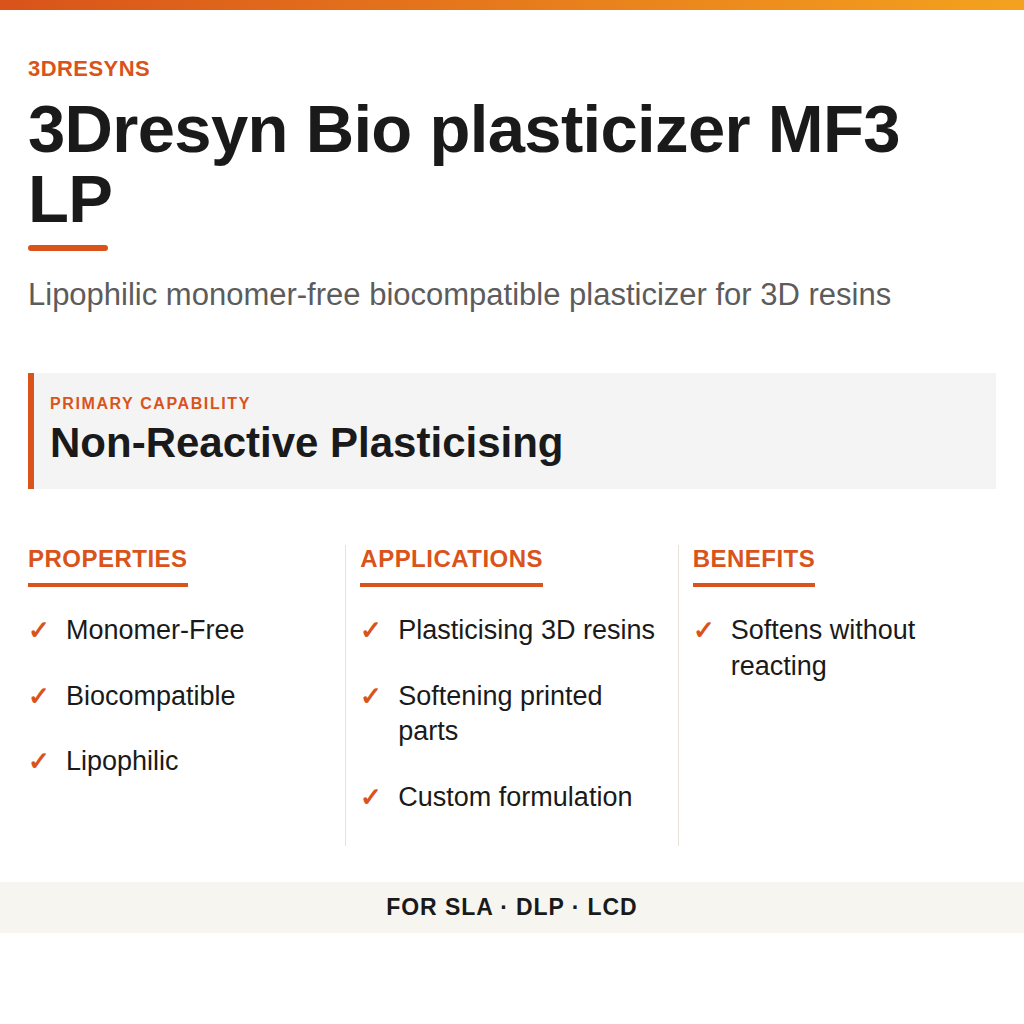
Non-reactive bioplasticizers
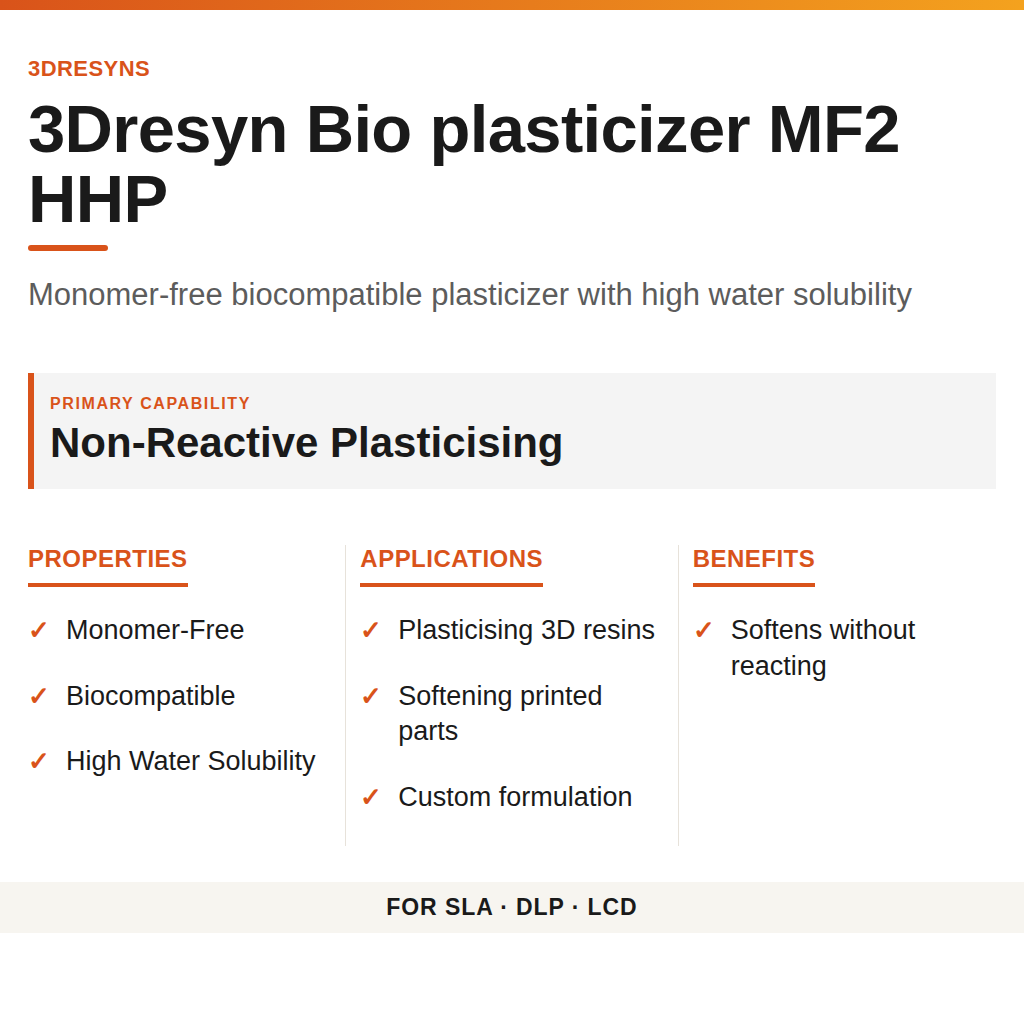
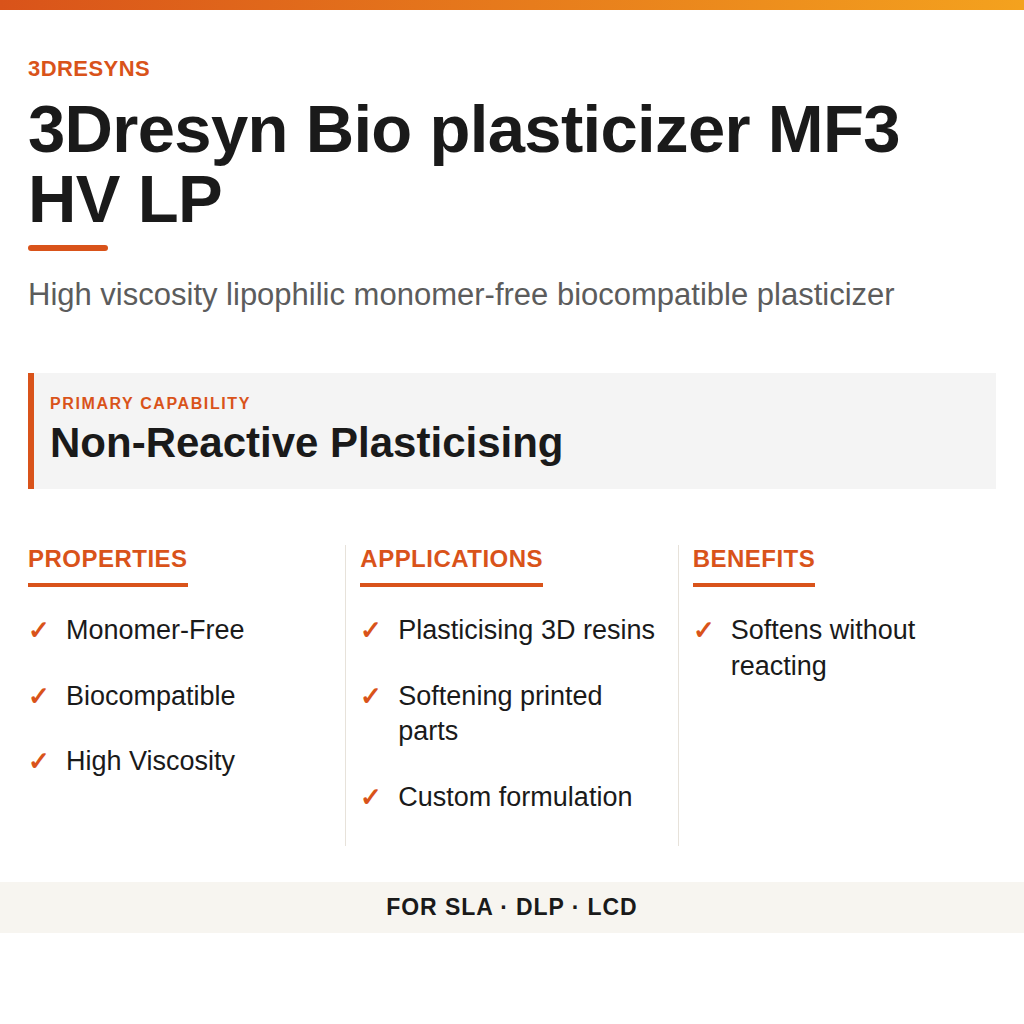
This family is structured around non-reactive bioplasticizers developed to plasticize 3D resins, reduce brittleness and tune flexibility, softness and deformation response through a non-reactive route rather than through reactive dilution.
Existing products in this route
What this really means
- This family is not a reactive thinning route but a non-reactive softening and compliance route
- The products are already differentiated by water solubility, lipophilicity and, in one case, higher viscosity
- These routes support controlled reduction of brittleness and targeted change in deformation response
- All currently visible grades are positioned as monomer-free, biocompatible and low hazard
Best for
- Plasticising resin systems without using reactive diluent logic
- Reducing brittleness while targeting softer and more compliant behavior
- Choosing between more hydrophilic and more lipophilic plasticization strategies
- Supporting bio-based or biocompatible formulation strategies where softer response is needed
Selection logic
Decision guide
How to choose the right functional modifier
Selection should begin from the actual limitation of the base formulation, not from a vague desire to “improve” it.
Decision guide
-
Need lower viscosity or different flow → start with reactive diluents
-
Need more stiffness or hardness → use rigidity and hardness adjusters
-
Need more softness or flexibility through reactive formulation tuning → use softness and flexibility adjusters
-
Need non-reactive plasticization, softer deformation response or reduced brittleness → use bioplasticizers
-
Need reinforced or ceramic composite behavior → validate separately whether those concentrates are currently available in the active product grid before selecting that route
Engineering rule
Every modifier changes more than one variable
A modifier chosen for viscosity, hardness, flexibility or plasticization will also affect curing behavior, process window, stability and sometimes safety positioning. That is why these families must be used as formulation tools, not as isolated “property switches.”
Final formulation behavior depends on modifier concentration, compatibility with the base resin, filler load, photoinitiator system, printing settings and post-processing workflow.
These products should be understood as targeted formulation routes for advanced users refining custom resin systems. Final suitability must always be validated within the complete formulation and intended application workflow.