
3D-ADD Self-Heal Collection — Repairable Additives for 3D Resins
Repairable additive concepts for 3D resins developed to support self-healing behavior, rework logic and longer-lived functional parts under demanding use conditions.
3Dresyns® Self-Heal additives in this collection are positioned for advanced additive manufacturing workflows where durability, repairability and damage tolerance are relevant design targets.
Navigate by: rigid, BioFlex, elastomer or seal-oriented self-heal route.
This collection groups 3Dresyns® self-healing and repairable additive concepts intended for advanced photopolymer formulation projects.
These additives are positioned for workflows where thermal-weld behavior, rework potential, lifetime extension and functional durability are part of the project objective.
The products in this collection are formulation additives rather than ready-to-print resins. Self-heal response, repairability and final durability depend on the base resin, the additive loading, the thermal-weld conditions and the overall repair protocol.
Applications that require a dedicated repairable or self-healing formulation, a specific target mechanical profile, or thermal, optical or processing targets beyond the listed additives can be addressed as a custom-designed material developed through our Customization Services program.
For these cases, 3Dresyns develops customized repairable and self-healing photopolymers according to customer specifications through the Customization Services program: Customization Services.
Key features & benefits
Choose your repairable additive family
Use the routes below to navigate the collection by target mechanical profile and repairable-behavior concept.
- Self-healing and repairable additive concepts for advanced 3D-resin formulation workflows.
- Improved lifetime and damage tolerance depending on grade and project configuration.
- Supports rework and maintenance strategies in advanced material development.
- Useful for functional durability positioning and behavior tuning in optics and photonics related projects.
Typical applications
Typical use scenarios across the collection
This collection is relevant for material-development projects where repairability or self-heal logic is part of the target functionality.
- Durable functional prototypes: parts intended to retain usefulness under repeated handling or use.
- Flexible components under cyclic stress: applications where repeated flexing may cause local damage over time.
- Crack-resistance studies: formulation projects exploring improved tolerance to damage initiation or propagation.
- Repairable part concepts: components designed around rework, maintenance or thermal-weld logic.
- Self-healing materials R&D: advanced innovation projects investigating repairable photopolymer behavior.
Why choose this collection
How to choose the right self-heal additive
Select the most suitable route according to the target mechanical family and intended repairable behavior.
- Need a rigid repairable route → choose 3D-ADD Self-Heal Rigid
- Need a flexible BioFlex-style route → choose 3D-ADD Self-Heal BioFlex
- Need an elastomeric repairable route → choose 3D-ADD Self-Heal Elastomer
- Need a seal-oriented repairable route → choose 3D-ADD Self-Heal Seal
- Prioritise higher stiffness and optical rigid systems → start with the rigid route
- Prioritise bendability with repair logic → start with the BioFlex route
- Prioritise softer elastic response → start with the elastomer route
- Prioritise sealing-oriented behavior → start with the seal route
Decision tree summary
Use this simplified engineering logic before detailed formulation validation.
- Need repairable rigid performance → Self-Heal Rigid
- Need repairable flexible performance → Self-Heal BioFlex
- Need repairable elastomeric performance → Self-Heal Elastomer
- Need repairable seal behavior → Self-Heal Seal
Then validate the final route under the intended resin formulation, additive loading, thermal-weld conditions and repair protocol.
Products in this collection
Rigid optic thermal-weld additive
For repairable rigid systems where optical performance, thermal-weld logic and structured rework behavior are relevant.
Flexible repairable additive route
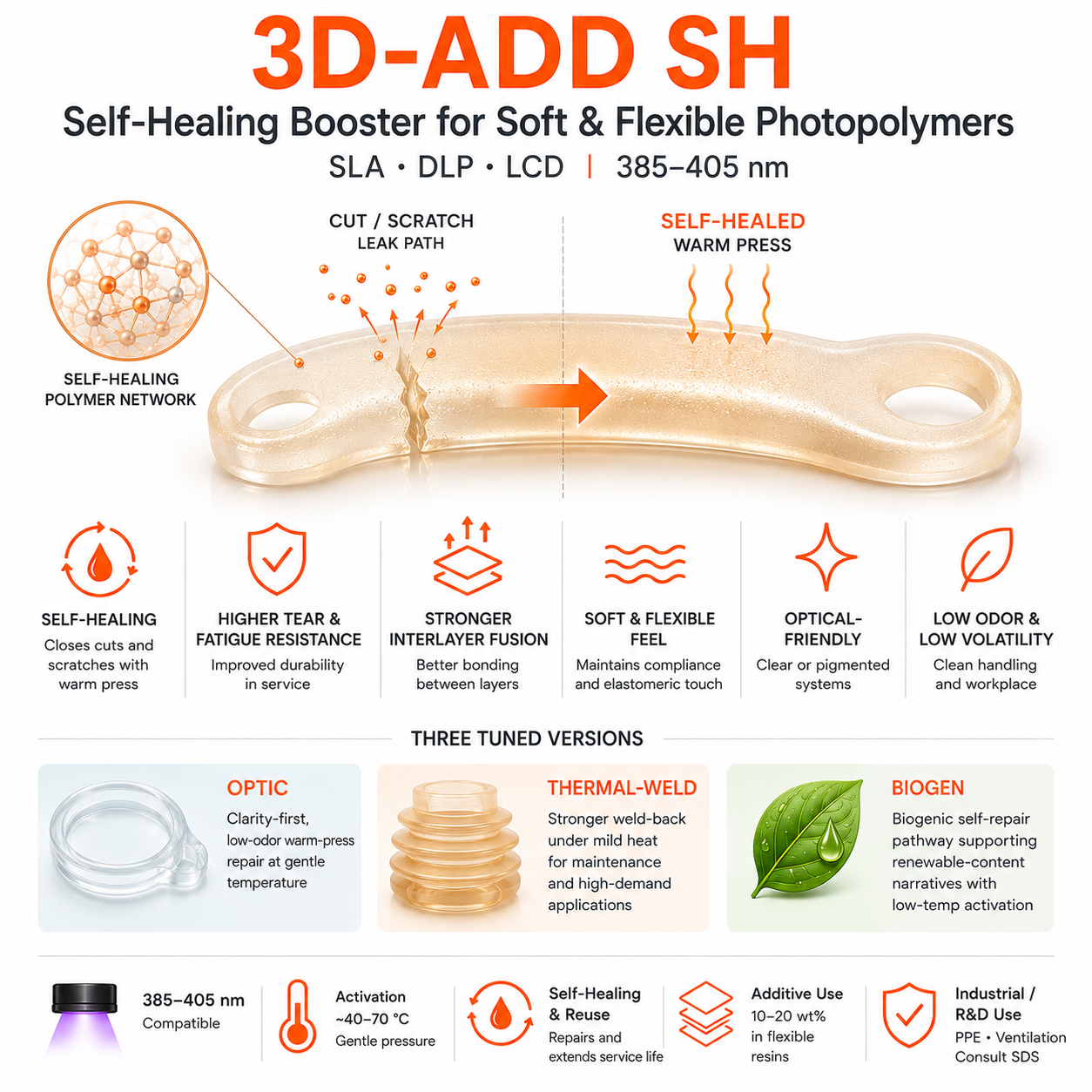
For flexible self-healing material concepts requiring bendability and repairable functionality under repeated deformation.
Elastomeric repairable additive route
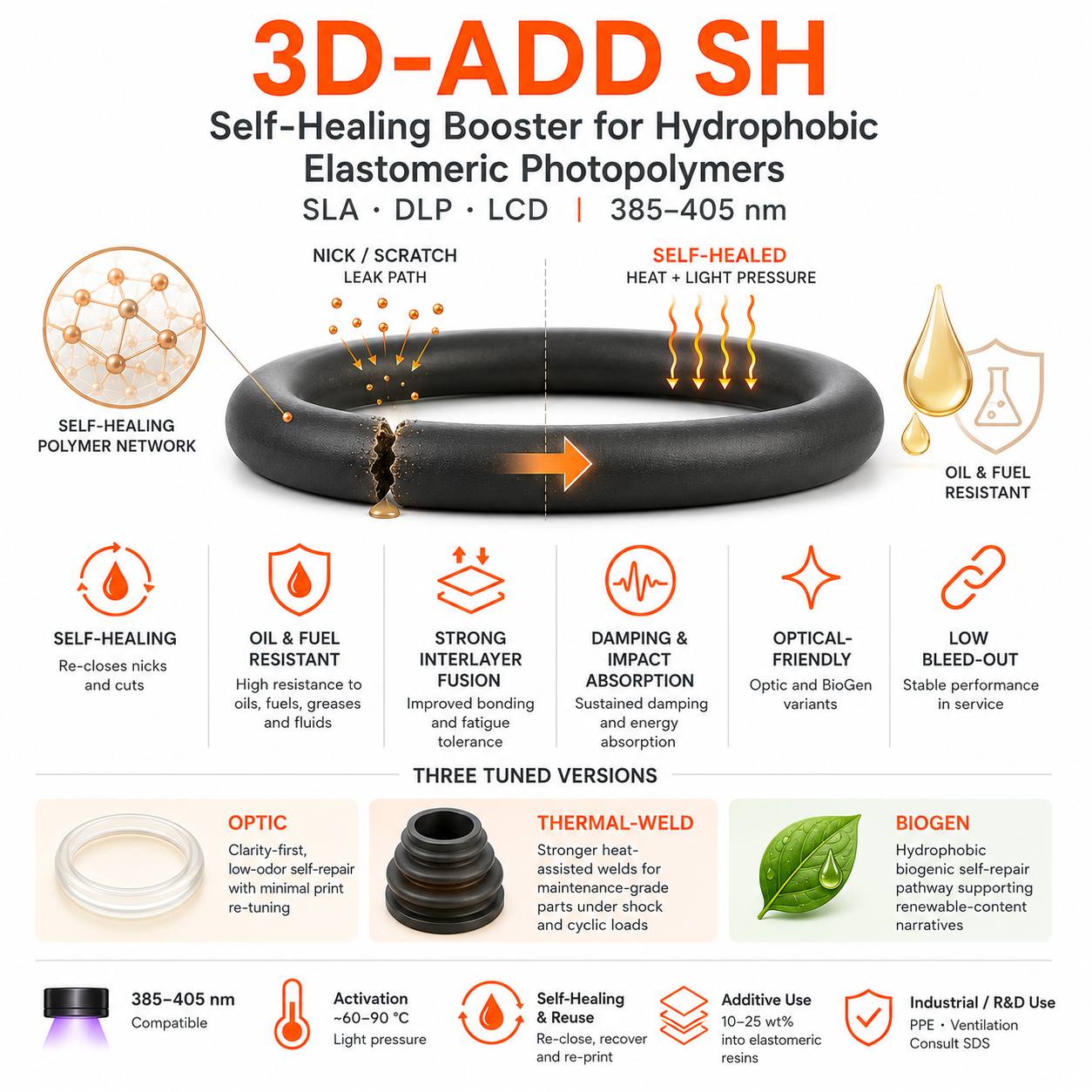
For softer and more elastomeric projects where cyclic-stress tolerance and repairable behavior are part of the development target.
Seal-oriented repairable additive route
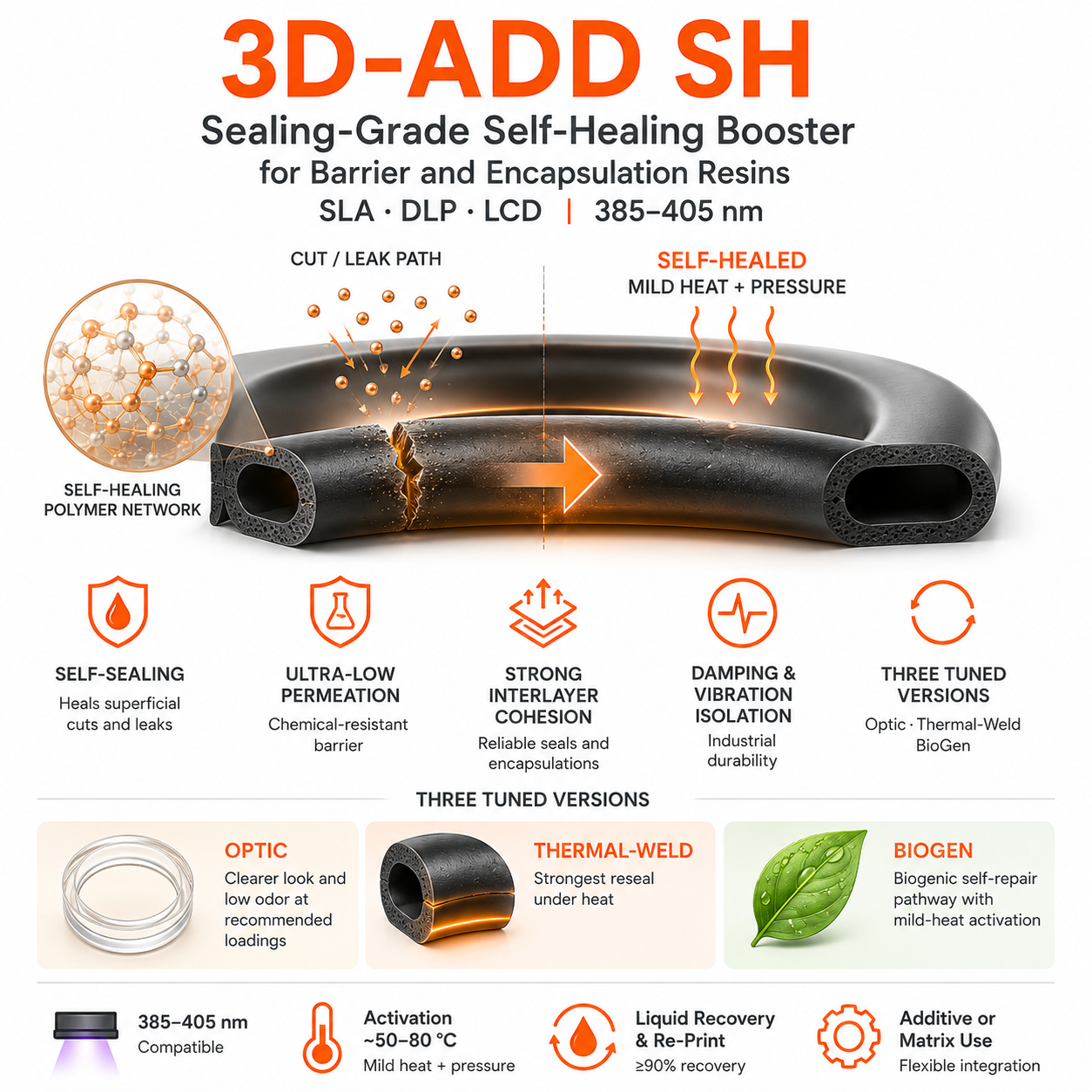
For sealing-related material concepts where repairability, thermal-weld logic and functional durability are part of the formulation strategy.
Technical overview table
Workflow-dependent performance
Self-heal response, repairability, optical behavior and final durability depend on the interaction between the selected additive, the base resin, additive concentration, thermal-weld conditions and the overall repair protocol.
Successful implementation therefore requires alignment between additive selection, target mechanical profile, formulation strategy and qualified repair workflow.
| Material | Target profile | Core concept | Main behavior | Typical positioning | Target workflow |
|---|---|---|---|---|---|
| Self-Heal Rigid | Rigid | Optic · Thermal-Weld · BioGen | Repairable rigid additive concept | Optics and photonics related rigid systems with rework potential | Advanced rigid photopolymer formulation R&D |
| Self-Heal BioFlex | Flexible | Optic · Thermal-Weld · BioGen | Repairable flexible additive concept | Flexible components under cyclic stress and repairable part concepts | Advanced flexible photopolymer formulation R&D |
| Self-Heal Elastomer | Elastomeric | Optic · Thermal-Weld · BioGen | Repairable elastomer additive concept | Softer self-healing systems and cyclic-stress oriented research | Advanced elastomeric photopolymer formulation R&D |
| Self-Heal Seal | Seal-oriented | Optic · Thermal-Weld · BioGen | Repairable seal additive concept | Seal-related rework and durability projects | Advanced seal-behavior photopolymer formulation R&D |
Mobile: scroll horizontally to view all columns. The first column remains visible while scrolling.
Portfolio overview
A repairable-behavior platform rather than a single modifier
This collection is structured around different mechanical targets, so users can approach repairability through rigid, flexible, elastomeric or seal-oriented formulation routes.
- Self-Heal Rigid covers the rigid route.
- Self-Heal BioFlex covers the flexible route.
- Self-Heal Elastomer covers the elastomeric route.
- Self-Heal Seal covers the seal-oriented route.
Workflow note
The right self-heal route depends on the formulation and repair protocol, not only on the additive name
These materials are intended for advanced R&D workflows where repairability is designed into the formulation, the target mechanical profile and the thermal-weld or maintenance strategy from the beginning.
In practice, the most effective route is to define the target repair mechanism and performance profile first, then validate the additive under the intended resin and use conditions.
Technical and commercial support
Documentation, technical selection help and project support
Use the resources below to move from self-heal additive preselection to technical discussion, formulation planning and project-specific development support.
Final CTA
Select the right self-heal route and validate the full repairable workflow
Use the route-based navigation above to identify the most relevant repairable additive, compare candidates in the technical overview table, and move forward with formulation-specific validation for durable and repairable material concepts.
Sort by
Filters

From prototyping to industrial production, performance depends on materials, calibration and process control