

3Dresyn OD-Clear TF ULTP – Tough & Foldable Photopolymer for Professional Orthodontic Laboratory Workflows
Ultra-low viscosity clear photopolymer for orthodontic aligners and dental laboratory workflows (ULTP optimized)
Product description
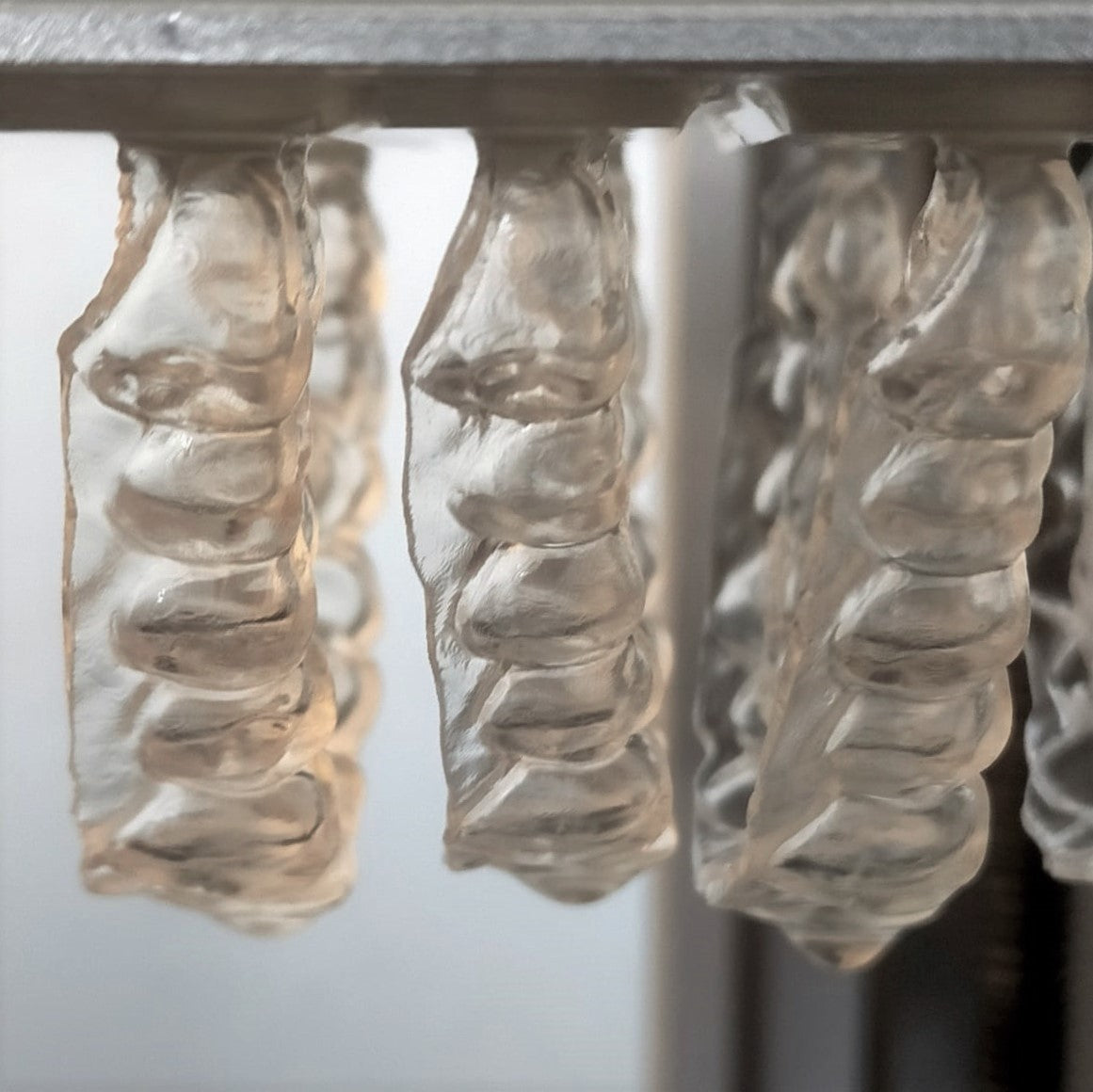
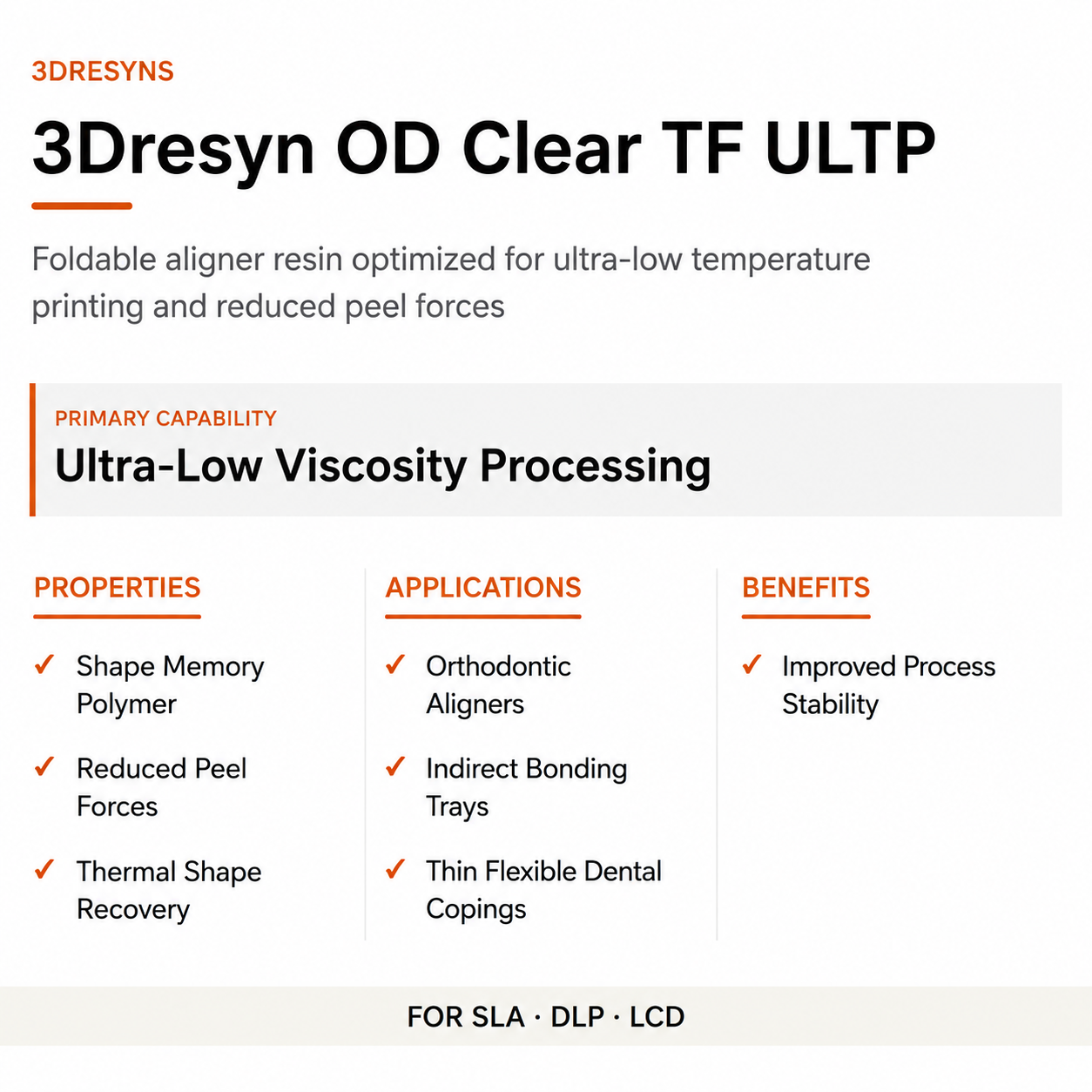
3Dresyn® OD Align ULTP is an advanced photopolymer engineered for orthodontic aligner fabrication workflows requiring ultra-low viscosity and reduced peel forces.
The formulation is based on 4D Shape Memory Polymer (SMP) technology, enabling thermal shape recovery and controlled mechanical response depending on geometry and processing conditions.
It is specifically optimized for Ultra Low Temperature Printing (ULTP), improving process stability, flow behaviour and printing reliability across a wide range of SLA, DLP and LCD systems.
Application framework
Intended for professional use in vat photopolymerization (SLA, DLP and LCD) additive manufacturing for dental laboratory workflows.
Final suitability of printed parts must be validated by the user according to the specific application, processing conditions and applicable regulatory requirements.
Typical applications
- Orthodontic aligners and teeth movement systems
- Indirect Bonding Trays (IBTs)
- Thin flexible dental copings
- Custom dental appliances requiring controlled flexibility
Material properties & test methods
Mechanical properties
- Flexural strength (break): <30 MPa (ISO 178 / ISO 20795-1 reference framework)
- Tensile strength: <30 MPa (ISO 527-1 / ISO 527-2)
- Young’s modulus: ~500–1000 MPa (typical, thickness dependent) (ISO 527-1 / ISO 527-2)
- Elongation at break: <30% (ISO 527-1 / ISO 527-2)
- Impact resistance (Notched Izod): <70 J/m (ISO 180)
- Shore hardness: D60–70 (ISO 868)
- Stress relaxation: <10% after 1 week at 2–20 MPa (internal method)
Thermal behaviour
- Shape memory activation via thermal stimulus (SMP-based system)
- Optimized for ULTP processing: 10–20 °C and above
Physical properties
- Viscosity: ~800–1000 mPa·s @ 20 °C (internal method)
- Tack behaviour: ultra-low tack with reduced peel/separation forces
- Optical behaviour: excellent clarity and non-yellowing
- Water solubility: ≤1.6 µg/mm³ (ISO 20795-1 reference framework)
- Water sorption (ULWA): ≤32 µg/mm³ (ISO 20795-1 reference framework)
- Residual monomer: <0.1% when properly cured and post-processed
- Shrinkage: very low (typical)
- Resolution capability: up to 20 µm (process dependent)
Functional performance characteristics
- Ultra-low viscosity enabling stable printing without heating
- Reduced peel forces for improved print reliability
- Shape memory behaviour for advanced aligner performance
- Controlled balance of flexibility, stiffness and dimensional stability
- High optical clarity for transparent appliances
Printing & processing guidelines
- Printing technologies: SLA, DLP and LCD
- Wavelength range: 385–405 nm
- Compatible with open-parameter vat photopolymerization systems
- Ultra-low viscosity enables printing without heating and improves resin flow
- Reduced peel forces lower mechanical stress on parts and printers
- Excellent vertical printability without supports (geometry dependent)
- Follow 3Dresyns IFU for exposure, washing and post-curing
Performance configurations
- Rigid version: comparable to PETG thermoforming disks (0.5–0.8 mm)
- Flexible version: comparable to TPU disks (0.6–0.9 mm)
Workflow recommendations
- Suitable for thin structures down to 0.2–0.3 mm
- IFU for 100% clarity & transparency
Biocompatibility & quality framework
- Biocompatibility-related testing may be performed under controlled laboratory conditions depending on formulation and validated workflow
- Evaluation frameworks may include ISO 20795 and ISO 10993 methodologies
- Manufacturing aligned with ISO 13485 quality management systems
- Organo-tin free formulation
- Final biological performance depends on validated processing workflow
Testing & processing disclaimer
Material properties are measured on printed and post-processed specimens and may vary depending on material version, printer type, printing parameters, build orientation, post-curing conditions and workflow validation. Reported values are indicative and provided for reference only.
Regulatory & legal notice
This material is supplied as a professional manufacturing material for dental laboratory workflows and is not marketed as a finished medical device. The regulatory classification, conformity assessment and validation of any final orthodontic appliance manufactured using this material remain the sole responsibility of the legal manufacturer in accordance with applicable regulations, including Regulation (EU) 2017/745.
Why choose 3Dresyn® OD Align ULTP
- Ultra-low viscosity formulation for superior printability
- Reduced peel forces for improved reliability and lower mechanical stress
- 4D Shape Memory Polymer (SMP) behaviour for aligner workflows
- Excellent optical clarity and non-yellowing
- Ultra low water absorption (ULWA)
- Very low shrinkage and high dimensional accuracy
- Compatible with a wide range of SLA/DLP/LCD systems
- Organo-tin free formulation
3Dresyns materials for aligner workflows are based on advanced polymer architectures designed to support more sustainable alternatives to conventional thermoforming disks.
Note: Disclaimer for printing aligners
Benefits of our 3D printed aligners
Recommendations for printing aligners
About certification of biomedical devices and food packaging
This technical datasheet should be used together with the relevant processing, calibration, safety and workflow documentation available in the 3Dresyns® Resources section.
Document reference: TDS-OD-ALIGN-ULTP-EN | Version: 2.0 | Last updated: March 2026
Choose options