
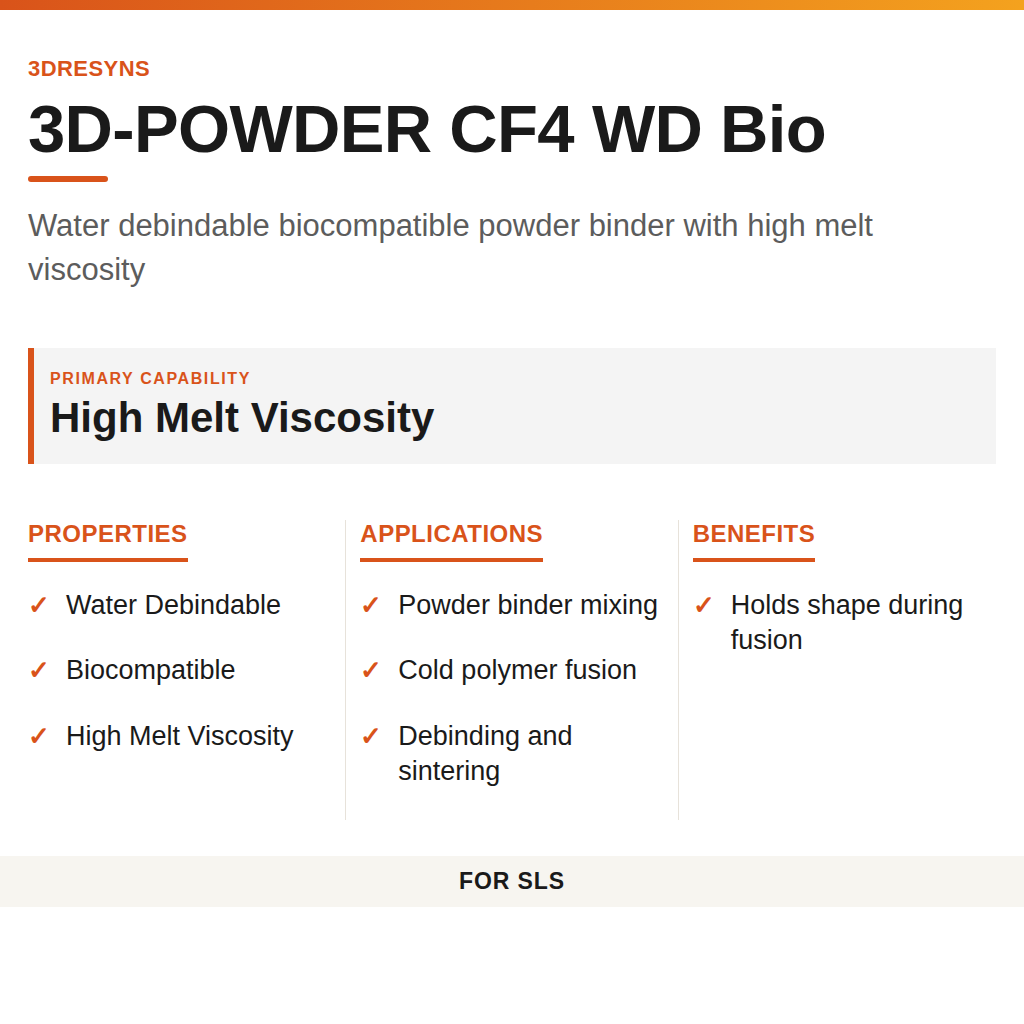



3D-POWDER CF4 WD Bio, Water Debindable Bio Eco Powder Binder with relatively high melt viscosity for Cold Fusion CF SLS printing of Metal, Ceramic & exotic powders
Product description
3D-POWDER CF4 WD Bio is a universal water debindable safe biocompatible powder binder with relatively high melt viscosity in comparison with other 3D-POWDER CF grades and thermal degradation <450ºC, designed for easy physical mixing with any chosen ceramic, metal, polymer, or exotic powder for plastic / polymer powder Selective Laser Sintering SLS, also known as Cold Metal Fusion CMF, Cold Ceramic Fusion CCF and Cold Polymer Fusion CPF.
This material is a universal water soluble debindable eco safe biocompatible powder binder for selective laser sintering of ceramics, metals, polymers and exotic powders, enabling eco friendly SLS printing, debinding and sintering workflows.
Application framework
Designed for selective laser sintering workflows using ceramic, metal, polymer and exotic powders, followed by water debinding in water at 60-100ºC and subsequent thermal debinding and sintering. Used together with a fusible co-binder (typically 3D-POWDER SLS PLA20-80 for this water route) and, optionally, a sacrificial pore former (3D-POWDER SLS PMMA 20-50) when controlled porosity is required.
Typical applications
- Cold Metal Fusion CMF
- Cold Ceramic Fusion CCF
- Cold Polymer Fusion CPF
- SLS printing of ceramics, metals, polymers and exotic powders
Measured physical properties
- Melting temperature: 55-60ºC (ISO 11357)
- Thermal degradation: <450ºC
- Average particle size: <250 microns
- Low moisture content for stable storage and recoating
- Bulk density: approximately 1.2 g/cm³
- Fine, free-flowing milled powder morphology for homogeneous mixing and good powder bed recoating
- Freely soluble in water
- Resolution: up to 100 microns of final products depending on the particle size of the chosen ceramic, metal, polymer, or exotic powder
The Cold Fusion powder system: binder, co-binder and optional pore former
3D-POWDER CF4 WD Bio is the low-temperature water-soluble binder of the blend. In a Cold Fusion green part it works together with two other functions:
- Binder (this product): the low-melting, water-soluble phase that wets and coats the functional powder and is removed first by water debinding, opening the pore network for clean thermal debinding and sintering. Because it melts at a very low temperature, during printing it also acts as a melt plasticizer and wetting agent that helps the co-binder coalesce — a binder behaviour well documented for low-melting water-soluble feedstock systems.
- Fusible co-binder (3D-POWDER SLS PLA20-80): the bio-based thermoplastic that melts and coalesces under the laser, providing the structural cohesion and toughness of the green part. PLA is recommended for this water route as it is bio-based and burns out cleanly.
- Optional pore former (3D-POWDER SLS PMMA 20-50): a sacrificial crosslinked spherical PMMA that does not melt but holds its shape and burns out cleanly, leaving controlled, smooth, spherical pores. Added only when controlled porosity or faster debinding of thicker parts is required; omitted when maximum sintered density is the goal.
Functional performance characteristics
- Universal water soluble debindable eco safe biocompatible powder binder with thermal degradation <450ºC for Selective Laser Sintering SLS printing of ceramic, metal, polymer, and exotic powders
- Safe biocompatible powder for eco friendly SLS printing, debinding and sintering of ceramics, metals, polymers, and exotic powders
- Low melting temperature for gentle, low-temperature fusion and a low bed temperature processing window
- Relatively high melt viscosity in comparison with other 3D-POWDER CF grades for reduced flow if or when overheated
- Forms the water-soluble body of the green part; structural cohesion and toughness are provided by the laser-sintered fusible co-binder (3D-POWDER SLS PLA20-80)
- Fine, free-flowing milled powder morphology for homogeneous mixing with the chosen functional powder and good powder bed recoating
- Fast water solubility for cold water debinding at 60-100ºC, faster in boiling water
- Thermal degradation <450ºC for optimum, clean thermal debinding
- Excellent adhesion, uniformity and stability without gravitational separation after mixing with micron and submicron ceramics, metals, and exotic powders
- Ceramic, metal, and exotic powder additions can be up to 60% volume concentrations
- Promotes controlled and reproducible process shrinkage which depends on final added powder ratio
- Minimum expansion coefficient to prevent micro-fractures
- Paraben free
Processing and handling performance
- Fine, milled particle size distribution below 250 microns, optimized for homogeneous mixing and powder bed recoating (typical value, not to be considered a specification)
- High water solubility with low hygroscopicity for ultra fast debinding speed
- Keep container closed
- Once formulated and mixed with other powders, keep powder blend dry in a container before printing
- Easy physical dry powder mixing and wetting with ceramics, metals, polymers and exotic powders with low cost dry powder mixing equipment
- Printable by most plastic / polymer powder SLS printers
- Soluble in water for cold water debinding at 60-100ºC, faster in boiling water, creating the pore network for clean thermal debinding and sintering without imperfections nor cracking
- Recommended mixing at room temperature in a powder mixer or similar to ensure full wetting and mixing
- Recommended starting composition (approximate ranges; the optimum depends on the functional powder, part geometry and printer, and must be validated for each case):
- Binder — 3D-POWDER CF4 WD Bio: approximately 10-20 wt%
- Fusible co-binder — 3D-POWDER SLS PLA20-80: approximately 5-15 wt%
- Functional powder (your chosen ceramic, metal, polymer or exotic powder or fiber): the balance, typically 65-85 wt%
- Optional pore former — 3D-POWDER SLS PMMA 20-50: 0-10 wt%, added when controlled porosity or faster debinding of thicker parts is required, adjusting the functional powder fraction accordingly
- Recommended plastic or polymer powder SLS printers: SLS printer compatibility, any open mode plastic / polymer powder SLS printer can be used
- Recommended printing process: use the standard printing parameters of the fusible co-binder (3D-POWDER SLS PLA20-80)
- Starting-point bed temperature: approximately 70-105ºC. This binder melts at a very low temperature (55-60ºC), so during printing it is molten and acts as a melt plasticizer and wetting agent that helps the PLA co-binder coalesce and wet the functional powder, rather than as the load-bearing fusible phase. This is the intended mechanism, not a fault
- Because the molten binder can promote caking if its fraction is too high, start at the lower end of the bed-temperature range and the lower end of the binder fraction, keep the blend dry, and increase only as recoatability allows. Treat these as orientative starting ranges, not a specification; the optimum depends on the functional powder, geometry and printer and must be validated
- If over-melting occurs reduce energy dosage, laser power and/or scan speed, and/or slightly decrease bed temperature
- If poor recoating or caking of the powder bed occurs, slightly reduce bed temperature and verify the powder blend is dry
- Use water or air jetting to clean the prints
- Cold debinding at 60-100ºC, faster in boiling water, in water for x hours, depending on print size
- Thermal debinding: insert flask in the preheated oven at 65ºC
- Ramp 1-2ºC/minute up to 250ºC
- Hold at 250ºC for 60 minutes
- Ramp 1-2ºC/minute up to 450ºC
- Hold at 450ºC for 30 minutes
- Ramp 2-5ºC/minute up to sintering temperature
- Hold at sintering temperature for 180 minutes
- Ramp -2ºC/minute down to 640ºC, then furnace-cool to room temperature
Chemical and safety characteristics
- Safe biocompatible powder binder
- Water soluble binder
- Paraben free
Testing & processing disclaimer
The reported properties may vary depending on part design and manufacturing practices. The percentage ratios can be increased or decreased depending on the specifications of the printing settings and the chosen ceramic, metal, or exotic powder. After ordering, 3Dresyns can supply upon request the instructions for calculating the optimum ratio by weight. Final printing, debinding, shrinkage and sintering behavior depend on the chosen powder system, part geometry and full processing workflow, and must be validated by the user.
Disclaimer
This material is supplied as a professional manufacturing material and is not marketed as a finished medical device. Final part performance and suitability must be validated by the user according to the intended application.
This technical datasheet should be used together with the relevant processing, calibration, safety and workflow documentation available in the 3Dresyns® Resources section.
Document reference: TDS-3D-POWDER-CF4-WD-BIO-EN | Version: 2.0 | Last updated: May 2026
Choose options