3Dresyn GrapNSEK1-GNP Bio, biocompatible graphene nanoplatelets based electrically conductive non soluble 3D resin
Product description
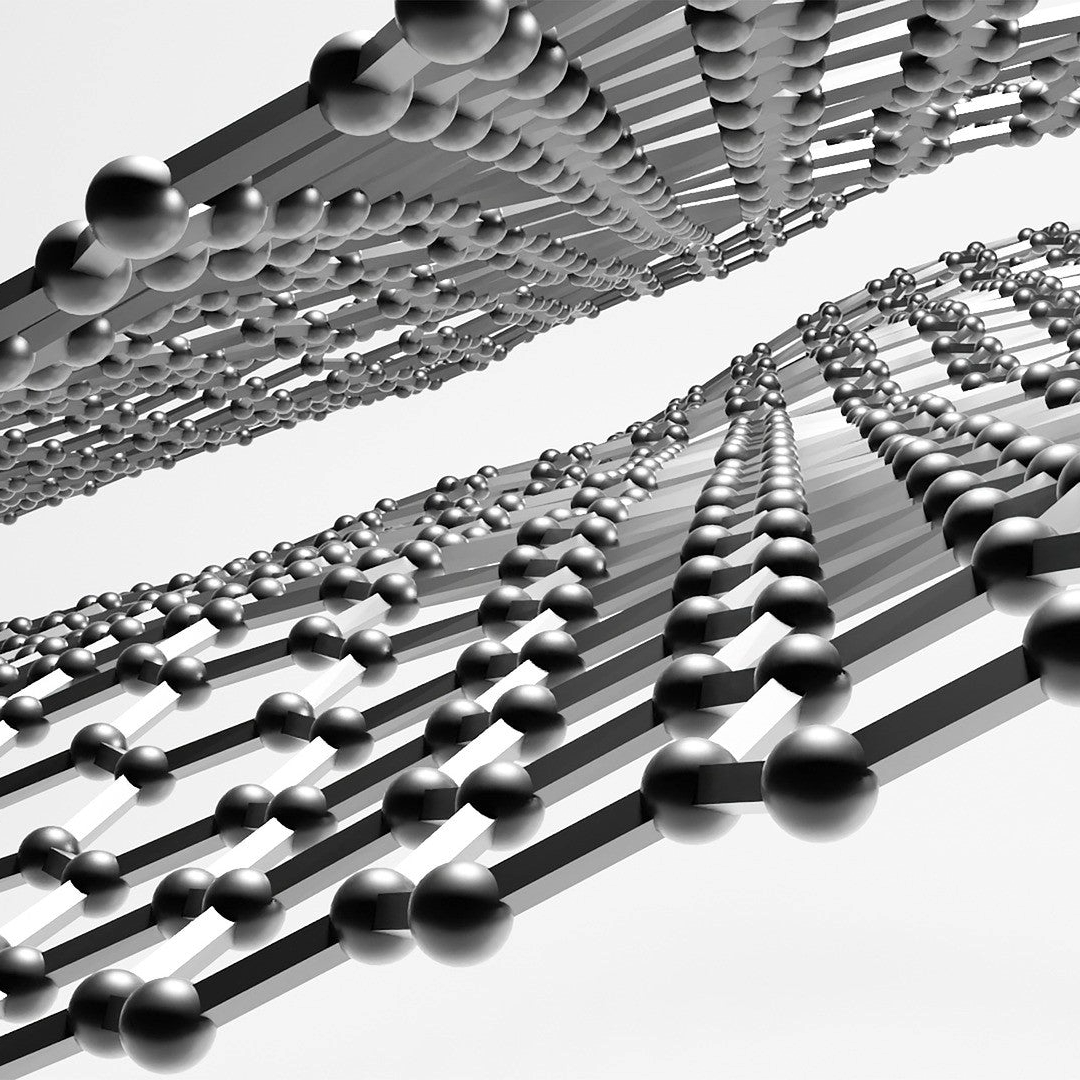
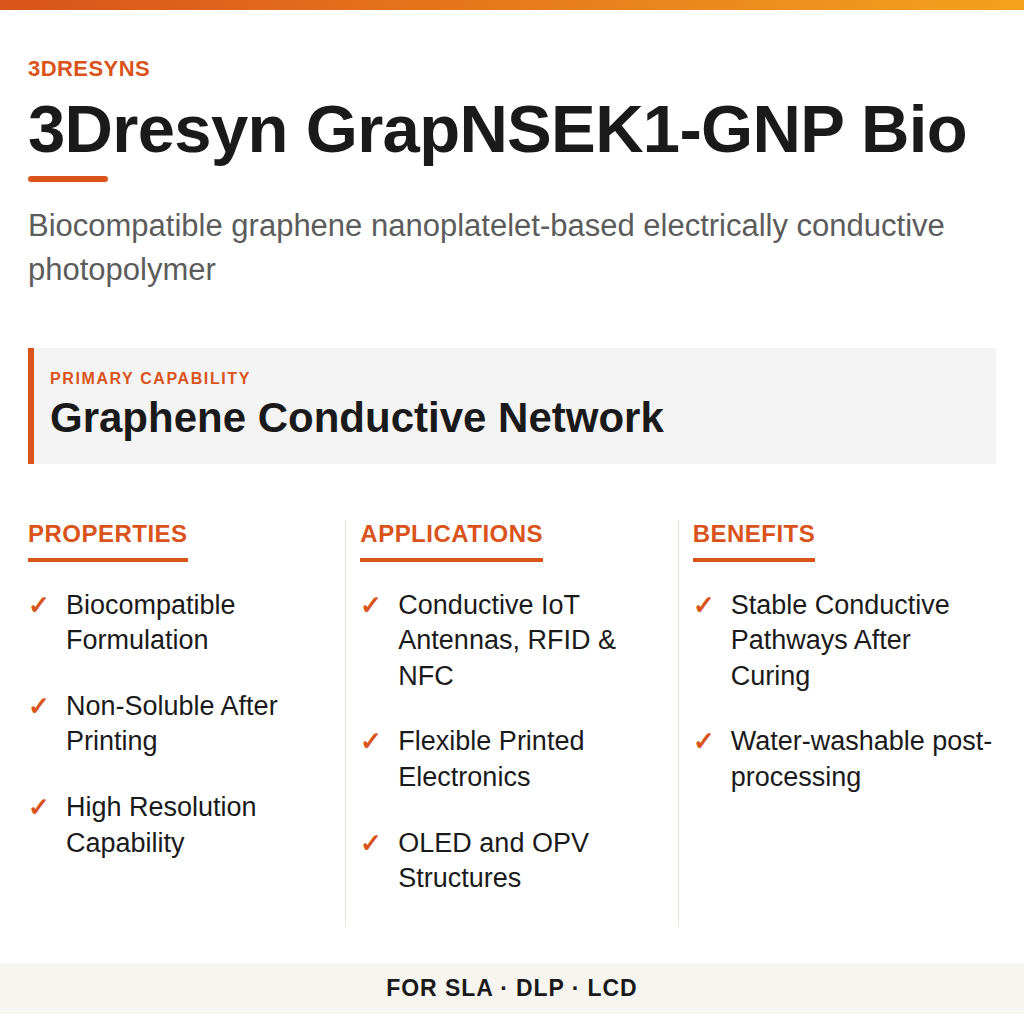
3Dresyn® GrapNSEK1-GNP Bio is a biocompatible, electrically and thermally conductive photopolymer based on graphene nanoplatelet (GNP) technology. It is designed for the additive manufacturing of conductive components and functional materials for electronics applications.
This system combines a graphene-based conductive additive with a non-soluble photopolymer matrix, enabling the fabrication of stable conductive structures while maintaining high resolution and printability in SLA, DLP and LCD 3D printing systems.
Application framework
Designed for use in vat photopolymerization systems (SLA, DLP and LCD) within research, development and industrial environments focused on printed electronics, conductive materials and advanced functional devices.
Typical applications
- Conductive structures for IoT antennas (HF, UHF), RFID and NFC
- Flexible printed electronics and interconnects
- OLED and OPV structures
- Functional prototyping of conductive components
- Research in graphene-based nanocomposites
Electrical properties
- Sheet resistance: ≥150 kΩ/square (250 µm films)
- Resistivity: ≥40 Ω·m
- Conductivity: ≤30 mS/m
Measured physical properties
- Material type: graphene nanoplatelet (GNP) nanocomposite
- Solubility: non-soluble after printing
- Cleaning: water washable
- Resolution capability: high (process-dependent)
Functional performance characteristics
- Graphene-based conductive system for functional material development
- Electrical and thermal conductivity
- Biocompatible-grade formulation (final part validation required)
- Stable conductive pathways after curing
- High resolution and fine feature capability
- Suitable for fabrication of functional conductive geometries
System composition and preparation
- Supplied as a two-component system:
- Part 1: graphene additive (3D-ADD GrapEK1-GNP Bio)
- Part 2: photopolymer matrix (3Dresyn® NSEK1 Bio)
- Mix Part 1 slowly into Part 2 under controlled stirring
- Recommended mixing methods: Conn blade rotary mixer or vortex mixer
- Avoid excessive shear energy to prevent foaming and premature gelation
Processing and handling performance
- Compatible with SLA, DLP and LCD 3D printing systems
- Recommended layer thickness: <20–30 µm for optimal resolution
- Excellent printability across a wide range of systems*
- Water-cleanable processing workflow
- Requires optimized exposure parameters depending on printer power
- Specific IFU recommended for each printer and application
Chemical and safety characteristics
- Biocompatible-grade formulation
- Nanocomposite system containing graphene nanoplatelets
- Organo-tin free formulation
Storage and handling note
Once mixed, the product has a limited working time and reduced shelf life, especially at temperatures above 40–50 °C. Storage at low temperature (refrigeration) can extend usability. It is strongly recommended to print shortly after mixing to avoid premature gelation.
Testing & processing disclaimer
Electrical performance depends on formulation, dispersion quality, geometry, printing parameters and post-processing conditions. Conductivity values are indicative and must be validated by the user for each specific application.
Disclaimer
This material is supplied as a professional functional material for research, development and manufacturing workflows. It is not marketed as a finished electronic or medical device. Final performance and suitability must be validated by the user.
This technical datasheet should be used together with the relevant processing, calibration, safety and workflow documentation available in the 3Dresyns® Resources section.
Document reference: TDS-GRAPNSEK1-GNP-BIO-EN | Version: 1.0 | Last updated: March 2026
Choose options