
3D resins by refractive index
Clear 3D resins organized by refractive index for structured optical material selection, optical matching and transparent-part development.
This collection supports comparison of transparent 3Dresyns materials according to refractive index, mechanical behavior and processability for optical prototyping, lens development, photonics and transparent functional parts.
Navigate by: target refractive index, optical matching requirement, mechanical behavior or material family.
The Optical Selection System (OSS) provides a structured methodology for selecting clear and optical photopolymers according to refractive index, mechanical behaviour and processing requirements.
OSS is part of the broader 3Dresyns® Photopolymer Engineering System, connecting material selection, optical matching, curing behaviour, dimensional control and application-oriented validation.
Related frameworks: Structured Selection Framework (SSF), Optical Selection System (OSS), Curing Rate Control System (CRCS), and Structured Mechanical Screening Protocol (SMSP).
This collection is structured to support refractive index matching, optical prototyping, lens development, light-guide design and transparent functional parts.
Materials are organized by RI to simplify comparison between optical performance, processability and functional mechanical response.
Standard low refractive index grades are supplied made-to-order across the RI 1.31–1.44 range. These materials are intended for applications where refractive index is the primary design parameter and are supplied using established low-RI photopolymer platforms.
Applications requiring specific mechanical, thermal, optical, chemical resistance or adhesion properties beyond the standard grades may require a custom-designed material developed through our Customization Services program.
Examples include combinations such as ultra-low refractive index with increased rigidity, enhanced glass adhesion, optimized microfluidic performance, tailored thermal resistance, or application-specific optical requirements.
For these cases, 3Dresyns can develop customized low-refractive-index photopolymers according to customer specifications through the Customization Services program: Customization Services.
Quick selection by refractive index
Choose your target RI range
Use the routes below to access the most relevant low, medium or high refractive index product groups.
Selection logic
How to choose the right optical resin
Select materials primarily by refractive index matching, then refine selection according to hardness, thermal resistance, flexibility, adhesion and processing viscosity.
- Need low-index optical matching below RI 1.45 → custom-designed low RI systems via Customization Services
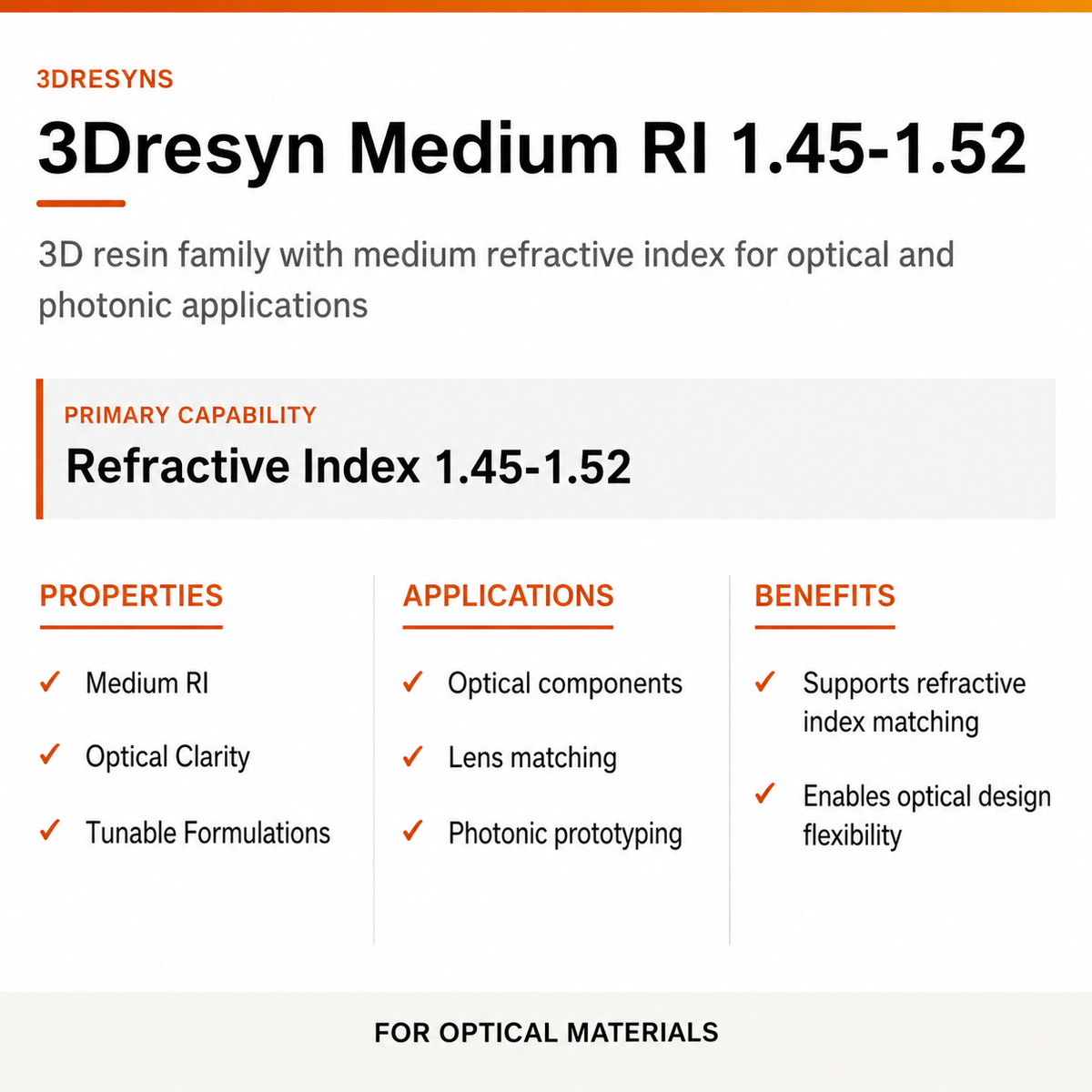
- Need balanced optical and mechanical behaviour → review medium RI products in the 1.45–1.52 range
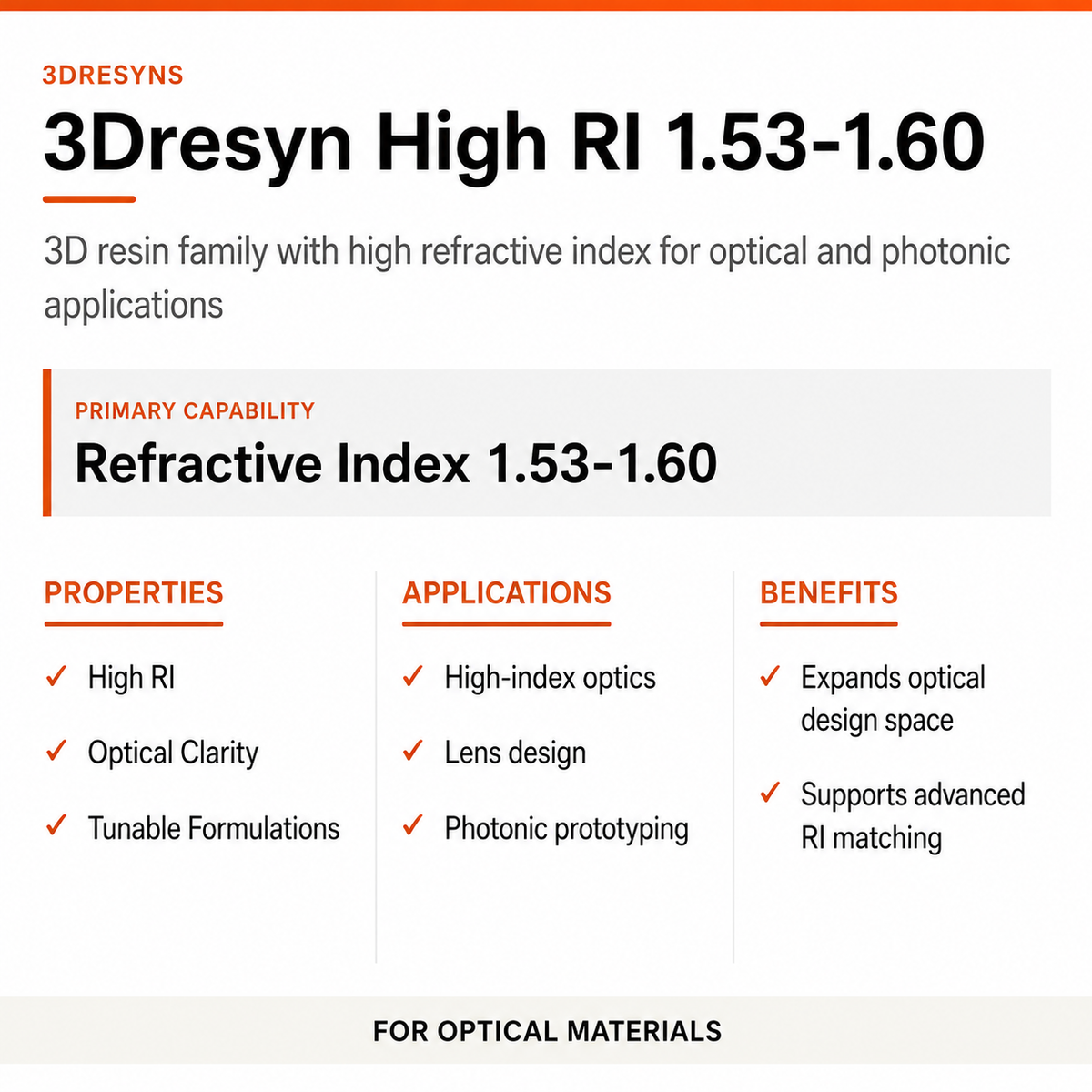
- Need higher refractive index → evaluate high RI products in the 1.53–1.60 range
- Need bio compatible optical systems → prioritize BC / BB / EBC families
- Need monomer-free route → prioritize MF-BC variants
Optical comparison principle
Refractive index is the primary selection parameter for optical matching, but final optical performance also depends on print quality, cure control, surface finish, post-processing and operating wavelength.
- Optical prototyping
- Lens and light-guide development
- Refractive index matching studies
- Photonics and optics research
- Transparent functional parts
Optical material comparison table
Use the refractive index reference table below to compare available 3Dresyns materials and select the most suitable resin for optical clarity, light management and RI matching requirements.
| Clear 3Dresyns by Refractive Index | RI at 589 nm | Source | Shore hardness | Tg ºC | Adhesion ISO2409* | Young modulus | Tensile strength MPa | Flexural strength MPa | Elongation % | Surface tension dyne/cm | Viscosity mPas 25ºC |
|---|---|---|---|---|---|---|---|---|---|---|---|
| RI-1.45HBC | 1.45 | Synthetic | D70 hard | <35 | 2 good | <1500 | <20 | <20 | <20 | 30-31 | <20 |
| RI-1.46EBC Elastic Bio Compatible | 1.46 | Synthetic | O50 Elastic, durable, non easy breakable | 0 | 2 good | <0.1 | <1 | <1 | <800 | 32-34 | <50 |
| RI-1.46BC Bio Compatible | 1.46 | Synthetic | D40 medium hard | <20 | 2 good | <10 | <10 | <10 | <30 | 35-37 | <20 |
| RI-1.46BB Bio Based and Biocompatible | 1.46 | Bio-based | D70 hard | <40 | 4 poor | <1000 | <20 | <20 | <10 | 35-36 | <200 |
| RI-1.46HBC Bio Compatible | 1.46 | Synthetic | D80 Hard | <50 | 4 poor | <1000 | <20 | <20 | <10 | 33-35 | <50 |
| RI-1.47MF-BC Bio Compatible | 1.47 | Synthetic Monomer Free | D80 hard | <-5 | 4 poor | >1000 | <20 | <20 | <10 | 37-39 | <100 |
| RI-1.47BB Bio Based and Bio Compatible | 1.47 | Bio-based | D80 hard | <80 | 0 excellent | <2000 | <10 | <10 | <3 | 29-31 | <20 |
| RI-1.48MF-BC Bio Compatible | 1.48 | Synthetic Monomer Free | D80 hard | >130 | 4 poor | 2000-3000 | <90 | <90 | <5 | 36-38 | <10000 |
| RI-1.49HBC | 1.49 | Synthetic | D85 hard | >110 | 4 poor | >2000 | <80 | <80 | <5 | 36-38 | <2000 |
| RI-1.49SBC Bio Compatible | 1.49 | Synthetic | A10-20 very soft | <-30 | 3 medium | <1 | <1 | <1 | <50 | 33-35 | <100 |
| RI-1.50BC Bio Compatible | 1.50 | Synthetic | D85 hard | <120 | 4 poor | >1000 | <20 | <20 | <5 | 37-39 | <200 |
| RI-1.50MF-BC Bio Compatible | 1.50 | Synthetic Monomer Free | A20, very soft, easy breakable | <-30 | 2 good | <1 | <1 | <1 | <50 | 41-42 | <50 |
| RI-1.51BC Bio Compatible | 1.51 | Synthetic | Soft, easy breakable | <-10 | 2 good | <2 | <2 | <2 | <70 | 40-41 | <50 |
| RI-1.52 | 1.52 | Synthetic | Soft, durable, non easy breakable | <10 | 2 good | <3 | <4 | <4 | <100 | 39-41 | <50 |
Mobile: scroll horizontally to view all columns. The first column remains visible while scrolling.
Engineering note
Optical performance depends strongly on printing resolution, surface quality, cure control, post-processing and wavelength-specific operating conditions. Final performance must always be validated on the printed and finished part.
Interpretation principle
These materials should be interpreted as structured optical engineering options organized by refractive index. Final suitability depends on the specific geometry, optical path, surface finish, wavelength and end-use environment.
* Adhesion values refer to typical internal reference data where available.
Refractive-index resin ranges
Move directly between low, medium and high refractive-index ranges
For refractive-index resin selection, start from the target optical window and compare the low-, medium- and high-RI material ranges before validating the finished printed part.
Sort by




From prototyping to industrial production, performance depends on materials, calibration and process control