

3D-ADD ReBond Weld — Self-Repair & Interlayer Welding Additive for photopolymerv 3D Resins
Product description
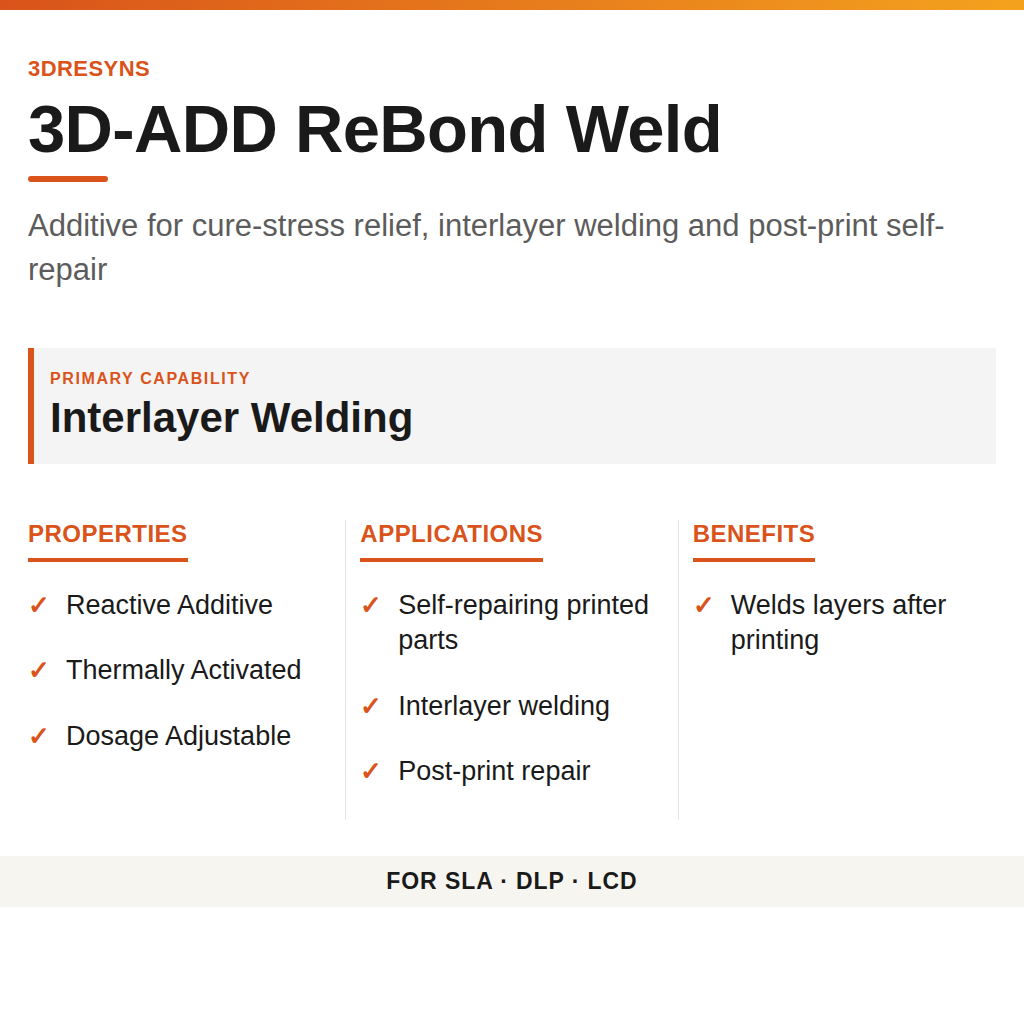
3D-ADD ReBond Weld upgrades photopolymer 3D resins with cure-stress relief, interlayer welding, and post-print self-repair at a controlled activation temperature.
It is a drop-in, reactive liquid with no non-reactive solvents, designed for open-materials printers. It is intended for engineering parts that tend to warp, micro-crack, or split between layers, as well as fixtures, housings, snap-fits, optical and functional parts that benefit from hot-welded joints and longer service life.
Application framework
Designed for use in open-materials SLA, DLP and LCD workflows at 385–405 nm. Suitable for common photopolymer 3D resin families including rigid-tough, tough-clear and engineering clear systems.
Typical applications
- Engineering parts that tend to warp, micro-crack, or split between layers
- Fixtures
- Housings
- Snap-fits
- Optical and functional parts that benefit from hot-welded joints and longer service life
Measured physical properties
- Optic activation window: ~75–95 °C, 10–30 min
- Thermal-Weld activation window: ~95–120 °C, 10–20 min
- Starting point: 7–10 wt% in the host resin
- Typical range: 5–15 wt% depending on matrix and goal
- Exposure: expect +5–20% vs your baseline
- Physical state: clear to pale-amber liquid
- Odor: very low (Optic) / low (Thermal-Weld)
- Density (25 °C): approx. 0.98–1.12 g·cm⁻³
- Shelf life: 12 months unopened
- Storage: sealed, 15–25 °C, dry, dark
- Delivery time is around 3-4 weeks after ordering
Functional performance characteristics
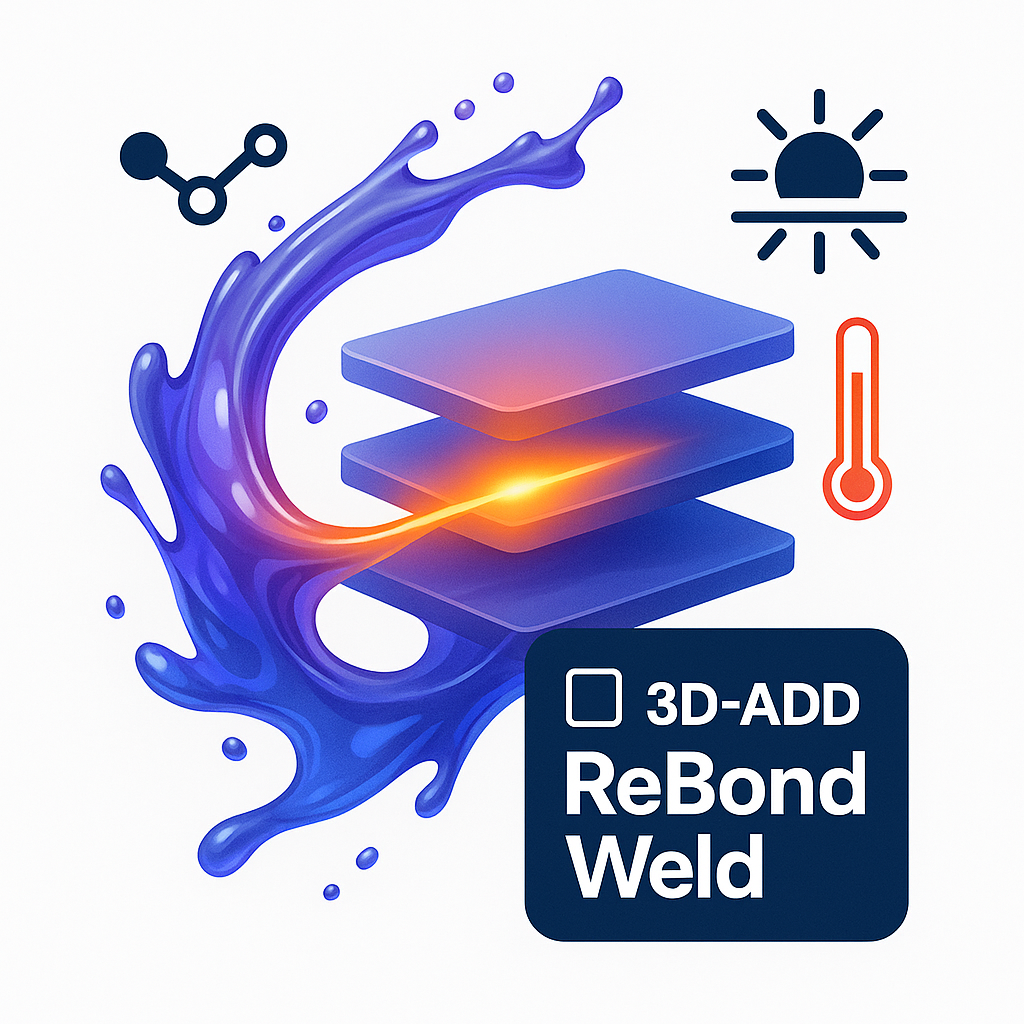
- Interlayer welding to reduce layer-split failures
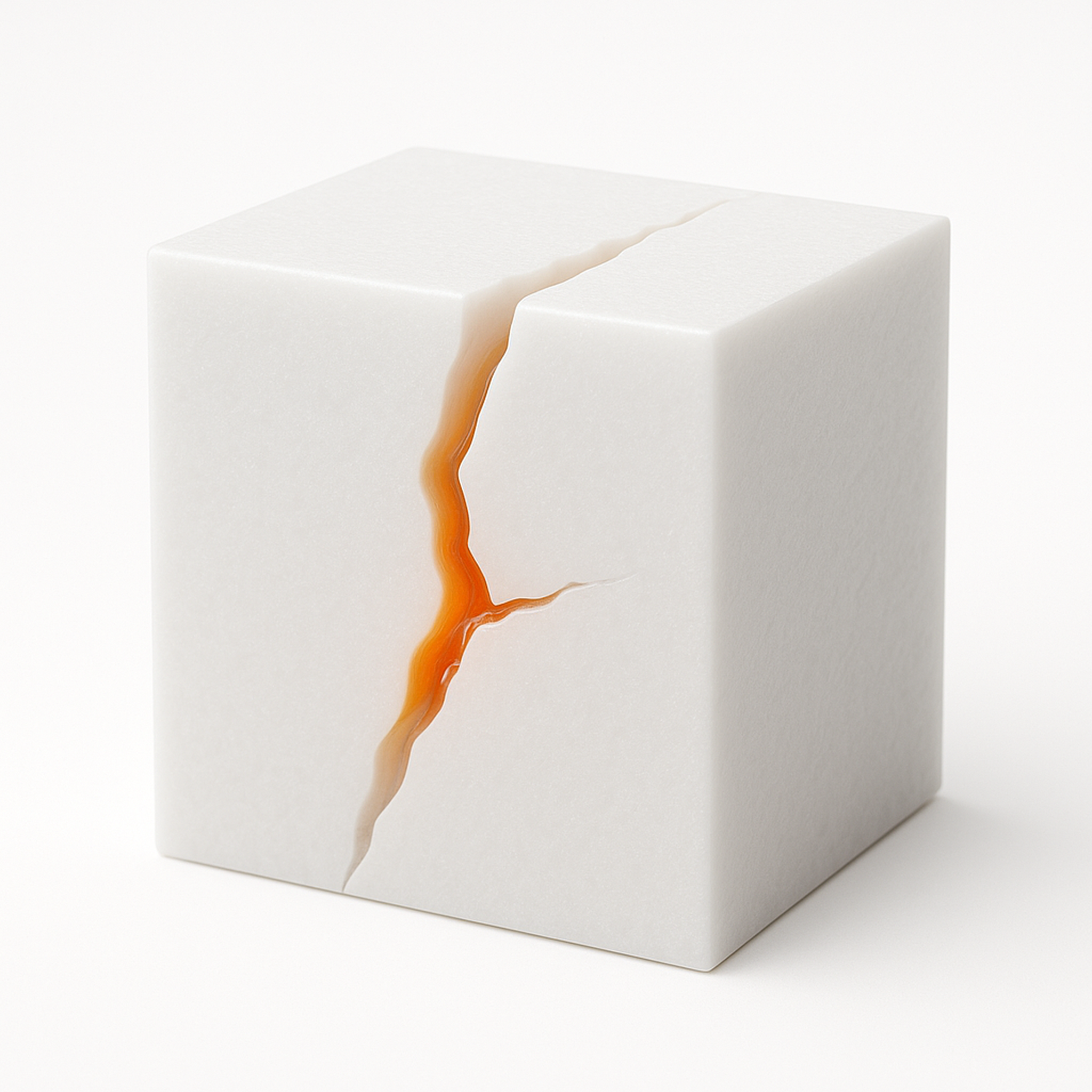
- Post-print self-repair to close microcracks after service or finishing
- Cure-stress management to mitigate warpage and micro-cracking during cure
- Optical-friendly Optic variant tuned for clarity and low odor
- Plug-and-play ready to mix additive
- Clear and lightly pigmented systems give the fastest activation
- Optic provides maximum clarity with slightly slower weld vs Thermal-Weld at equal dose
- Thermal-Weld provides fastest, strongest thermal welding for engineering resins and higher-Tg matrices
Processing and handling performance
- Blend under low light and stir until homogeneous
- Temper to 40–50 °C if needed to speed mixing
- Degas before filling the vat
- Print on SLA, DLP and LCD at 385–405 nm
- Increase exposure +5–20% from your baseline and re-optimize base/per-layer times
- Post-cure with your standard protocol
- Avoid excessive over-post-cure if a later hot-weld is planned
- Align the interface or crack surfaces
- Activate within the variant window for 10–30 min with light pressure or a simple clamp
- Optional brief local light assist after heating to lock the interface
- For optics, clean gently and allow 24 h stress relaxation for best clarity
- Dense pigments, heavy filler, or very high-Tg matrices may need higher dosage or temperature
- Each order includes the product, 1× graduated beaker, and 1× 250 mL black bottle to protect resins from light
- It is supplied as a kit, which contains the product, one graduated beaker and one empty 250 mL black bottle to measure, mix, keep and protect the 3D resins from daylight
- Please do not expose any 3D resins to natural or room light to prevent their curing.
Chemical and safety characteristics
- Reactive liquid with no non-reactive solvents
- VOC: none added; reactive medium
- Industrial/R&D use
- Use gloves, goggles and lab coat
- Ventilate
- Consult MSDS before use
Testing & processing disclaimer
Dense pigments, heavy filler, or very high-Tg matrices may need higher dosage or temperature. Validate weld test, crack closure, dimensional drift and optics on internal coupons.
Disclaimer
This material is supplied as a professional manufacturing material and is not marketed as a finished medical device. Final part performance and suitability must be validated by the user according to the intended application.
3D-ADD ReBond Weld is supplied as a reactive, drop-in additive for integration into open-materials SLA, DLP and LCD photopolymers. Applications that require a dedicated interlayer-welding, cure-stress-relief or self-repair formulation, or specific mechanical, thermal (high-Tg), optical or processing targets beyond what the additive provides on its own, can be addressed through a custom-designed material.
For these cases, 3Dresyns develops customized resin and additive systems according to customer specifications through the Customization Services program: Customization Services.
This technical datasheet should be used together with the relevant processing, calibration, safety and workflow documentation available in the 3Dresyns® Resources section.
Document reference: TDS-3D-ADD-REBOND-WELD-EN | Version: 1.0 | Last updated: March 2026
Choose options