
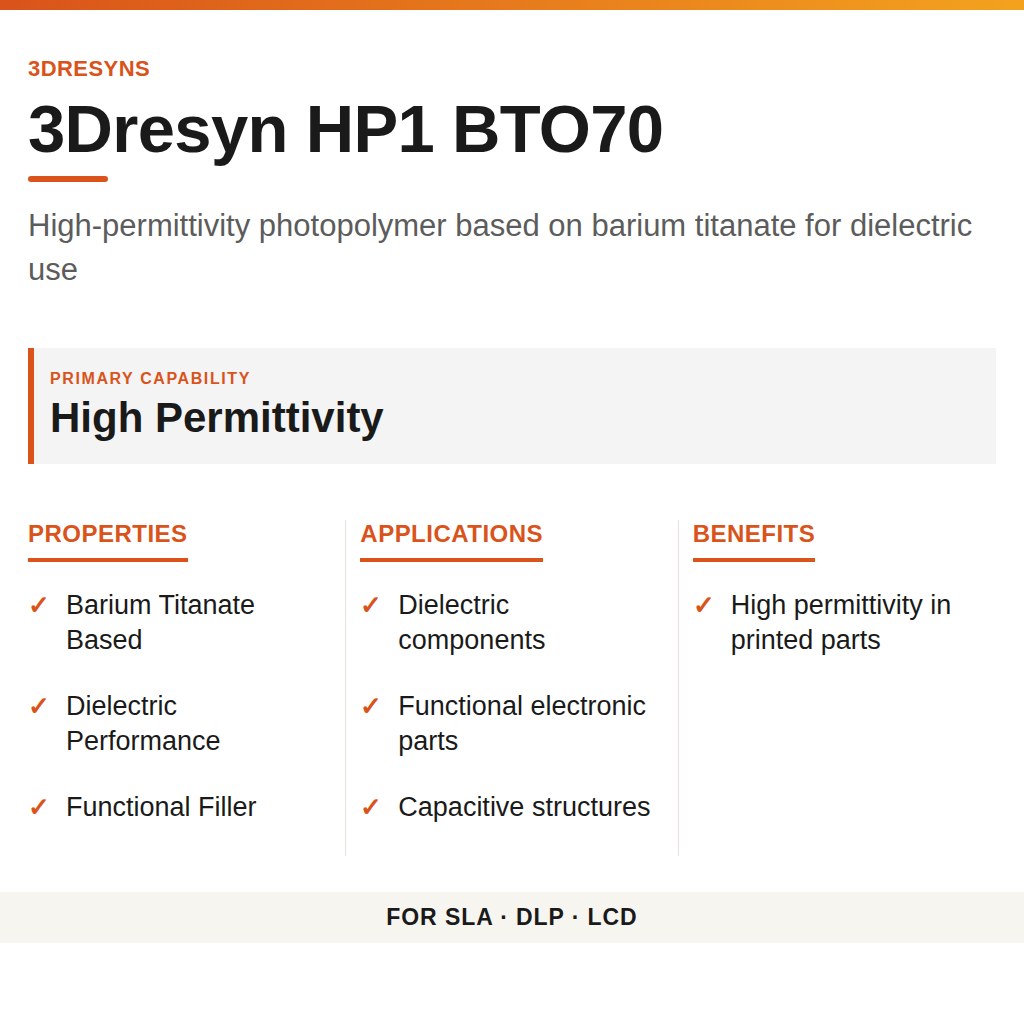

3Dresyn HP1 BTO70 High Permittivity resin with ferroelectric, pyroelectric, and piezoelectric properties
Product description
3Dresyn® HP1 BTO70 is a high-permittivity photopolymer formulation based on Barium Titanate (BTO), engineered for advanced dielectric and functional electronic applications. The material is supplied as a free-flowing paste containing high dielectric ceramic loading, enabling the fabrication of components with elevated relative permittivity using SLA, DLP and LCD 3D printing workflows.
This formulation enables the design and manufacturing of functional dielectric devices with controlled electrical behavior across RF and microwave frequency ranges.
Application framework
Designed for use in advanced additive manufacturing systems (SLA, DLP and LCD) within research, electronics and high-frequency engineering environments requiring controlled dielectric properties.
Typical applications
- High permittivity dielectric components
- RF and microwave devices
- Antennas and resonators
- Filters and RF cavities
- Sensors and transducers
- Capacitors, resistors and insulating components
- Functional electronic and electromagnetic devices
Electrical properties
- Relative permittivity (εr): 8–9 (typical)
- Loss tangent (δ): <0.04 at 10–20 GHz
Material characteristics
- Based on Barium Titanate (BTO) high dielectric ceramic system
- Ferroelectric, pyroelectric and piezoelectric behavior
- Free-flowing paste formulation
- Medium hardness material behavior
- Elongation at break: <5%
Functional performance characteristics
- High dielectric constant for advanced electromagnetic design
- Suitable for high-frequency applications (RF and microwave)
- Stable dielectric performance across relevant frequency ranges
- Enables miniaturization of electronic components
- Compatible with multi-material and hybrid manufacturing approaches
Processing and handling performance
- Printable with professional SLA, DLP and LCD systems
- High resolution capability depending on process parameters
- Very low shrinkage during processing
- Optimized for stable layer formation and repeatability
- Alternative processing route: injectable catalysed system in sacrificial or durable 3D printed molds
Chemical and safety characteristics
- Non cytotoxic formulation
- Safe handling under standard laboratory conditions
- Inorganic-organic hybrid system (ceramic-filled photopolymer)
Processing note
Dielectric performance is dependent on printing parameters, geometry, frequency range and post-processing conditions. Calibration and validation are required for each specific application.
Testing & processing disclaimer
Electrical and mechanical properties are measured under controlled conditions and may vary depending on printer type, exposure parameters, geometry and post-processing workflow.
Disclaimer
This material is supplied as a professional functional material for research and engineering workflows. It is not marketed as a finished electronic device. Final performance and suitability must be validated by the user.
This technical datasheet should be used together with the relevant processing, calibration, safety and workflow documentation available in the 3Dresyns® Resources section.
Document reference: TDS-HP1-BTO70-EN | Version: 1.0 | Last updated: March 2026
Choose options