
Density adjusters
Reactive density-adjustment additives for photopolymer 3D resins, developed to tune weight, mass distribution and bulk-density behavior in application-specific printed parts.
3Dresyns® density adjusters in this collection are positioned for engineering workflows where lighter or heavier parts are required to meet buoyancy, ballast, feel, balance or density-matching targets.
Navigate by: high-density route, low-density route and concentrate route.
This collection groups density-adjustment additives developed for higher or lower density targeting, improved weight control and formulation tuning for specialized performance.
These routes are intended for workflows involving buoyancy concepts, ballast logic, density-matched components and specialized engineering validation parts. :contentReference[oaicite:1]{index=1}
Key features & benefits
Choose your density-adjustment family
Use the routes below to navigate the collection by whether the target is higher density, lower density or concentrated high-density tuning.
- Density tuning additives for higher or lower density targeting.
- Improved weight control and formulation-property adjustment.
- Useful for buoyancy or ballast design constraints.
- Suitable for specialized engineering validation parts and density-matched components.
Typical applications
Typical use scenarios across the collection
This collection is suitable for workflows where part mass and density are design variables rather than secondary outcomes.
- Weight-optimized prototypes: reducing or increasing mass to match functional objectives.
- Density-matched components: tuning a part to better match the bulk behavior of a target component.
- Buoyancy concepts: lighter parts for floatation-related validation.
- Ballast concepts: heavier parts for balance, stability or inertial targets.
- Functional material development and engineering validation: when density is part of the design logic.
Why choose this collection
How to choose the right density adjuster
Select the most suitable route according to whether the formulation needs to become heavier, lighter or more strongly density-shifted via a concentrate route.
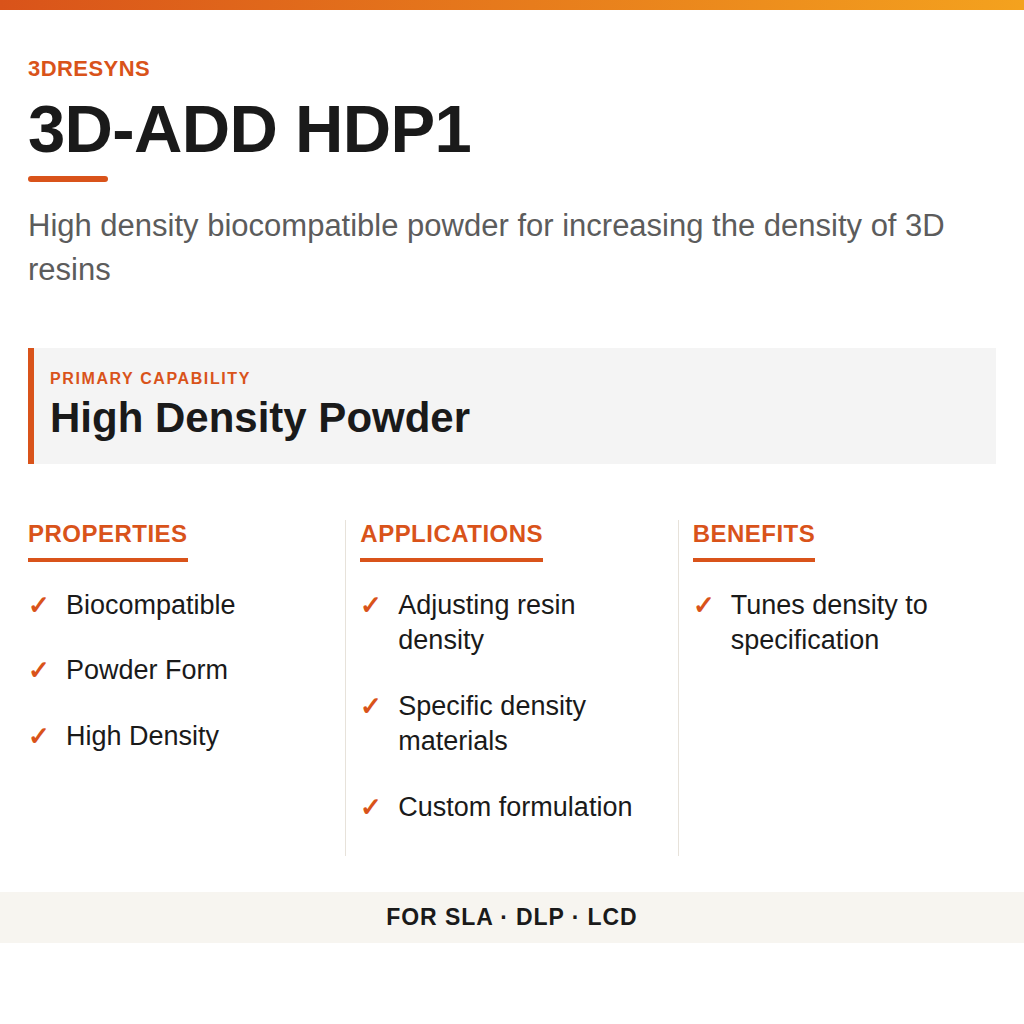
- Need to increase density with a powder route → choose 3D-ADD HDP1
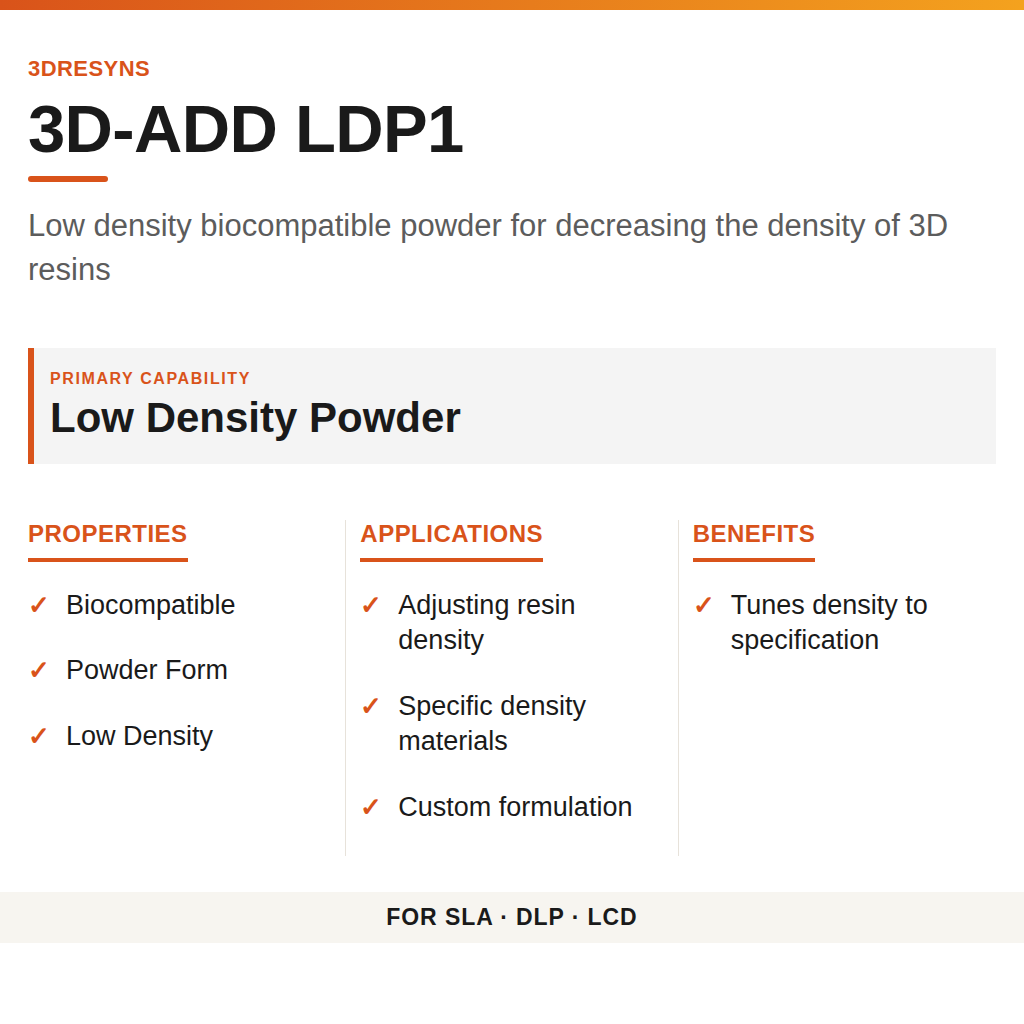
- Need to decrease density with a powder route → choose 3D-ADD LDP1
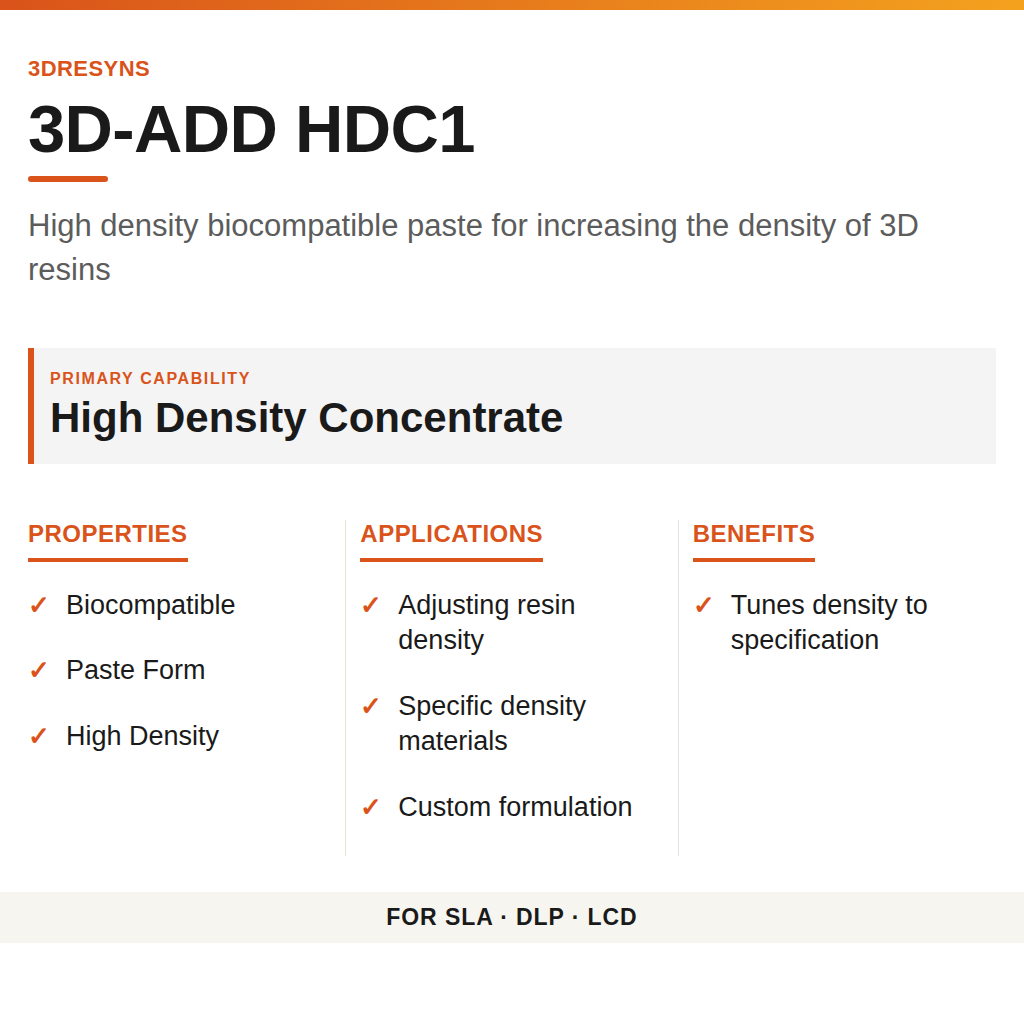
- Need a higher-density concentrate route → choose 3D-ADD HDC1
- Prioritise heavier parts or ballast logic → start with HDP1 or HDC1
- Prioritise lower mass or buoyancy logic → start with LDP1
- Prioritise stronger density increase with concentrate-style handling → start with HDC1
Decision tree summary
Use this simplified logic before detailed formulation validation.
- Need higher density → HDP1 or HDC1
- Need lower density → LDP1
- Need buoyancy-oriented tuning → LDP1
- Need ballast-oriented tuning → HDP1 or HDC1
Then validate the final route under the intended resin chemistry, additive loading, mixing protocol and mechanical-performance window.
Products in this collection
High-density powder and concentrate routes
For workflows requiring higher mass, improved ballast behavior or density increase relative to the base resin system.
Low-density powder route
For workflows requiring lower mass, reduced density or buoyancy-oriented behavior relative to the base resin system.
Technical overview table
Workflow-dependent performance
Final density, mass distribution, buoyancy behavior and mechanical side effects depend on the interaction between the selected adjuster, the base resin, additive loading and the mixing or curing workflow.
Successful implementation therefore requires alignment between density route, weight target, formulation strategy and qualified process conditions.
| Material | Primary role | Core concept | Main behavior | Typical positioning | Target workflow |
|---|---|---|---|---|---|
| 3D-ADD HDP1 | High-density powder | Increasing the density of 3Dresyns | Raises density and supports higher-mass or ballast-oriented designs | Weight-matched components, ballast concepts and validation parts | Engineering & prototyping density-increase workflows |
| 3D-ADD LDP1 | Low-density powder | Decreasing the density of 3D resins | Lowers density and supports lighter parts or buoyancy-oriented designs | Weight-optimized prototypes and buoyancy concepts | Engineering & prototyping density-decrease workflows |
| 3D-ADD HDC1 | High-density concentrate | Concentrated density-increase route | Supports stronger high-density tuning through a concentrate format | Specialized engineering validation and denser material-development routes | Engineering & prototyping concentrate-based density-increase workflows |
Mobile: scroll horizontally to view all columns. The first column remains visible while scrolling.
Portfolio overview
A focused density-tuning platform rather than a broad modifiers page
This collection is compact and clearly structured around three mass-control routes: one for lowering density and two for increasing it, including a concentrate option. :contentReference[oaicite:2]{index=2}
- HDP1 covers the high-density powder route.
- LDP1 covers the low-density powder route.
- HDC1 covers the high-density concentrate route.
Workflow note
The right density route depends on the mass objective, not only on the additive format
These modifiers are most useful when the physical target is defined first: lighter part, heavier part, ballast behavior, buoyancy response or density matching versus a reference component.
In practice, the correct path is to define the mass and balance objective first, then validate the modifier under the intended resin system, geometry and process conditions.
Technical and commercial support
Documentation, technical selection help and workflow support
Use the resources below to move from density-adjuster preselection to formulation planning, calibration or broader technical support. :contentReference[oaicite:3]{index=3}
Final CTA
Select the right density-adjustment route and validate the final mass target
Use the route-based navigation above to identify the most relevant density modifier, compare candidates in the technical overview table, and move forward with formulation-specific validation for lighter, heavier or density-matched printed parts.
Related functional-modifier routes
Explore closely related 3Dresyns collections
Use these links to move between closely related material, process or formulation families in the 3Dresyns catalogue.
Sort by



From prototyping to industrial production, performance depends on materials, calibration and process control