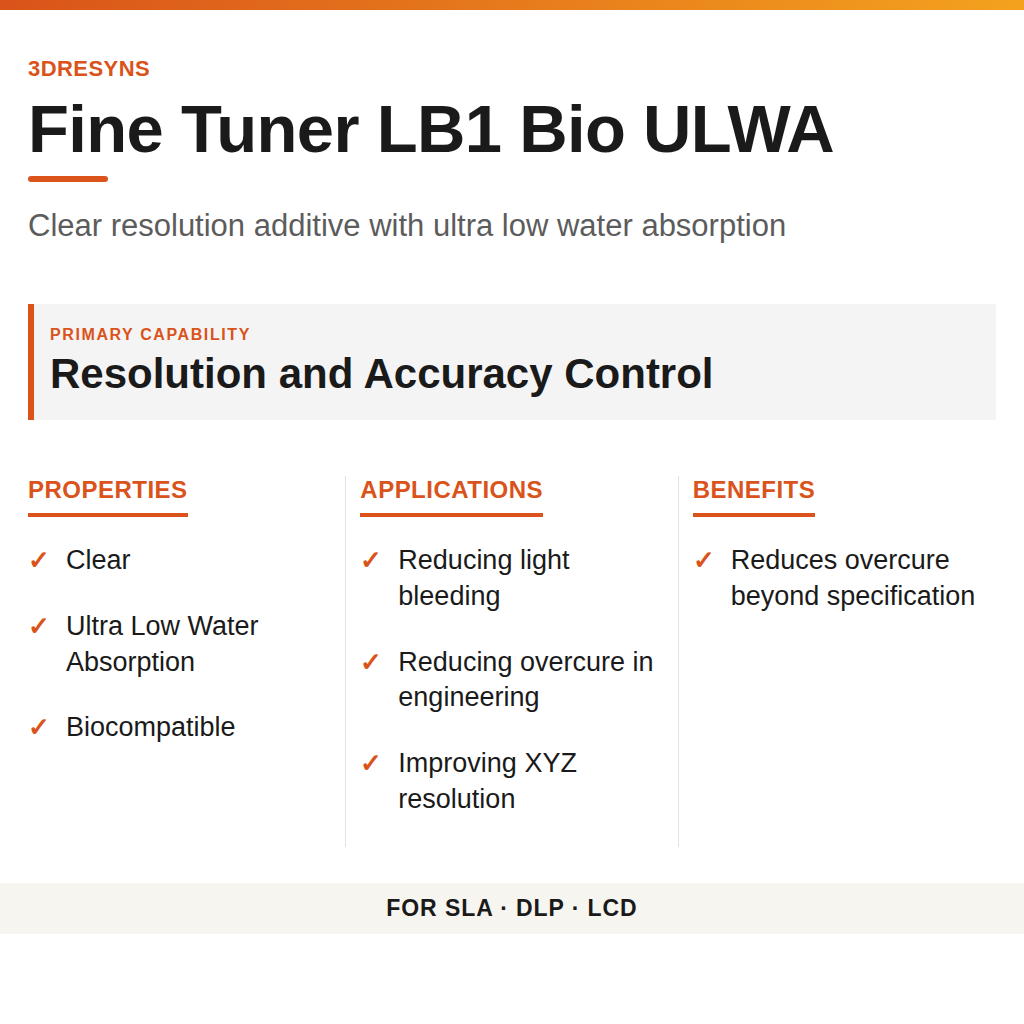
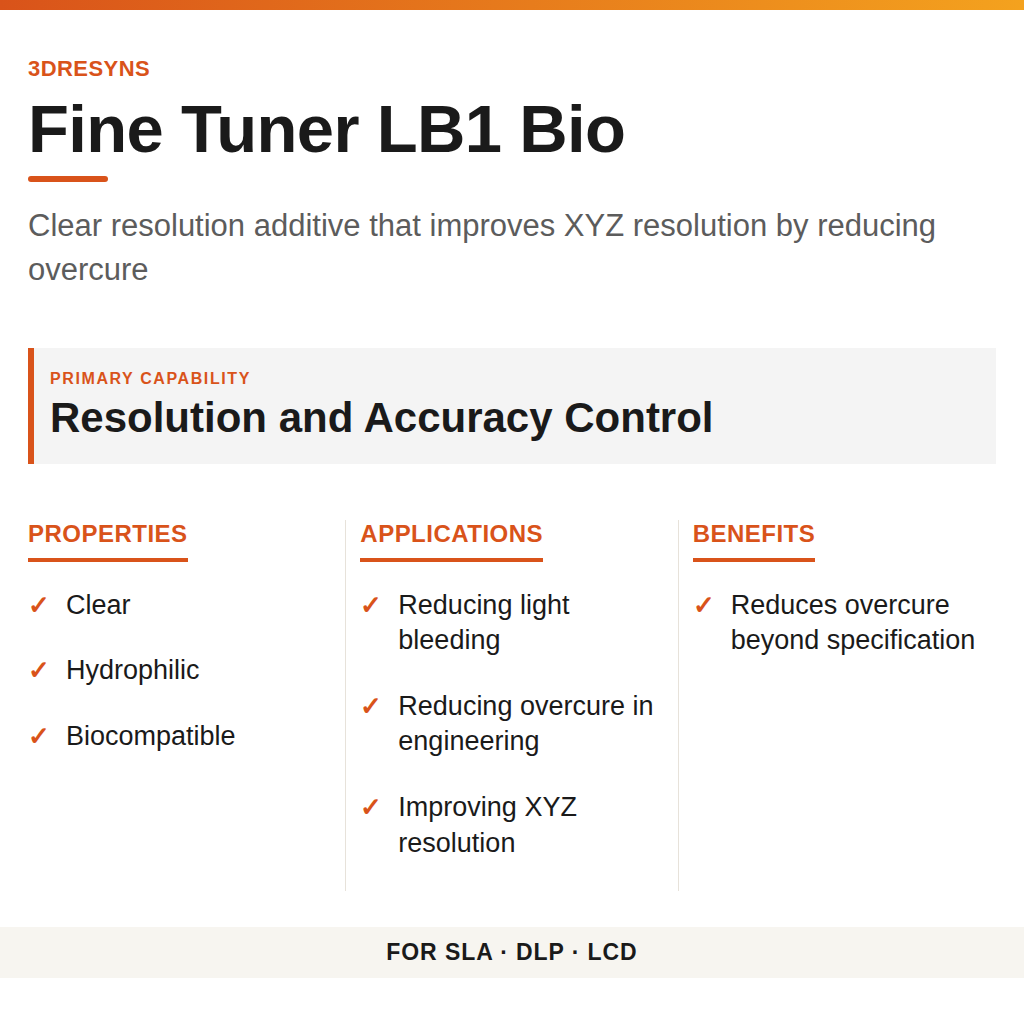
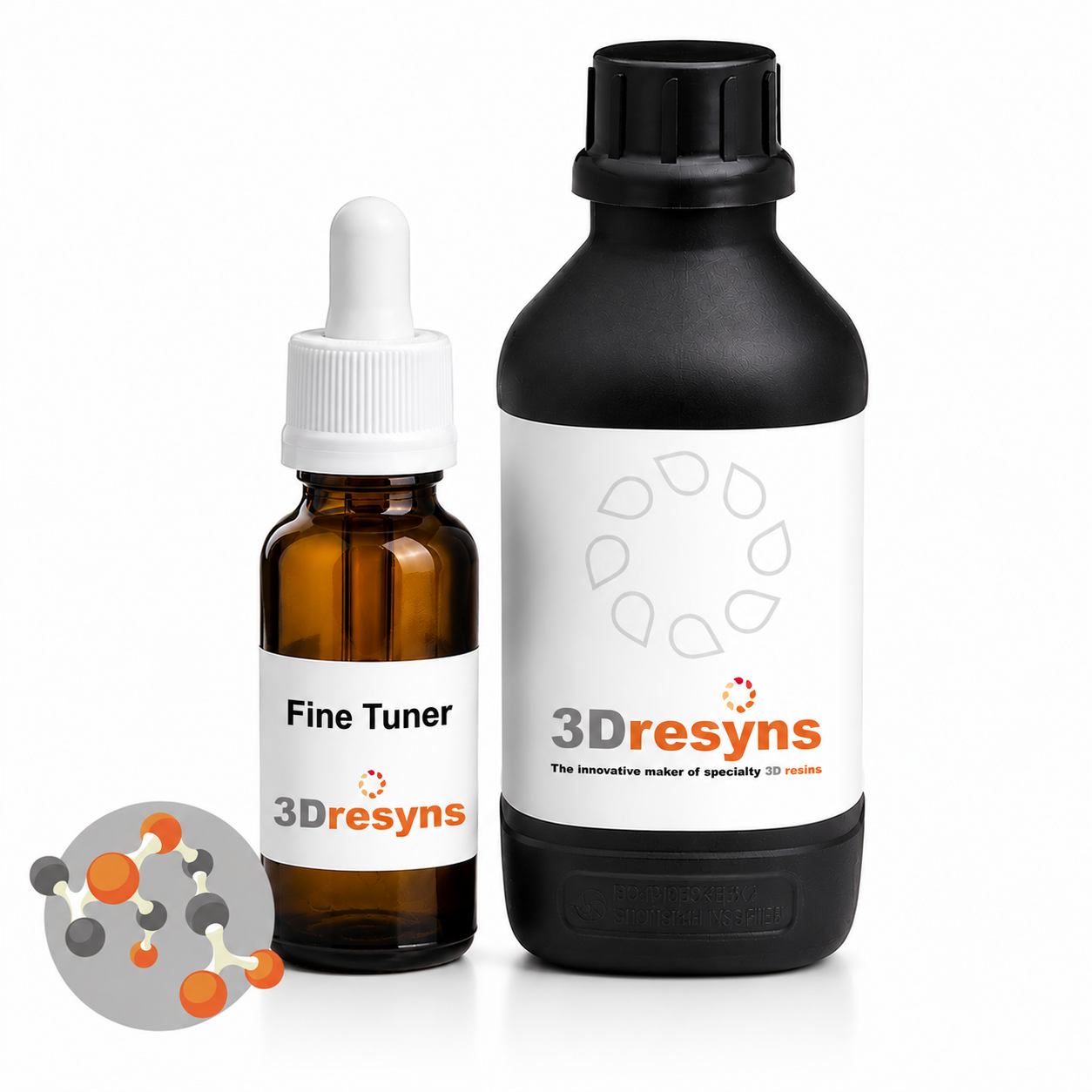
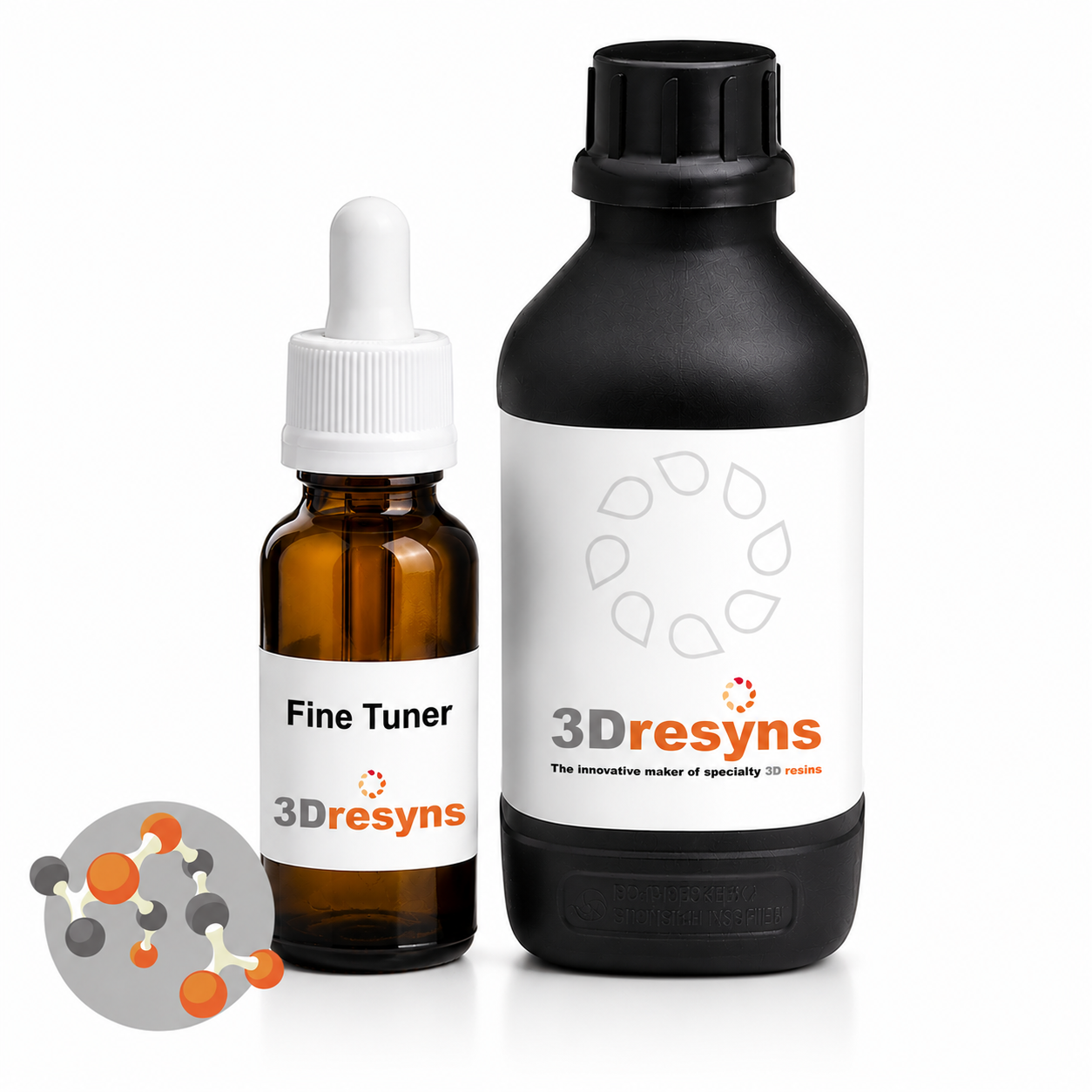
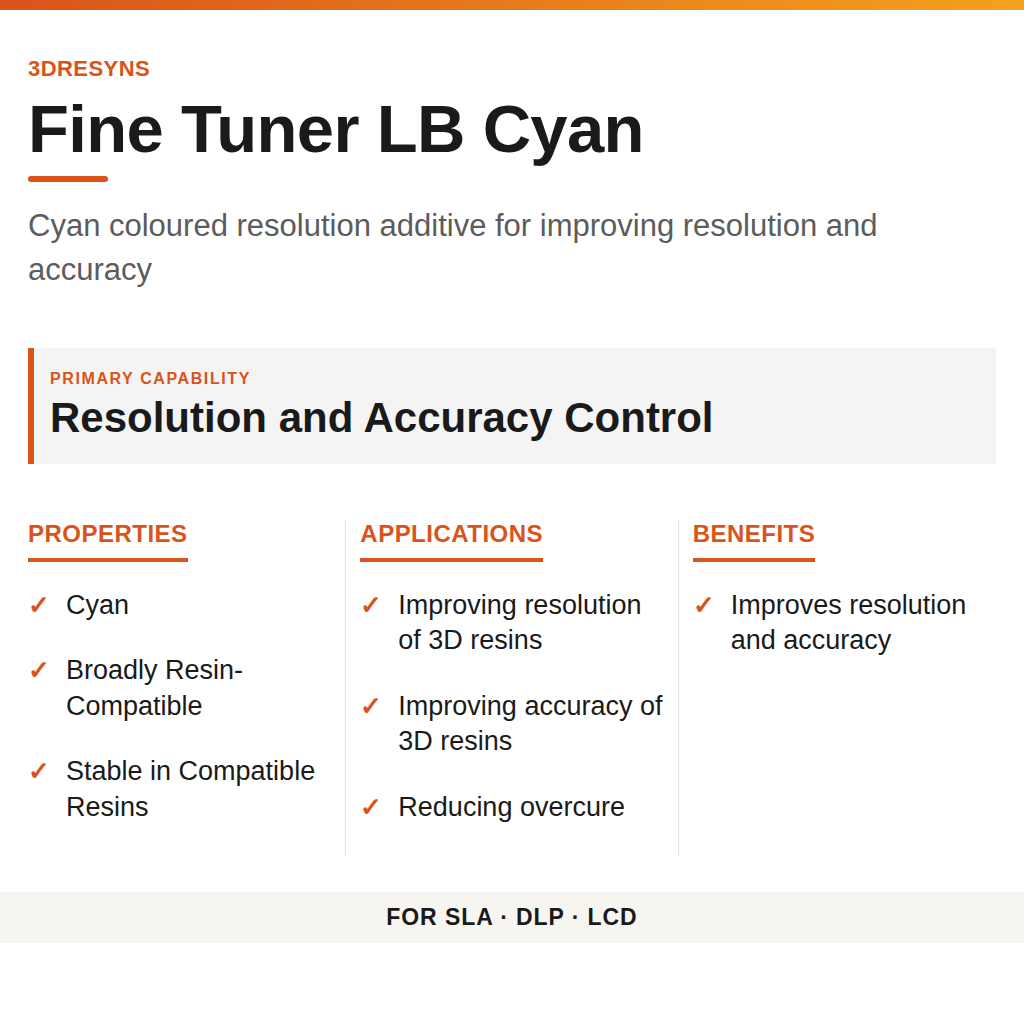
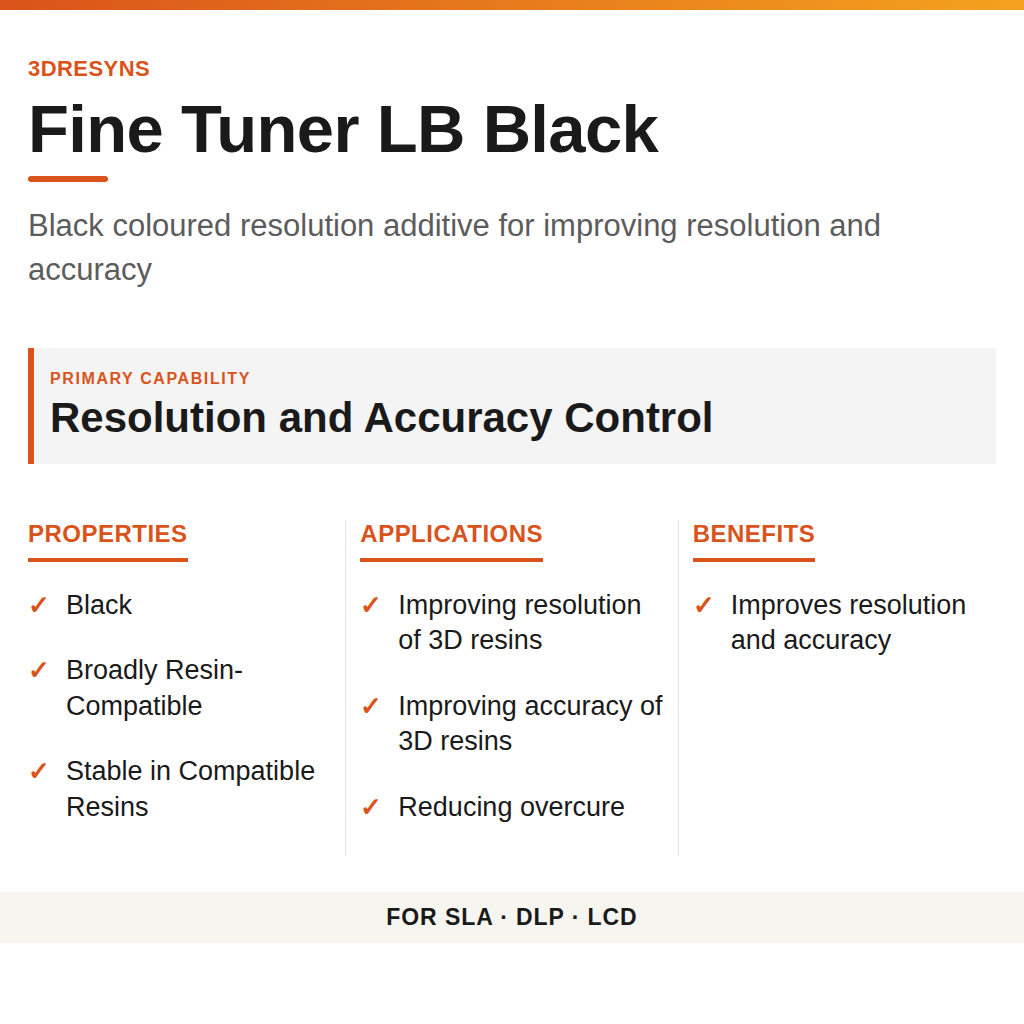
Light blockers and resolution modifiers for controlling cure depth, light penetration and feature definition in photopolymer systems.
This collection provides formulation additives designed to improve printing resolution, reduce overcuring and enable precise control of voxel formation in SLA, DLP and LCD/MSLA workflows.
Navigate by: resolution control strategy, cure-depth tuning, optical attenuation or formulation objective.
These are formulation additives and not ready-to-print resins. Proper formulation and validation are required before use.
Control light as a processing variable
Light blockers regulate how deeply light penetrates into the resin, directly affecting curing thickness and feature sharpness.
They are essential tools for achieving high-resolution printing, especially in fine-feature and micro-scale applications.
Quick selection by function
Functional navigation
Choose your resolution strategy
Select the additive according to the desired control over light propagation and curing behavior.
Typical routes
Key features & benefits
Optical control
Precise control of curing depth and voxel definition
Capabilities
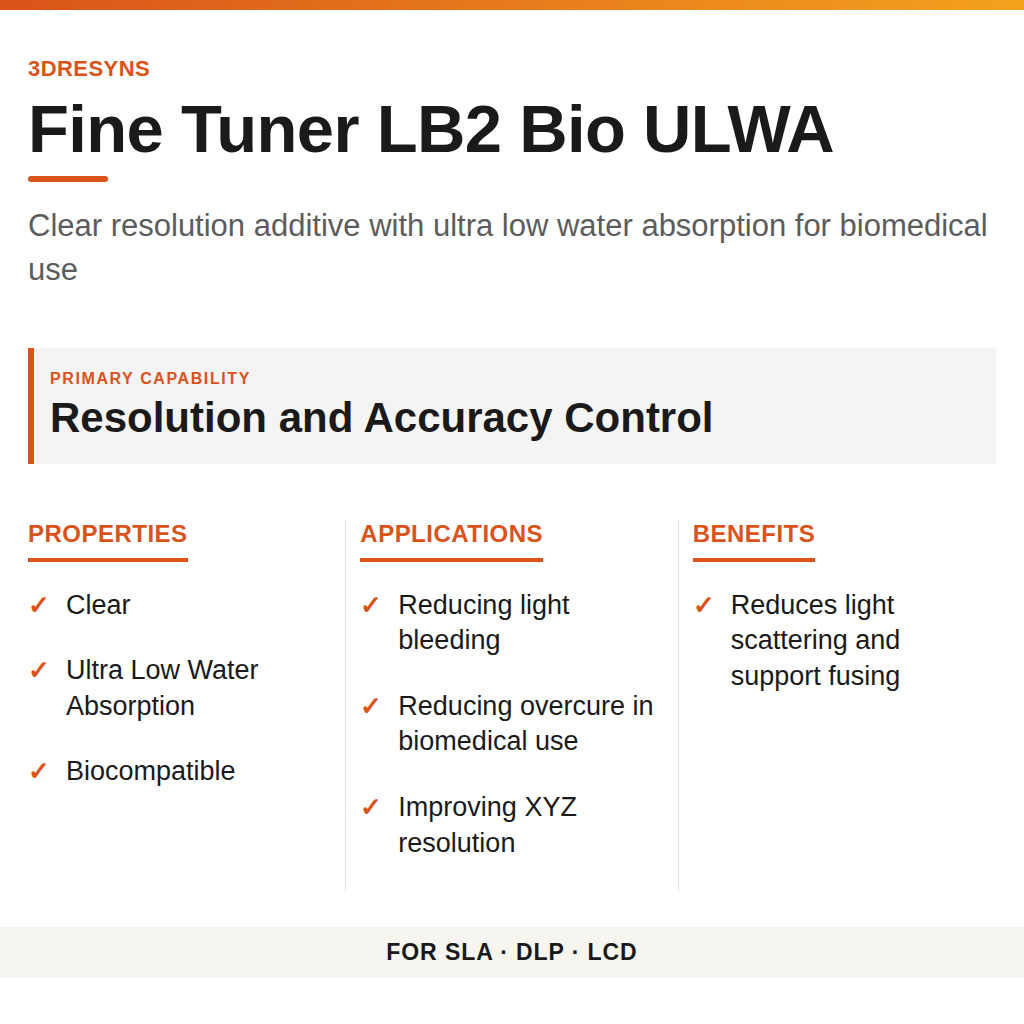
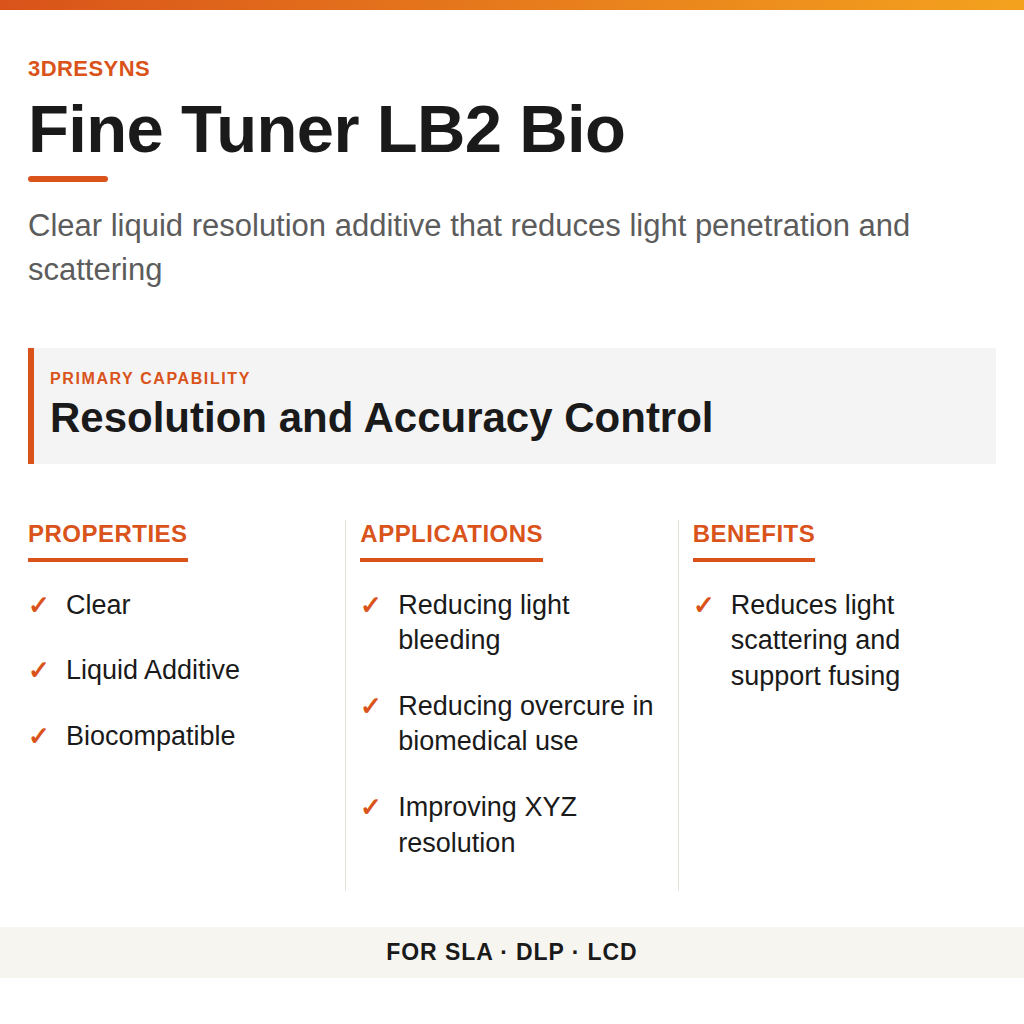
- Reduction of cure depth through controlled light attenuation
- Improved XY and Z resolution in fine-feature printing
- Minimization of light scattering and overcuring effects
- Balancing between resolution, curing speed and mechanical performance
- Compatibility with SLA, DLP and LCD/MSLA systems (formulation-dependent)
- Support for high-resolution, microfluidic and precision applications
Use cases
Typical applications
Applications
- High-resolution 3D printing and microfabrication
- Microfluidics and fine internal channel definition
- Reduction of z-overcure and layer bleeding
- Optimization of exposure parameters for specific printers
- Development of custom high-precision photopolymer systems
- Research and advanced formulation tuning
Collection overview
Products in this collection
Products in this collection are shown below.
This collection includes light blockers, optical attenuators and resolution modifiers designed for advanced photopolymer formulation and precision control.
Selection logic
Decision guide
How to select the right light blocker
Select the additive based on the required balance between resolution and curing efficiency.
Decision guide
-
Need finer detail → increase light blocking to reduce cure depth
-
Need to reduce overcuring → use attenuation modifiers to limit light penetration
-
Need higher productivity → balance blocker concentration with photoinitiator system
-
Need stable processing → optimize formulation to avoid undercuring or loss of adhesion
Engineering rule
Resolution vs curing trade-off
Increasing light blocking improves resolution but reduces curing depth and speed. This trade-off must be optimized depending on geometry, layer thickness and printer characteristics.
System performance must always be validated experimentally.
Final performance depends on wavelength, light intensity, exposure time, resin composition and additive concentration. Results vary between printers and formulations.
These materials should be understood as formulation tools for optical control in photopolymerization. They require controlled integration into a validated resin system.