3D-ADD GrapEK1-GNP Bio, biocompatible electrically conductive graphene nanoplatelets 3D additive
Product description
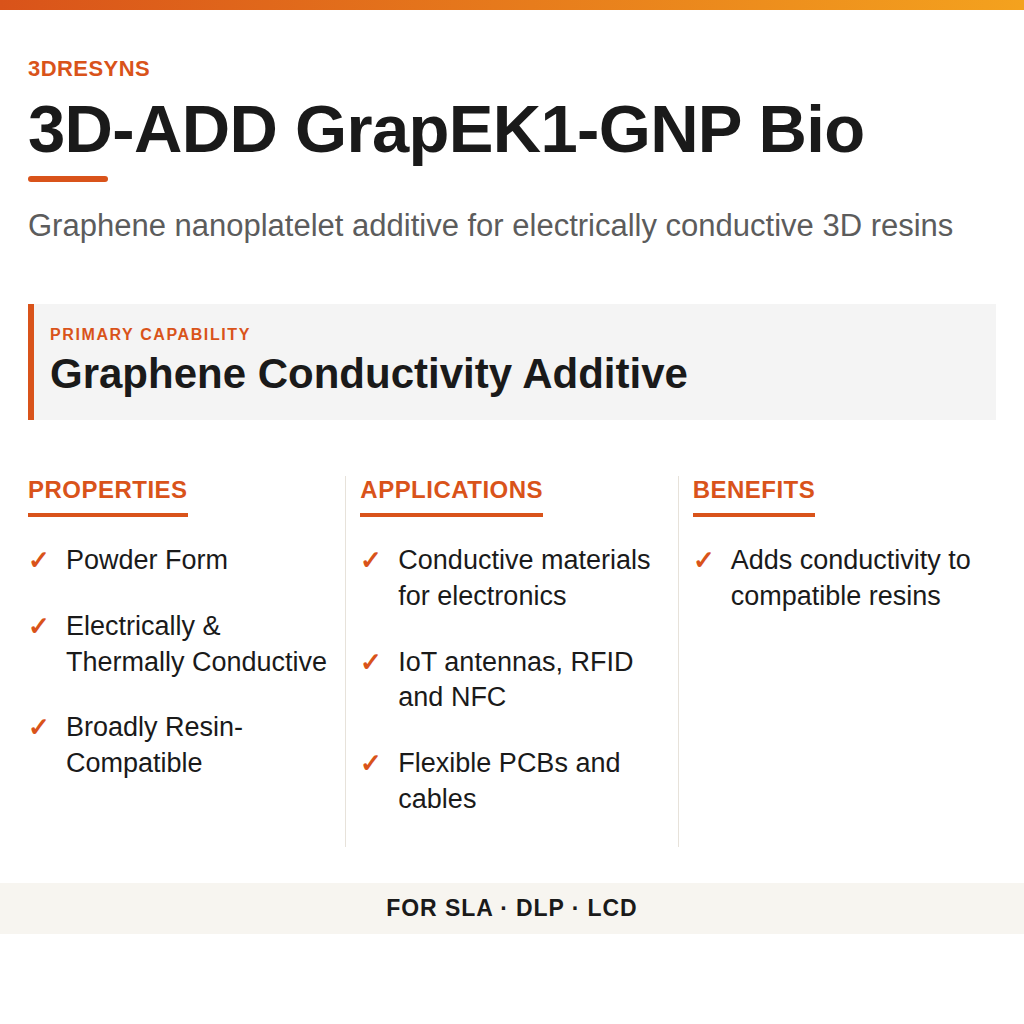
3D-ADD GrapEK1-GNP Bio is a biocompatible electrically and thermally conductive graphene nanoplatelets additive for 3D printing conductive materials for electronics, including antennas for IoT applications (HF, UHF), RFID and NFC tags, OLED, OPVs, flexible PCBs and flexible cables.
This nano graphene additive is supplied in powder form and is designed to provide conductivity to 3D resins. It is supplied as a kit for measuring, mixing, storing and protecting conductive 3D resins from daylight.
Application framework
Designed as a conductive additive for 3D resins for 3D printing conductive materials for electronics applications. It is compatible with most 3D resins and can be used together with 3D-ADD EKC to obtain synergistic properties of clarity and conductivity.
Typical applications
- 3D printing conductive materials for electronics
- Antennas for IoT applications (HF, UHF)
- RFID and NFC tags
- OLED, OPVs, flexible PCBs and flexible cables
Measured physical properties
- Sheet resistance >150 kΩ/square
- Resistivity >40 Ω.m
- Conductivity <30 mS/m
- Typical achievable values at 5% dosage by weight at 250 microns*
- Guaranteed shelf life: 12 months
Functional performance characteristics
- Predispersed conductive graphene nanoplatelets additive in powder form
- Excellent compatibility with most 3D resins
- Improved biocompatibility and conductivity can be achieved when used with 3Dresyn NSEK Bio
- 3D-ADD GrapEK1-GNP Bio and 3D-ADD EKC are compatible and can be mixed and used together to get synergistic properties of clarity and conductivity
Processing and handling performance
- Easy and optimum dispersion in 3D resins with Cowles or vortex mixers at 1500 rpm for 5 minutes
- Dosage of 3D-ADD GrapEK1-GNP Bio can be custom adjusted
- Typical dosages of 2-3 % (up to 5%) are recommended
- Excessive dosage may promote the formation of clusters, or clumps (sea-island or nodular structures) and asymptotic behavior of the percolation network
- The higher the dosage the lower the cured thickness and the printable Z layer thickness
- Z layer thickness of <20-40 microns (<0.02-0.04 mm) are recommended at high dosages in low power LCD printers
- More more information read: Instructions for Use IFU for conductive resin systems
- 3D-ADD GrapEK1-GNP Bio is supplied as a kit, which contains 3D-ADD GrapEK1-GNP Bio, one graduated beaker to measure exactly the volume of 3Dresyns used, and one empty 100 mL amber bottle to mix, keep and protect conductive 3D resins from day light
- Please do not expose 3Dresyns to direct natural or artificial room light to prevent curing
Chemical and safety characteristics
- Biocompatible
- Electrically conductive
- Thermally conductive
Testing & processing disclaimer
Conductivity of 3D printed parts will depend on several variables, such as % 3D-ADD GrapEK1-GNP Bio, the contribution to promote conductivity of the chosen 3D resin, the degree of dispersion of the conductive additive, etc. When 3D-ADD GrapEK1-GNP Bio is added online as functional additive to any 3D resin, conductivity of the resulting product cannot be guaranteed since conductivity depends on both, 3D-ADD GrapEK1-GNP Bio, as well as on the contribution to promote conductivity of the chosen 3D resin. Low power 3D printers may exhibit printability limitations at high dosage of 3D-ADD GrapEK1-GNP Bio and high Z layers. In such cases reduce Z layer thickness and exposure times accordingly following our Instructions for Use IFU.
Disclaimer
This material is supplied as a professional manufacturing material and is not marketed as a finished medical device. Final part performance and suitability must be validated by the user according to the intended application.
This technical datasheet should be used together with the relevant processing, calibration, safety and workflow documentation available in the 3Dresyns® Resources section.
Document reference: TDS-3D-ADD-GRAPEK1-GNP-BIO-EN | Version: 1.0 | Last updated: March 2026
Choose options