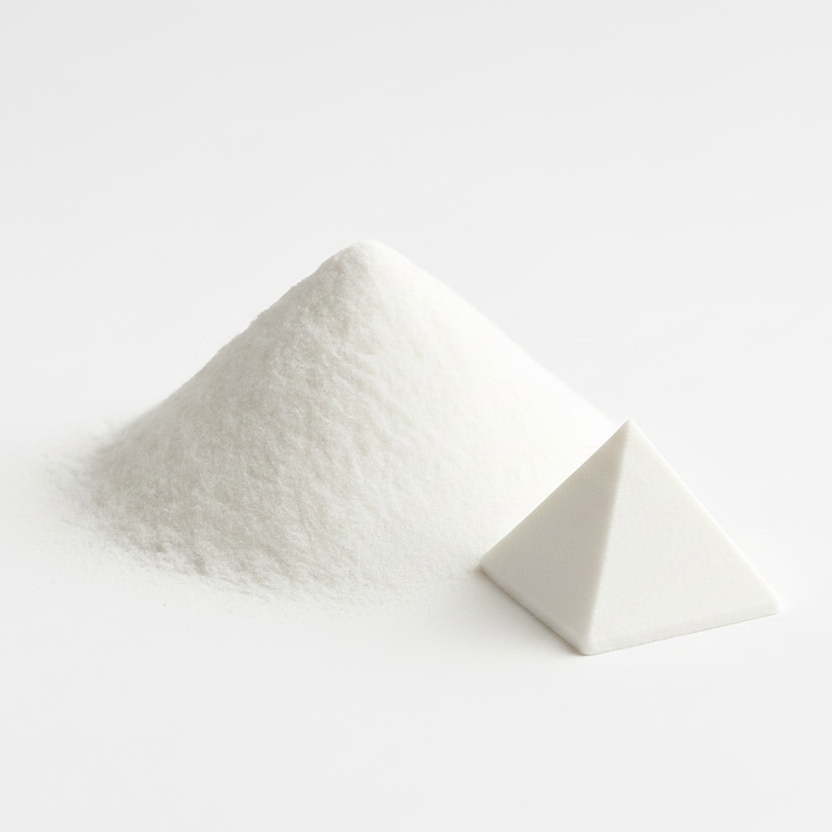
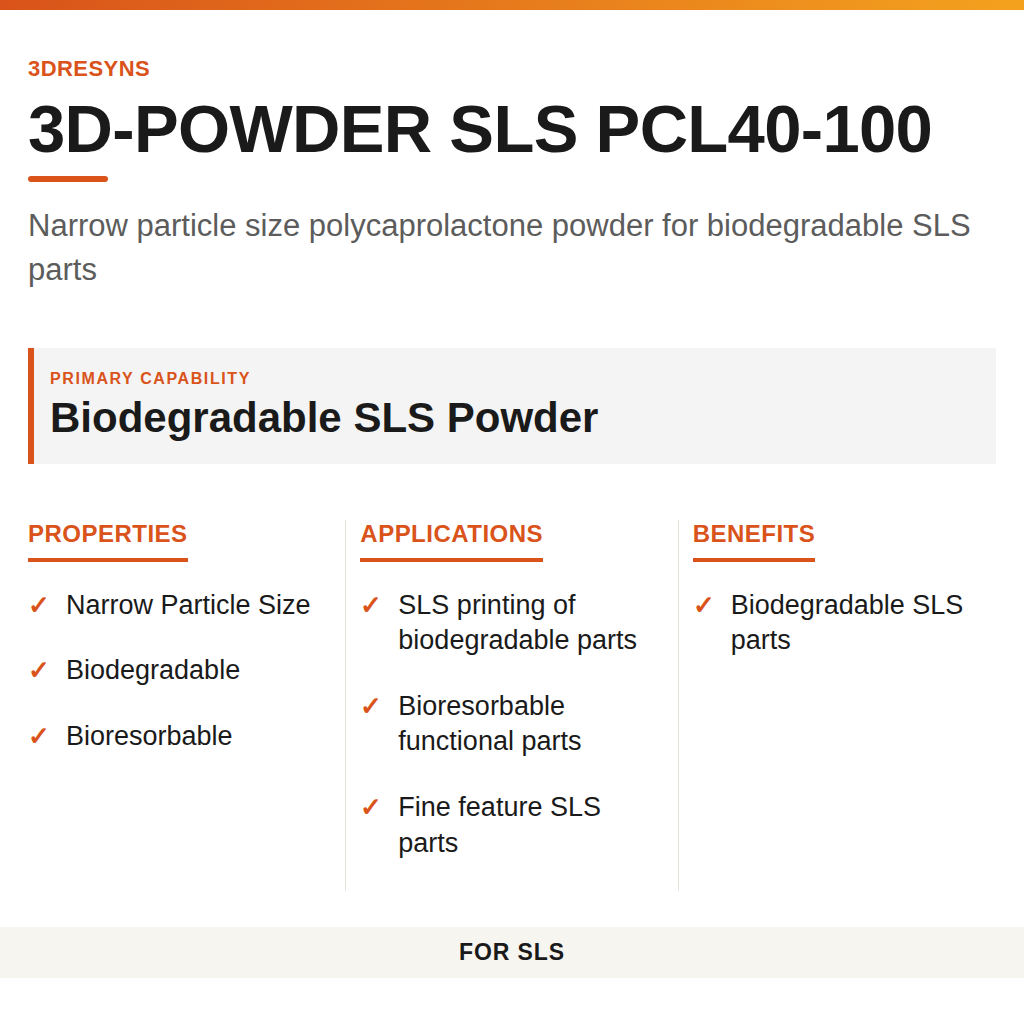
3D-POWDER SLS PCL40-100, narrow Particle Size Distribution Polycaprolactone PCL powder for ultra-low temperature cold SLS printing of flexible, biodegradable and bioresorbable parts
Product description
3D-POWDER SLS PCL40-100 is a narrow particle size distribution PolyCaproLactone (PCL) powder for Selective Laser Sintering SLS of flexible, biodegradable and bioresorbable functional parts at ultra-low processing temperature.
PCL is a semi-crystalline aliphatic polyester with an ultra-low melting temperature (around 60ºC), which makes it the lowest-melting functional SLS powder in the 3Dresyns range and ideal for cold, low-energy SLS printing on open printers with minimal or no bed heating. It is biocompatible, biodegradable and bioresorbable, degrading cleanly into carbon dioxide and water, and is widely used in biomedical, tissue-engineering and low-temperature prototyping applications.
Application framework
Designed for direct Selective Laser Sintering of functional PCL parts, where the printed part itself is made of PCL (unlike sacrificial binders, this powder remains in the final part). Its ultra-low melting temperature allows gentle, low-energy fusion on a cold or minimally heated bed. Typical fields are biomedical scaffolds, tissue engineering, drug-delivery carriers and low-temperature prototyping, where biocompatibility, flexibility and controlled bioresorption are required.
Typical applications
- SLS printing of flexible, biodegradable and bioresorbable PCL parts
- Biomedical scaffolds and tissue-engineering structures
- Drug-delivery carriers and controlled-release devices
- Low-temperature, low-energy SLS prototyping on printers with minimal or no bed heating
- Flexible, soft-touch functional parts where high elongation and toughness matter
Measured physical properties
- Polymer type: semi-crystalline aliphatic polyester PolyCaproLactone (PCL)
- Melting temperature: 58-65ºC (ISO 11357)
- Glass transition temperature: approximately -60ºC (ISO 11357)
- Density: 1.14 g/cm³ (ISO 1183)
- Maximum particle size: <150 microns
- Lowest melting temperature of the 3Dresyns SLS functional powder range, enabling cold low-energy SLS printing
- Thermal degradation well above the melting point (clean burnout to carbon dioxide and water)
- Resolution: up to 50 microns depending on the chosen particle size grade
Typical mechanical properties of the bulk polymer*
- Tensile strength: 16-26 MPa (ISO 527-2)
- Tensile modulus: approximately 400 MPa (ISO 527-2) — low modulus, flexible material
- Elongation at break: very high, typically >300% (ISO 527-2) — highly ductile
- Flexible, tough behaviour with high extensibility
- Biocompatible, biodegradable and bioresorbable; degrades into carbon dioxide and water
*Bulk-polymer reference values for the solid material; final SLS part properties depend on particle size, energy density, packing and printing parameters, and must be validated by the user for each application.
Functional performance characteristics
- Semi-crystalline thermoplastic that melts and coalesces under the laser at ultra-low temperature to build flexible, tough functional parts directly
- Lowest melting temperature in the 3Dresyns SLS functional powder range, allowing cold-bed, low-energy SLS printing on printers with limited heating capability
- Biocompatible, biodegradable and bioresorbable, suitable for biomedical scaffolds, tissue engineering and drug-delivery research
- High elongation at break and flexibility for soft, tough parts
- Clean thermal behaviour; degrades into carbon dioxide and water
- Soluble in common organic solvents for post-processing or secondary operations where required
- Narrow particle size distribution for uniform, reproducible layer fusion and resolution
Processing and handling performance
- Typical narrow particle size distribution in microns, not to be considered a specification:
- D100: 150 (100% of particles have less than 150 microns)
- D90: 100 (90% of particles have less than 100 microns)
- D50: 70 (50% of particles have less than 70 microns)
- D10: 40 (10% of particles have less than 40 microns)
- Recommended printing process: use a cold or minimally heated bed and a low laser energy dosage, as the powder melts at very low temperature (around 60ºC)
- Keep the powder cool and dry: PCL softens when warm, so store and handle below its melting point and verify the powder is dry before printing
- If over-melting occurs reduce energy dosage, laser power and/or scan speed, and/or keep the bed cooler
- If poor recoating or caking of the powder bed occurs, keep the powder cool and dry
- Use air jetting to clean the prints
- Recyclable: recover unfused powder by sieving and reuse by blending with fresh powder
- Recommended plastic or polymer powder SLS printers: SLS printer compatibility, any open mode plastic / polymer powder SLS printer can be used
- Follow the 3Dresyns IFU for SLS printing for calibration and parameter optimization
Chemical and safety characteristics
- PolyCaproLactone (PCL), semi-crystalline aliphatic polyester
- Biocompatible, biodegradable and bioresorbable
- Non-toxic; degrades into carbon dioxide and water
Testing & processing disclaimer
The reported properties may vary depending on part design and manufacturing practices. Final part properties, resolution, and printing behaviour depend on the chosen particle size grade, printer capability and processing parameters, and must be validated by the user. It is the manufacturer's responsibility to adjust the printing parameters and validate the suitability of the printed parts for the intended use. 3Dresyns makes no guarantee of properties, expressed or implied, regarding the accuracy of these results to be obtained from the use thereof. Standards: melting and glass transition temperature (ISO 11357), density (ISO 1183), tensile strength / tensile modulus / elongation at break (ISO 527-2).
Disclaimer
This material is supplied as a professional manufacturing material and is not marketed as a finished medical device. Although PCL is a biocompatible and bioresorbable polymer, any biomedical or medical-device use must satisfy the regulatory framework applicable to the finished device and must be validated by the user according to the intended application.
This technical datasheet should be used together with the relevant processing, calibration, safety and workflow documentation available in the 3Dresyns® Resources section.
Document reference: TDS-3D-POWDER-SLS-PCL-40-100-EN | Version: 1.0 | Last updated: May 2026
Choose options