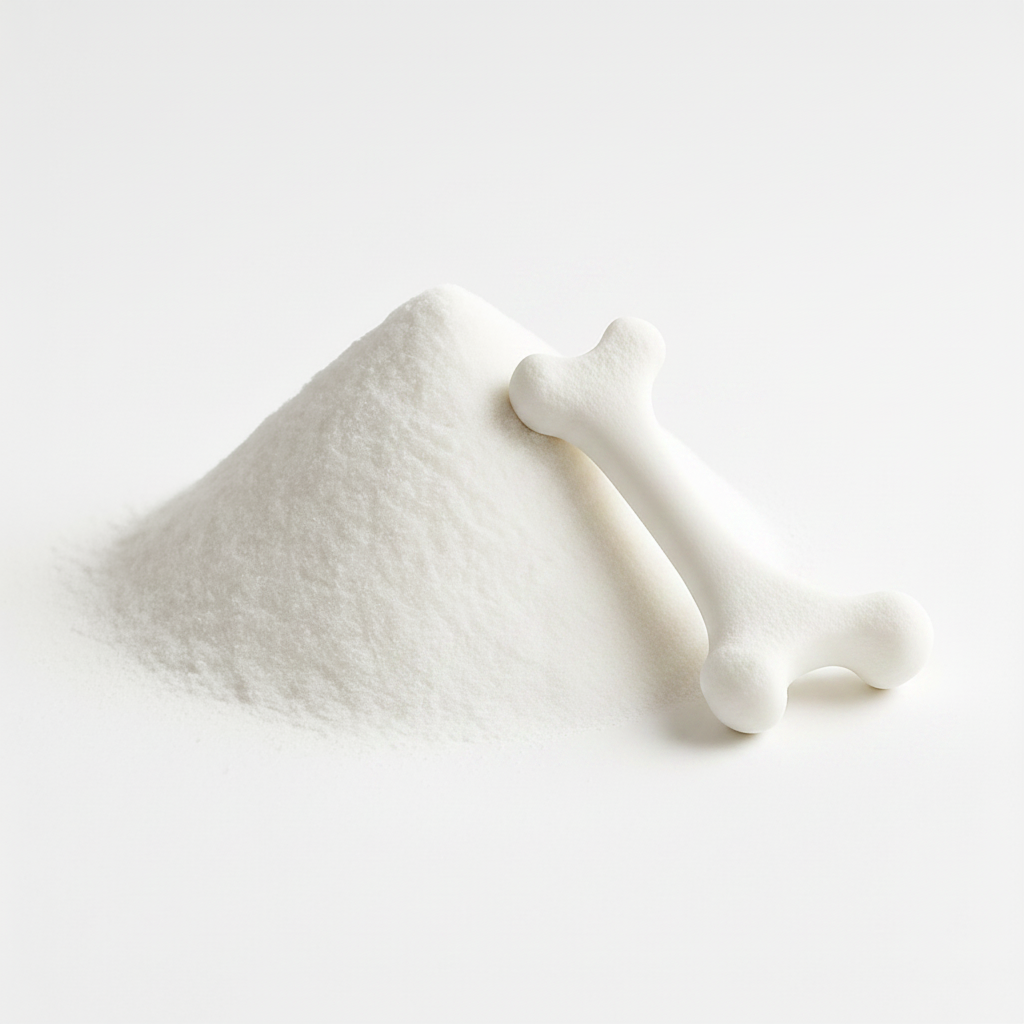
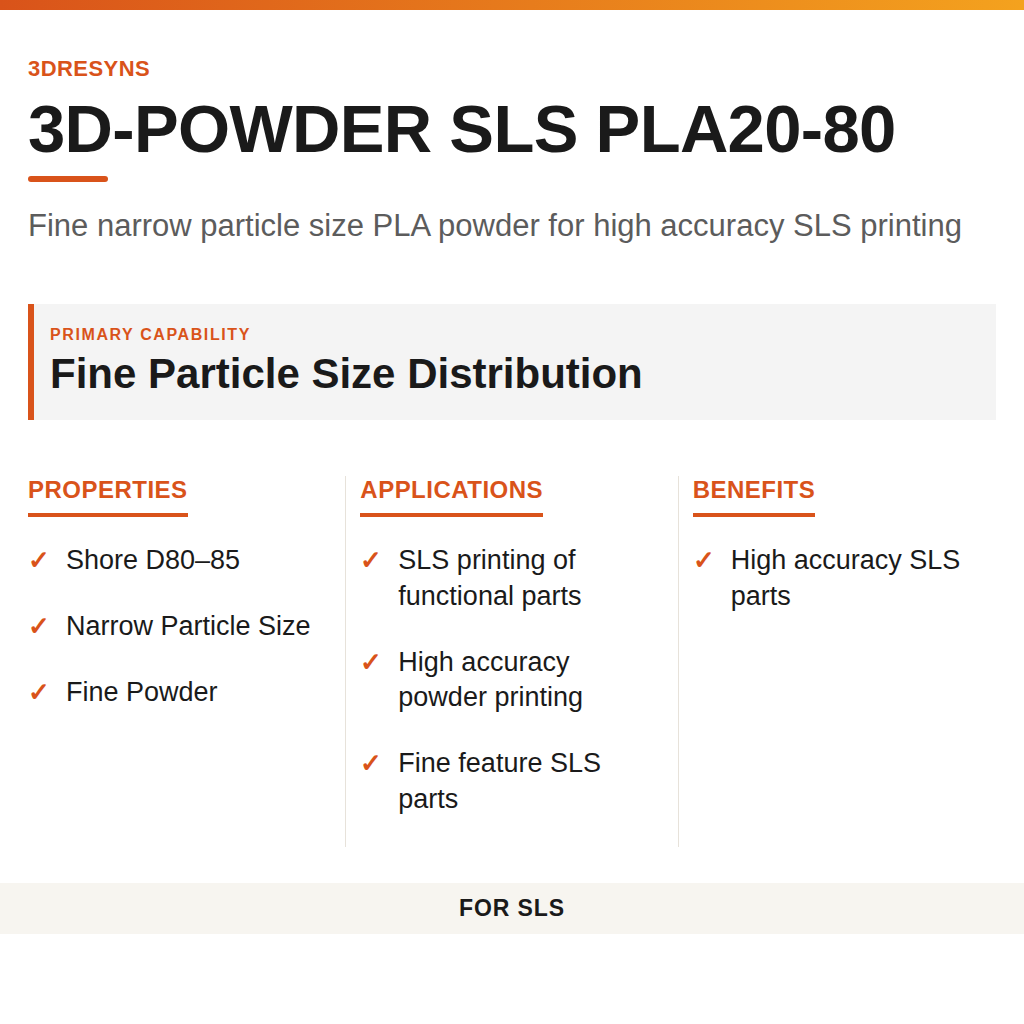
3D-POWDER SLS PLA20-80, fine & narrow particle size distribution Polylactic Acid PLA powder for high resolution SLS printing
Product description
3D-POWDER SLS PLA20-80 is a specifically designed fine and narrow particle size distribution polylactic acid PLA powder for SLS printing of high accuracy and resolution PLA printed parts.
This transparent SLS powder is designed for direct SLS printing of biodegradable, absorbable, resorbable, and biocompatible medical parts.
Application framework
Designed for selective laser sintering of PLA powder parts requiring high accuracy and high resolution, including biodegradable and biocompatible medical parts. Also suitable as a cobinder for Cold Metal Fusion, Cold Ceramic Fusion, Cold Polymer Fusion and Cold Exotic Powder Materials Fusion workflows.
Typical applications
- Direct SLS printing of biodegradable, absorbable, resorbable, and biocompatible medical parts
- High accuracy and high resolution SLS printed PLA parts
- Cold Metal Fusion, Cold Ceramic Fusion, Cold Polymer Fusion and Cold Exotic Powder Materials Fusion with 10% addition for low temperature debinding
Measured mechanical properties
- Tensile strength: 35-45 MPa (ISO 527-2)
- Flexural strength: 35-45 MPa (ISO 178)
- Young’s modulus: 3900-4100 MPa (ISO 527-2)
- Elongation at break: 2-3% (ISO 527-2)
- Shore hardness: D80-85 (ISO 868)
- Izod impact strength, notched: 15 J/m (ASTM D256 & ISO 180)
- Flexural modulus: 3500 MPa (ISO 178)
Measured physical properties
- Density: 1.25 g/cm³ (ISO 1183)
- Water absorption after 24 hours: <1% (ISO 62)
- Vicat softening temperature: 60-80ºC (ISO 306/B50)
- Melting temperature: 160-180ºC (ISO 11357)
- Coefficient of Friction COF-static: 0.45 (ISO 8295)
- Heat Deflection Temperature HDT at 1.8 MPa: 65-70ºC (ISO 75)
- Service temperature: from -20ºC up to 60ºC continuous
- High accuracy and resolution of final products: 50-100 microns depending on laser spot size and layer thickness
Functional performance characteristics
- Transparent SLS powder for direct SLS printing of biodegradable, absorbable, resorbable, and biocompatible medical parts
- Excellent bioactivity and osteogenesis
- Castable with excellent clean ash free burn-out
- Low thermal degradation temperature <360ºC
- Ideal cobinder for Cold Metal Fusion CMF
- Bio based from renewable source
- White thermoplastic SLS powder with superior biocompatibility
- Printable by most plastic / polymer powder SLS printers
- Similar properties and printing settings to Javil PLA 3110P Additive Powder
- Excellent flow and levelling
Processing and handling performance
- Typical narrow particle size distribution in microns, not to be considered a specification:
- D100: 90 (100% of particles have less than 90 microns)
- D90: 80 (90% of particles have less than 80 microns)
- D50: 60 (50% of particles have less than 60 microns)
- D10: 20 (10% of particles have less than 20 microns)
- D1: 2 (1% of particles have less than 2 microns)
- Recommended plastic or polymer powder SLS printers: SLS printer compatibility
- Recommended printing process: use the standard printing parameters of your equivalent polymer powder and follow 3Dresyns IFU for SLS printing
- Starting point printing settings: scan speed 2000 mm/s, scan spacing 0.1 mm, layer thickness 150 microns, laser power 7 W, laser type CO2 laser, build chamber temperature 100-105°C
- For Cold Metal Fusion, Cold Ceramic Fusion, Cold Polymer Fusion, and Cold Exotic Powder Materials Fusion, add 10% of 3D-POWDER SLS PLA20-80 for low temperature debinding at 360ºC
- For more information read About Cold Metal Fusion CMF, Cold Ceramic Fusion CCF, and Cold Exotic Powders Fusion CEPF
- Additional related resource: Powder Binders for SLS Cold Metal, Ceramic & Exotic Powder Fusion
Chemical and safety characteristics
- Polylactic acid PLA powder
- Bio based from renewable source
- Biodegradable, absorbable, resorbable, and biocompatible
Testing & processing disclaimer
The reported properties may vary depending of part design and manufacturing practices. It is the manufacturer’s responsibility to adjust the printing parameters and validate the suitability of the printed parts for the intended use. 3Dresyns makes no guarantee of properties, expressed or implied, regarding the accuracy of these results to be obtained from the use thereof.
Disclaimer
This material is supplied as a professional manufacturing material and is not marketed as a finished medical device. Final part performance and suitability must be validated by the user according to the intended application.
This technical datasheet should be used together with the relevant processing, calibration, safety and workflow documentation available in the 3Dresyns® Resources section.
Document reference: TDS-3D-POWDER-SLS-PLA20-80-EN | Version: 1.0 | Last updated: March 2026
Choose options