
Dispersants
Dispersants for photopolymer 3D resins, developed to improve wetting, powder dispersion, formulation stability and printability in filled and composite resin systems.
3Dresyns® dispersants in this collection are positioned for pigment-, filler-, ceramic-, metal- and composite-oriented workflows where stable, high-quality dispersions are critical for reliable processing and repeatable results.
Navigate by: general-purpose dispersant route, fast-curing dispersant route, water- and solvent-soluble route and composite formulation logic.
This collection includes dispersants designed to improve wetting, stabilize pigments and powders, reduce sedimentation risk and support better printability in filled photopolymer resin systems.
These materials are especially relevant in ceramic, metal, pigment and advanced composite workflows where dispersion quality strongly affects viscosity, flow, stability, layer formation and final process repeatability.
Key features & benefits
Choose your dispersant route
Use the routes below to navigate the collection by formulation logic, curing behavior and media compatibility.
- Improved dispersion of fillers, pigments, ceramics and metals.
- Reduced sedimentation risk and increased formulation stability.
- Better flow and printability in filled and composite resin systems.
- Improved consistency and repeatability for composite resin workflows.
- Support for high-solid dispersions and advanced materials development.
Typical applications
Typical use scenarios across the collection
This collection is suitable for workflows where dispersion quality is a key formulation variable rather than a secondary adjustment.
- Filled resin formulations: improving wetting, flow and stability of particle-loaded systems.
- Ceramic and metal composite systems: supporting higher solids content with better processability.
- Pigment dispersion: improving color concentrate quality and low-dosage pigment incorporation.
- Stability-focused development: reducing sedimentation and improving storage or process robustness.
- High-performance composite R&D projects: tuning dispersion quality for demanding additive manufacturing applications.
Why choose this collection
How to choose the right dispersant route
Select the most suitable route according to whether the main objective is broad general use, faster and harder photoreactivity, or compatibility with water- and solvent-soluble systems.
- Need a broad general-purpose reactive dispersant → choose 3D-ADD Disper-All1
- Need a faster-curing and harder reactive dispersant → choose 3D-ADD Disper-All2
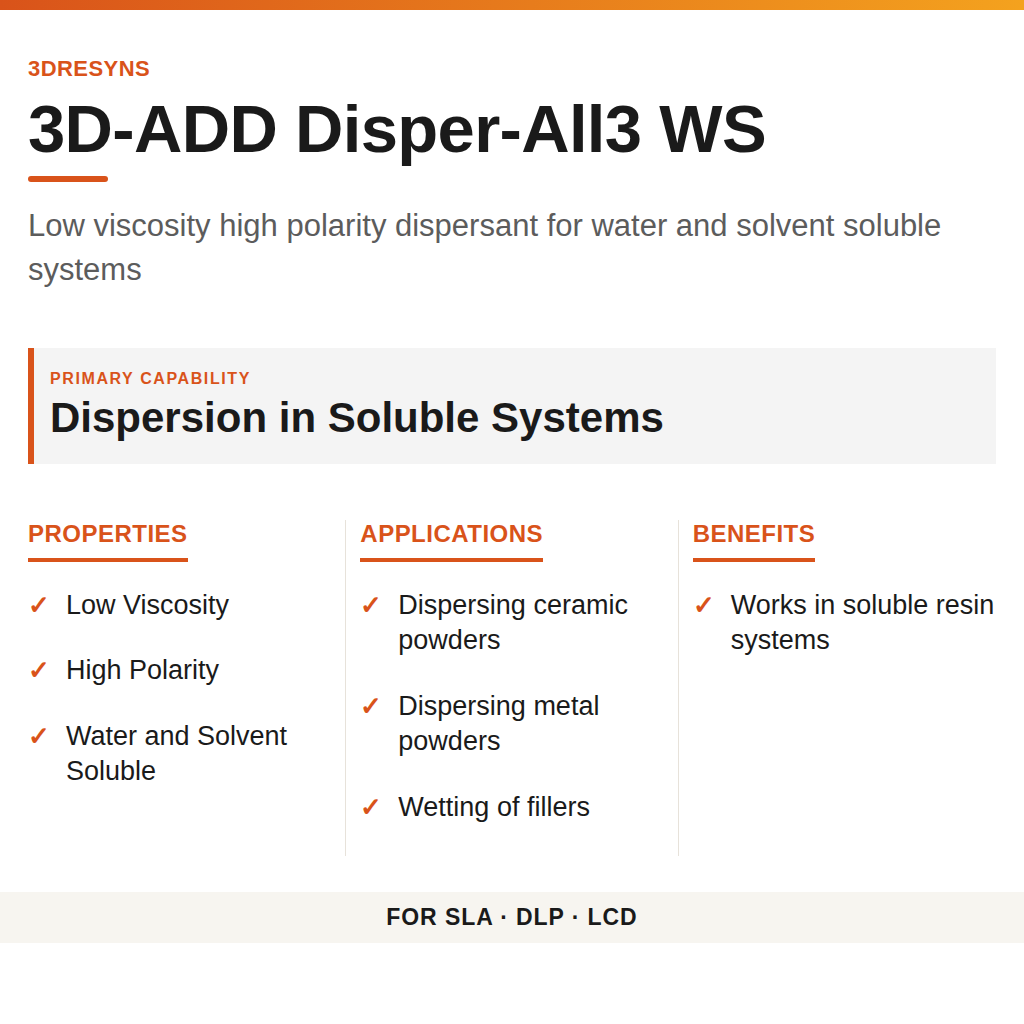
- Need a non-photoreactive option for water- and solvent-soluble systems → choose 3D-ADD Disper-All3 WS
- Need high solids loading with good flow → compare the route against your powder type, polarity and target solids content
- Prioritise softer and slower reactive behavior → start with Disper-All1
- Prioritise faster and harder reactive behavior → start with Disper-All2
- Prioritise water/solvent compatibility or conductive / high-polarity systems → start with Disper-All3 WS
Decision tree summary
Use this simplified logic before moving into detailed slurry or composite-formulation validation.
- Need a reactive general-use dispersant → Disper-All1
- Need a reactive dispersant with faster curing response → Disper-All2
- Need a non-photoreactive dispersant for water- or solvent-soluble systems → Disper-All3 WS
- Need very high solids loading or special powder compatibility → validate the route under the intended powder family, loading and process conditions
Then confirm the final route under the intended resin family, solids fraction, powder morphology, viscosity target and qualified printing workflow.
Products in this collection
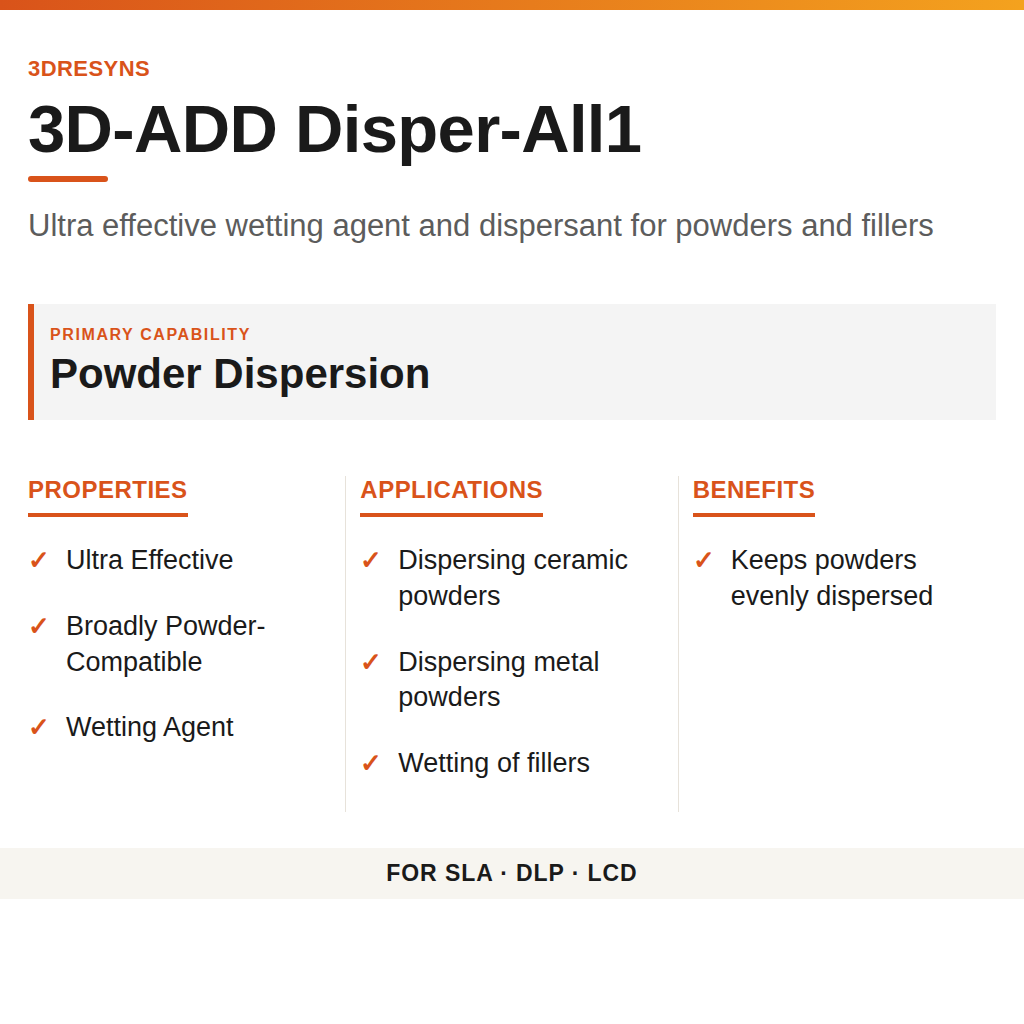
Broad-use reactive dispersant for powders, pigments, ceramics and metals
For workflows requiring a general-use ultra-effective wetting agent and dispersant across a broad range of organic, inorganic, ceramic and metal nano- and micro-powders.
- General-usage ultra-effective wetting agent and dispersant.
- Suitable for organic, inorganic, ceramic and metal nano- and micro-powders.
- Supports ultra-high-concentration dispersions with good flow.
- Optimum dosage below 10% of total resin solids for highly concentrated slurries.
- Optimum dosage below 1% of total resin solids for low-dosage pigment dispersion.
- Bio-based, biodegradable and positioned as a slower and softer photoreactive route versus Disper-All2.
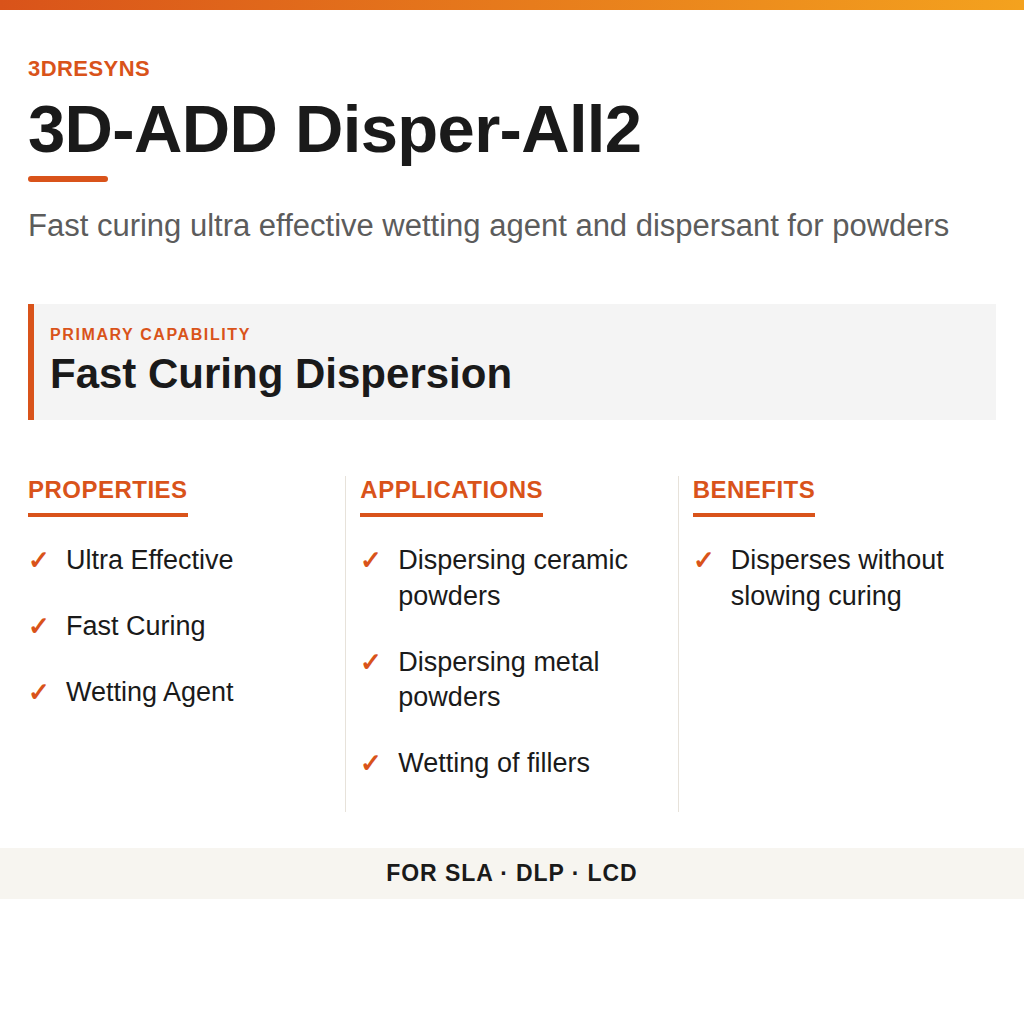
Fast-curing reactive dispersant for filled and composite resin systems
For workflows requiring a reactive dispersant with faster and harder photoresponse while keeping very strong wetting and dispersion capability.
- Ultra-effective wetting agent and dispersant for broad powder families.
- Functionalized to react fast with light.
- Bio-based and biodegradable.
- Supports ultra-high-concentration dispersions with good flow.
- Optimum dosage below 10% of total resin solids for concentrated slurries.
- Optimum dosage below 1% of total resin solids for low-dosage pigment dispersion.
- Positioned as an ultra-fast and harder photoreactive route versus Disper-All1.
Non-photoreactive dispersant for water- and solvent-soluble systems
For workflows requiring a high-polarity dispersant designed for water- and solvent-soluble resin systems, including certain conductive formulations.
- Low-viscosity, high-polarity dispersant for water- and solvent-soluble resin systems.
- Suitable for high-polarity systems and conductive 3D resins.
- Non-photoreactive route.
- Optimum dosage between 1% and 10% on powder solids for pigments, fillers, ceramics and metals.
- Supports very high powder loading by weight with good flow for suitable low-oil-absorption powders, wires and fibers.
- Water and solvent soluble, with certain turbidity at high dosage.
- Biodegradable and supplied as a kit like the other Disper-All routes.
Technical overview table
Workflow-dependent dispersion performance
Final wetting efficiency, solids loading capacity, viscosity profile, sedimentation resistance and printability depend on the interaction between the selected dispersant route, the base resin, powder surface chemistry, particle size distribution, additive loading and curing conditions.
Successful implementation therefore requires alignment between powder family, formulation polarity, dispersant route, solids target and qualified printing workflow.
| Material | Primary role | Core concept | Photoactivity | Loading logic | Typical positioning | Target workflow |
|---|---|---|---|---|---|---|
| 3D-ADD Disper-All1 | Reactive dispersant | Broad-use wetting and dispersing route for powders, pigments, ceramics and metals | Reactive; slower and softer versus Disper-All2 | Typically below 10% of total resin solids for concentrated slurries; below 1% for low-dosage pigments | General composite formulation, pigment concentrates, ceramic and metal-filled resin development, high-detail filled systems | SLA / DLP / LCD / Inkjet workflows requiring broad compatibility and stable filled formulations |
| 3D-ADD Disper-All2 | Fast reactive dispersant | Fast-curing wetting and dispersing route for powders, pigments, ceramics and metals | Reactive; ultra-fast and harder versus Disper-All1 | Typically below 10% of total resin solids for concentrated slurries; below 1% for low-dosage pigments | Filled systems needing strong dispersion plus faster and harder photoreactive response | SLA / DLP / LCD / Inkjet workflows where faster reactive behavior is preferred |
| 3D-ADD Disper-All3 WS | Water / solvent dispersant | High-polarity dispersant for water- and solvent-soluble systems, including certain conductive routes | Non-photoreactive | Typically 1-10% on powder solids; validate against polarity, turbidity and loading target | Water-soluble and solvent-soluble formulations, conductive 3D resins, very high weight-fraction powder dispersions | High-polarity SLA / DLP / LCD / Inkjet formulation workflows for powders, wires and fibers |
Mobile: scroll horizontally to view all columns. The first column remains visible while scrolling.
Portfolio overview
A focused dispersion platform rather than a generic additives page
This collection is compact and clearly structured around three complementary dispersant routes: a broad general reactive route, a faster reactive route and a dedicated water/solvent-soluble route.
- 3D-ADD Disper-All1 covers the general-purpose reactive route.
- 3D-ADD Disper-All2 covers the faster-curing reactive route.
- 3D-ADD Disper-All3 WS covers water- and solvent-soluble systems.
- Together, they support dispersion design across standard, high-reactivity and high-polarity composite formulation targets.
Workflow note
The right dispersant route depends on the powder system and process target
These materials are most useful when the formulation objective is defined first: higher solids loading, better pigment wetting, lower sedimentation, faster reactive behavior or compatibility with water/solvent-soluble systems.
In practice, the correct path is to define the final slurry or composite objective first, then validate the chosen route under the intended resin family, powder chemistry, additive loading and exposure conditions.
Technical and commercial support
Documentation, technical selection help and workflow support
Use the resources below to move from dispersant preselection to formulation planning, slurry validation or broader technical support.
Final CTA
Select the right dispersant route and validate the final composite formulation
Use the route-based navigation above to identify the most relevant dispersant workflow, compare candidates in the technical overview table, and move forward with formulation-specific validation for better wetting, improved stability and more reliable filled-resin processing.
Related additive routes
Explore closely related 3Dresyns collections
Use these links to move between closely related material, process or formulation families in the 3Dresyns catalogue.
Sort by

From prototyping to industrial production, performance depends on materials, calibration and process control