
Direct printing of sintering ceramics, metals, and exotic materials
Direct-printing resin systems for sintering ceramics, metals and exotic materials through powder-loaded green-part fabrication, controlled debinding and final thermal conversion.
3Dresyns® materials in this collection are positioned for print-to-sinter workflows where wetting, dispersion, powder loading, debinding behaviour and dimensional control must work together as one engineered system.
Navigate by: debinding logic, water solubility, powder compatibility and target sintering workflow.
This collection groups 3Dresyns® materials for direct printing of ceramic, metal, polymer and exotic powder-loaded green bodies intended for debinding and sintering workflows.
Material selection should be aligned with debinding route, thermal window, powder type, solids loading, shrinkage control and the final functional target of the sintered part.
Key features & benefits
Choose your direct-printing sintering route
Use the routes below to navigate the collection by debinding logic and powder-processing strategy.
- Print-to-sinter material concepts for ceramic, metal and exotic-filled workflows.
- Compatibility with green-part fabrication, debinding and sintering development.
- Support for micron, submicron and selected nano-powder loaded routes depending on system.
- Useful for R&D, technical prototypes and validation of sintered end-use properties.
Typical applications
Typical use scenarios across the collection
This collection is relevant for teams developing powder-loaded vat photopolymerization workflows where the printed part is an intermediate green body that will be debound and thermally converted.
- Ceramic and metal R&D: development of printable formulations and process windows for sintering routes.
- Green-part printing: fabrication of powder-loaded parts with controlled geometry before debinding and firing.
- Debinding and sintering development: optimisation of removal strategy, shrinkage control and thermal conversion sequence.
- Technical prototypes: high-resolution parts for materials validation before industrial scale-up.
- Advanced materials validation: exploration of sintered end-use properties in ceramic, metal, polymer and exotic powder systems.
Why choose this collection
How to choose the right direct-printing sintering material
Select the most suitable route according to powder compatibility, debinding strategy and target process constraints.
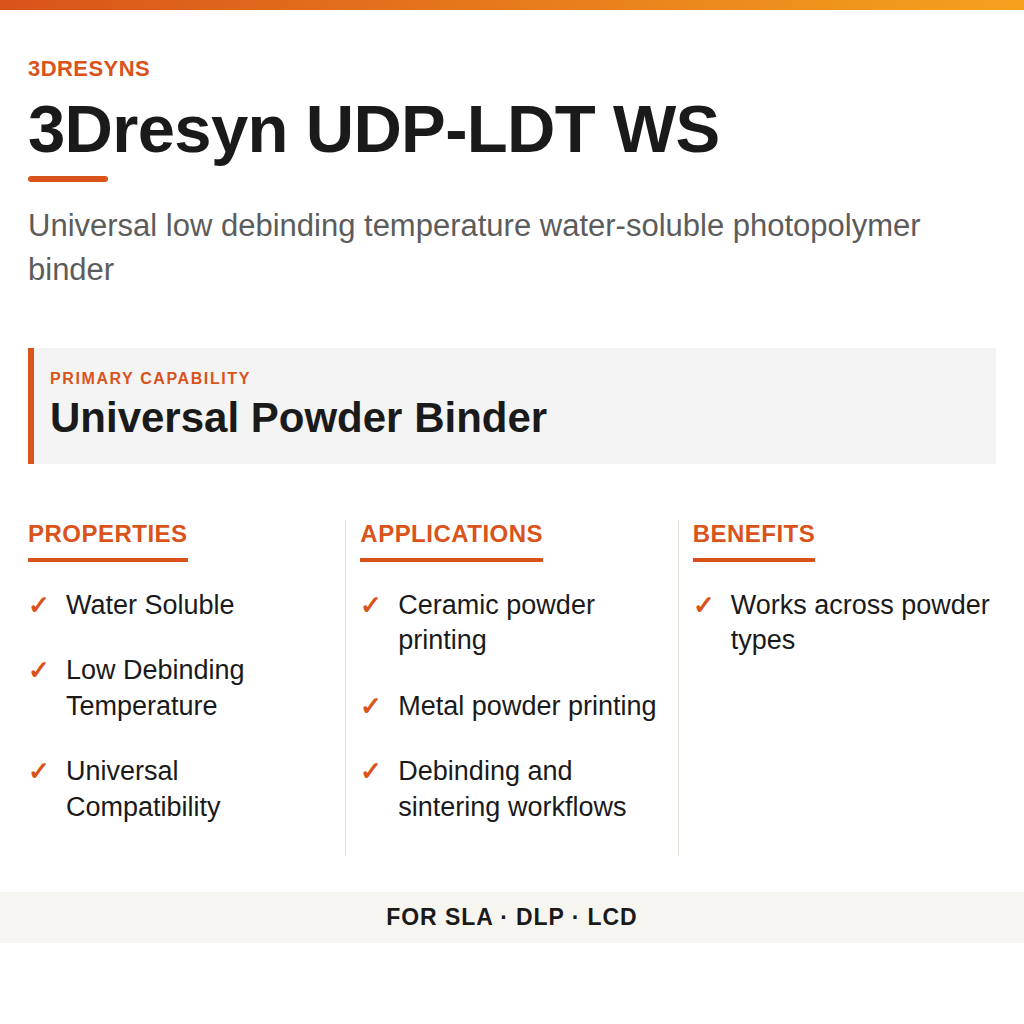
- Need a universal low-debinding-temperature and water-soluble route → 3Dresyn UDP-LDT WS
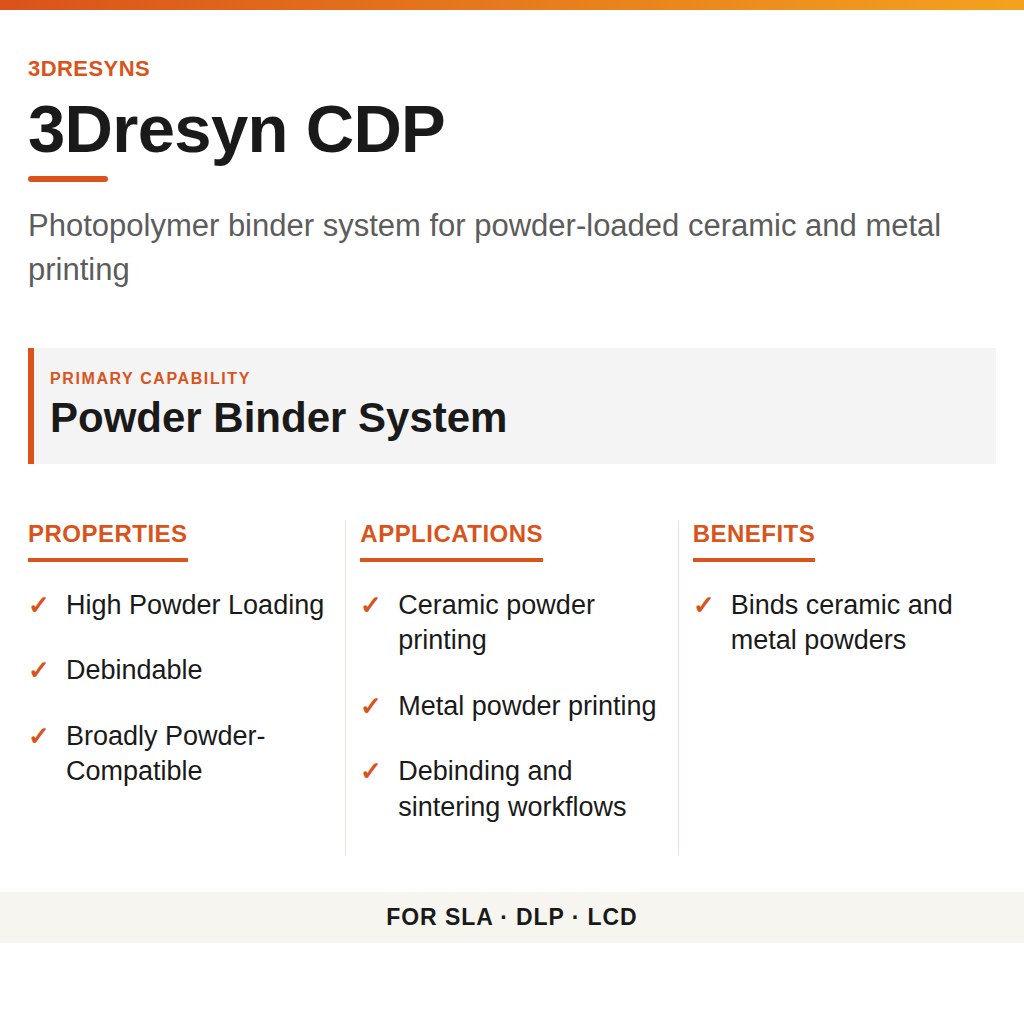
- Need a direct-printing base system with broad powder compatibility → 3Dresyn CDP
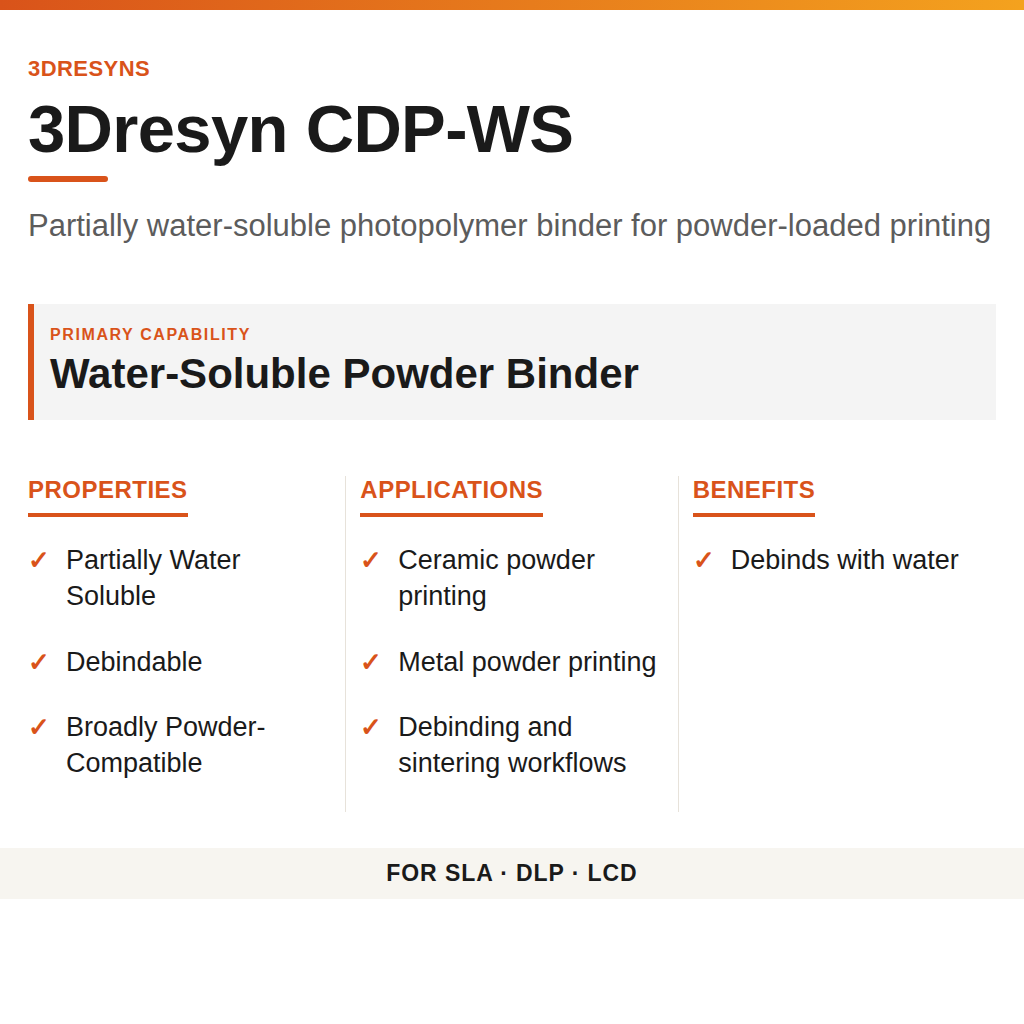
- Need controlled water solubility with structural stability → 3Dresyn CDP-WS
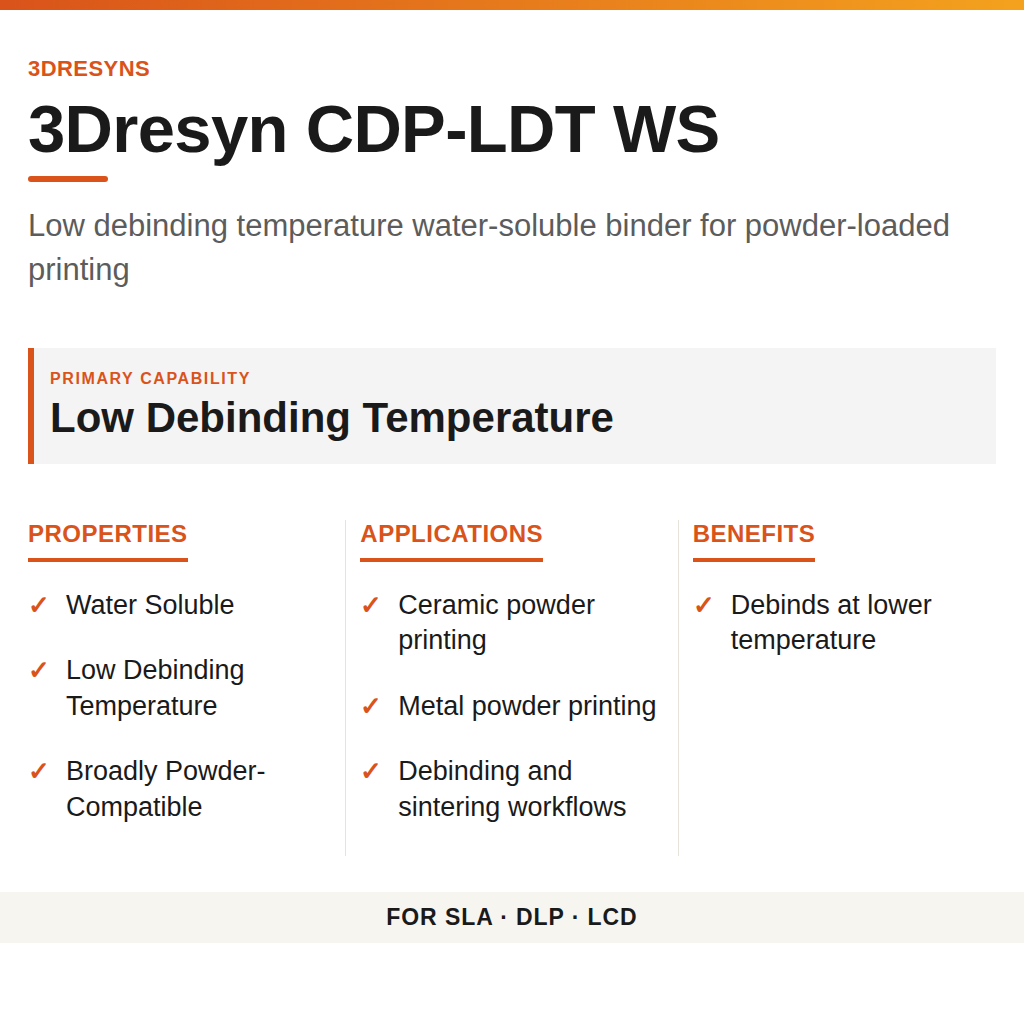
- Need combined water solubility and accelerated low-temperature debinding → 3Dresyn CDP-LDT WS
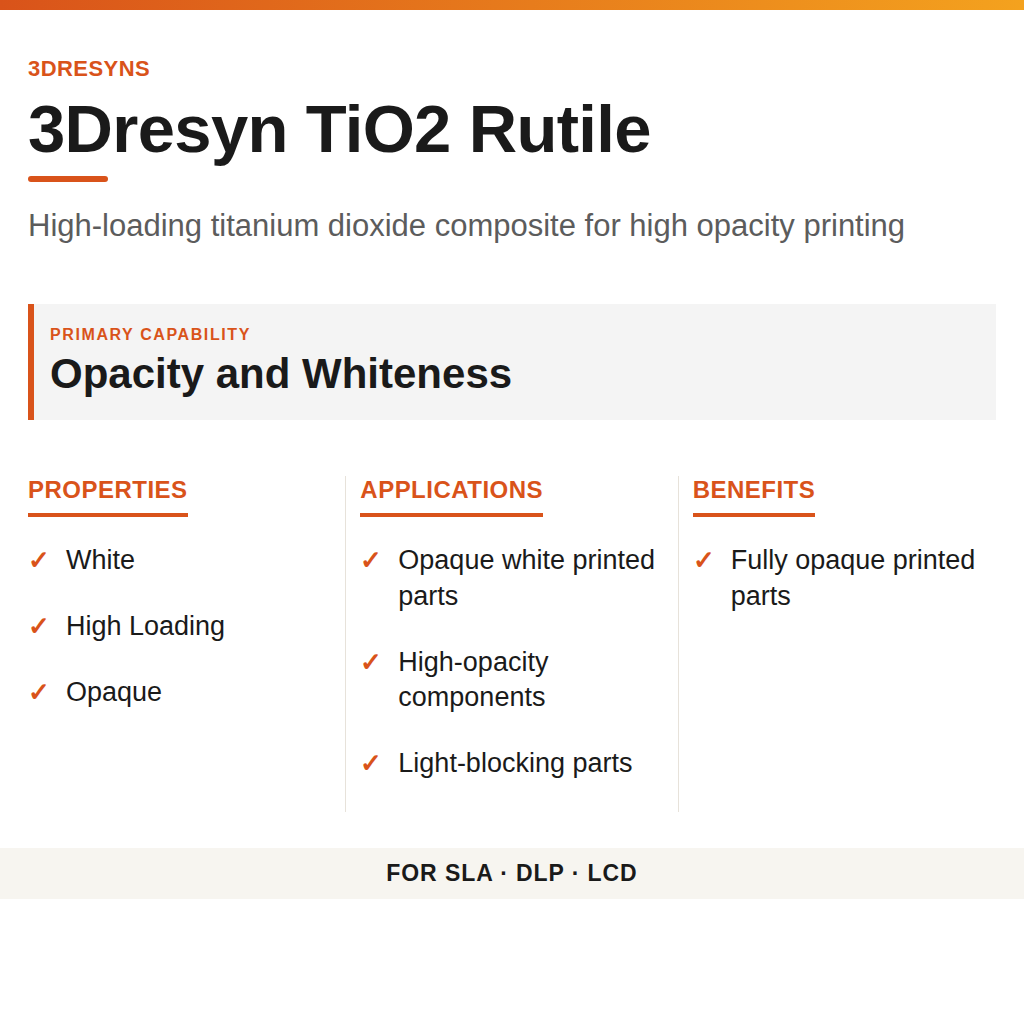
- Need a highly opaque ceramic-filled white route → 3Dresyn TiO2 Rutile
- Prioritise lower debinding temperature → evaluate UDP-LDT WS or CDP-LDT WS
- Prioritise water-assisted debinding → evaluate the WS routes
- Prioritise general powder wetting and high solids loading flexibility → start with CDP or UDP-LDT WS depending on thermal logic
Decision tree summary
Use this simplified engineering logic before detailed formulation and furnace validation.
- Need broad ceramic / metal / polymer / exotic compatibility with lower-temperature debinding → UDP-LDT WS
- Need a standard direct-printing powder-loaded binder matrix → CDP
- Need water-soluble debinding support → CDP-WS
- Need water-soluble plus low-temperature debinding logic → CDP-LDT WS
- Need opaque TiO2-loaded white parts or ceramic-style masking route → TiO2 Rutile
Then validate the final route under the intended solids content, particle size, printer settings, debinding medium, thermal ramp and sintering cycle.
Products in this collection
Universal low-debinding-temperature water-soluble route
For broad powder-loaded workflows where low-temperature debinding and water-assisted removal are important for green-part processing and subsequent sintering.
Direct-printing base binder system
For ceramic, metal, polymer and exotic powder-loaded formulations requiring strong wetting, dispersion and a stable direct-printing route for green-body fabrication.
Controlled water-soluble direct-printing route
For workflows that need partial water solubility to support debinding while preserving sufficient green-body stability during handling and thermal processing.
Low-debinding-temperature water-soluble route
For powder-loaded workflows where accelerated debinding through combined water solubility and lower-temperature decomposition is strategically useful.
Ultra-white TiO2-loaded route
For high-opacity white parts, optical masking elements and selected ceramic-loaded photopolymer workflows requiring strong whiteness and opacity.
Technical overview table
Workflow-dependent performance
Powder wetting, dispersion, solids loading, green strength, debinding rate, shrinkage and final sintering result depend on the interaction between resin system, powder type, particle size, solids fraction, printer settings and thermal processing protocol.
Successful implementation therefore requires alignment between material selection, powder formulation, printing parameters, debinding method and qualified sintering schedule.
| Material | Debinding logic | Core profile | Typical behaviour | Typical positioning | Target workflow |
|---|---|---|---|---|---|
| UDP-LDT WS | Low debinding temperature + water soluble | Universal powder-loaded route | High wetting, strong dispersion, fast debinding and good flow | Broad ceramic, metal, polymer and exotic powder workflows with lower-temperature debinding needs | Direct printing, debinding and sintering of powder-loaded green parts |
| CDP | Standard debinding window | Base photopolymer binder system | Excellent wetting, dispersion and flow with high powder loading support | General direct-printing route for ceramic, metal, polymer and exotic powders | Powder-filled green bodies for debinding and sintering |
| CDP-WS | Water soluble | Water-assisted debinding route | Controlled water solubility with maintained structural stability | Workflows needing water-assisted debinding without losing dimensional integrity too early | Direct printing, debinding and sintering of powder-loaded green parts |
| CDP-LDT WS | Low debinding temperature + water soluble | Accelerated debinding route | Efficient dispersion, high powder loading and lower-temperature debinding behaviour | Powder systems benefiting from combined water solubility and thermal decomposition at lower temperature | Direct printing, debinding and sintering of powder-loaded green parts |
| TiO2 Rutile | Debindable composite matrix | High-opacity TiO2-filled resin | Ultra-white, opaque and stable particle dispersion | Optical masking, white ceramic-style parts and high-opacity components | Vat photopolymerization with optional subsequent thermal processing |
Mobile: scroll horizontally to view all columns. The first column remains visible while scrolling.
Portfolio overview
A sintering-development platform rather than a single green-body resin
This collection is structured around different debinding and powder-processing logics so users can choose a route that better matches powder family, thermal sensitivity and processing strategy.
- UDP-LDT WS adds a more universal low-debinding and water-soluble route.
- CDP provides the core direct-printing powder-loaded binder logic.
- CDP-WS introduces controlled water-soluble behaviour.
- CDP-LDT WS combines water solubility and lower-temperature debinding.
- TiO2 Rutile extends the portfolio toward opaque ceramic-loaded white applications.
Workflow note
The right route depends on the full green-body-to-sinter chain
These materials should be selected as part of a complete system, not only by resin name. Final results depend on powder identity, solids loading, particle morphology, wetting quality, printing parameters, debinding route and sintering cycle.
In practice, the correct path is to choose the debinding logic first, then validate powder dispersion, shrinkage behaviour and thermal conversion under the intended process window.
Technical and commercial support
Documentation, technical selection help and custom development support
Use the resources below to move from route preselection to formulation guidance, workflow validation or project-specific development support.
Final CTA
Select the right print-to-sinter route and validate the full thermal workflow
Use the debinding- and process-based navigation above to identify the most relevant direct-printing system, compare candidates in the technical overview table, and move forward with powder-specific validation for ceramic, metal or exotic sintering workflows.
Before choosing direct AM: Compare direct vs indirect routes →
Related powder and sintering routes
Explore closely related 3Dresyns collections
Use these links to move between closely related material, process or formulation families in the 3Dresyns catalogue.
Sort by
From prototyping to industrial production, performance depends on materials, calibration and process control