
Reactive bio diluents
Reactive bio diluents for controlled viscosity adjustment and process optimization of photopolymer resins used in SLA, DLP and LCD 3D printing.
3Dresyns® reactive diluents in this collection are designed to support formulation tuning, improve resin handling and adapt printability to different printer conditions, temperature windows and application requirements.
Navigate by: mechanical contribution, viscosity-reduction logic and workflow objective.
This collection includes 3Dresyns® 3D diluents developed to adjust viscosity and processing behaviour of photopolymer resins used in SLA, DLP and LCD 3D printing.
These solutions are positioned to support formulation tuning, flow adaptation, recoating optimisation and process stability while maintaining consistent curing behaviour and repeatable printing outcomes.
Key features & benefits
Choose your reactive diluent family
Use the routes below to navigate the collection by the type of behaviour you want the diluent to contribute to the final formulation.
- Controlled viscosity reduction for SLA, DLP and LCD resin formulation workflows.
- Support for improved resin flow, recoating behaviour and processing stability.
- Behaviour-specific reactive diluent options, from rigid and hard to foldable and elastic.
- Useful for industrial, dental, medical and research users seeking customized resin performance.
Typical applications
Typical use scenarios across the collection
This collection is relevant for users fine-tuning resin processability and final behaviour under demanding formulation or printing conditions.
- High-resolution printing: lowering viscosity to improve fine-feature formation and smoother recoating.
- Filled or high-viscosity formulations: improving flow and handling where resin movement is otherwise limited.
- Printer-specific optimisation: adapting resin behaviour to different SLA, DLP and LCD platforms.
- Process stability tuning: improving consistency, repeatability and handling across print cycles.
- Custom resin development: adjusting viscosity, wavelength response, functionality or application-specific formulation targets.
Why choose this collection
How to choose the right reactive diluent
Select the most suitable route according to the formulation behaviour you want to introduce while reducing viscosity in a controlled manner.
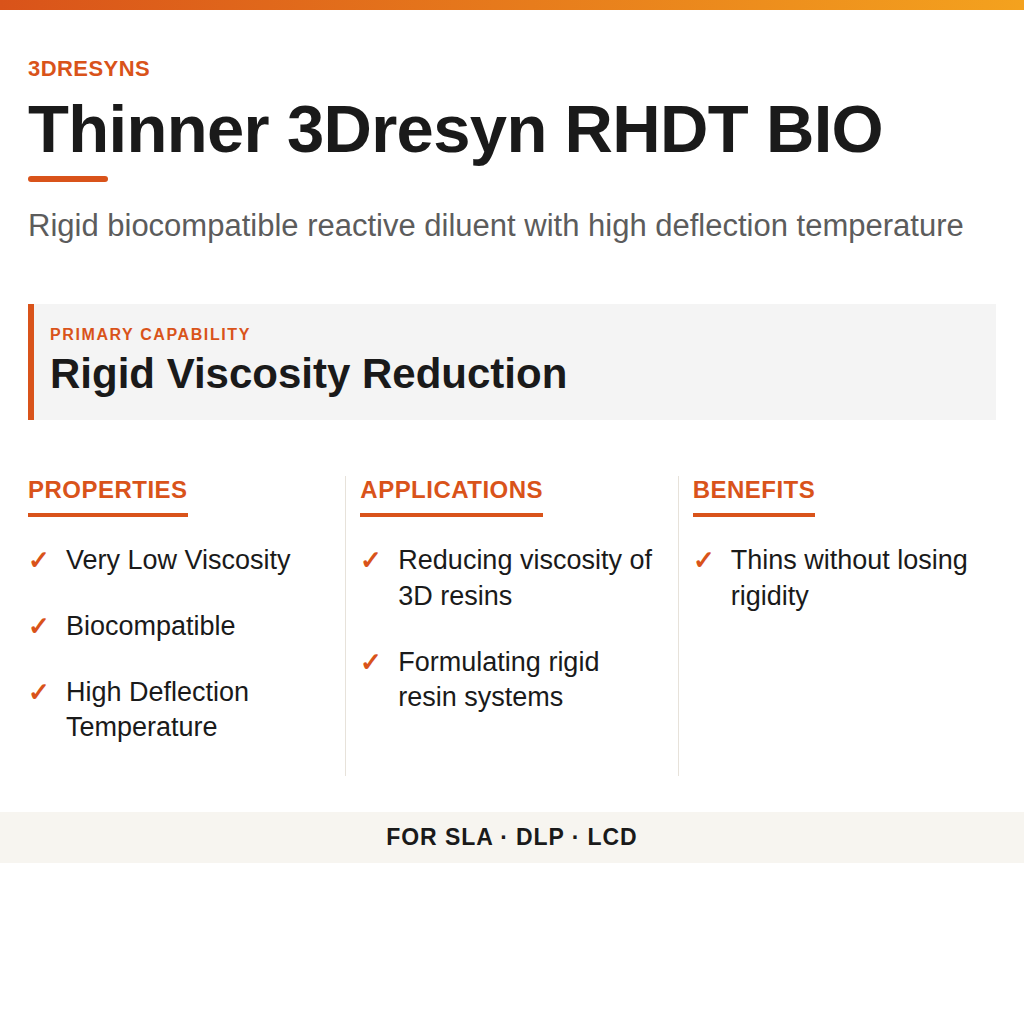
- Need rigid viscosity reduction with higher heat-resistance contribution → Thinner 3Dresyn RHDT Bio
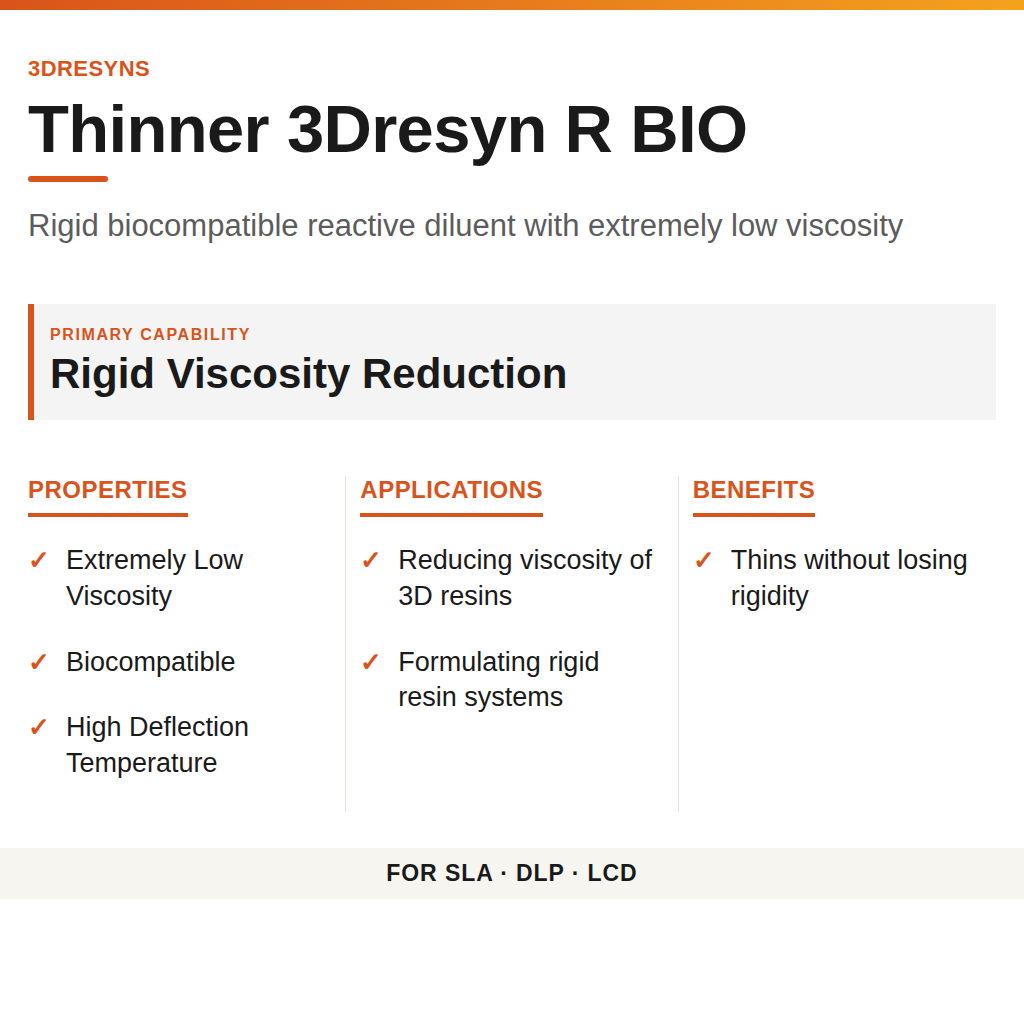
- Need rigid behaviour without the stronger HDT positioning → Thinner 3Dresyn R Bio
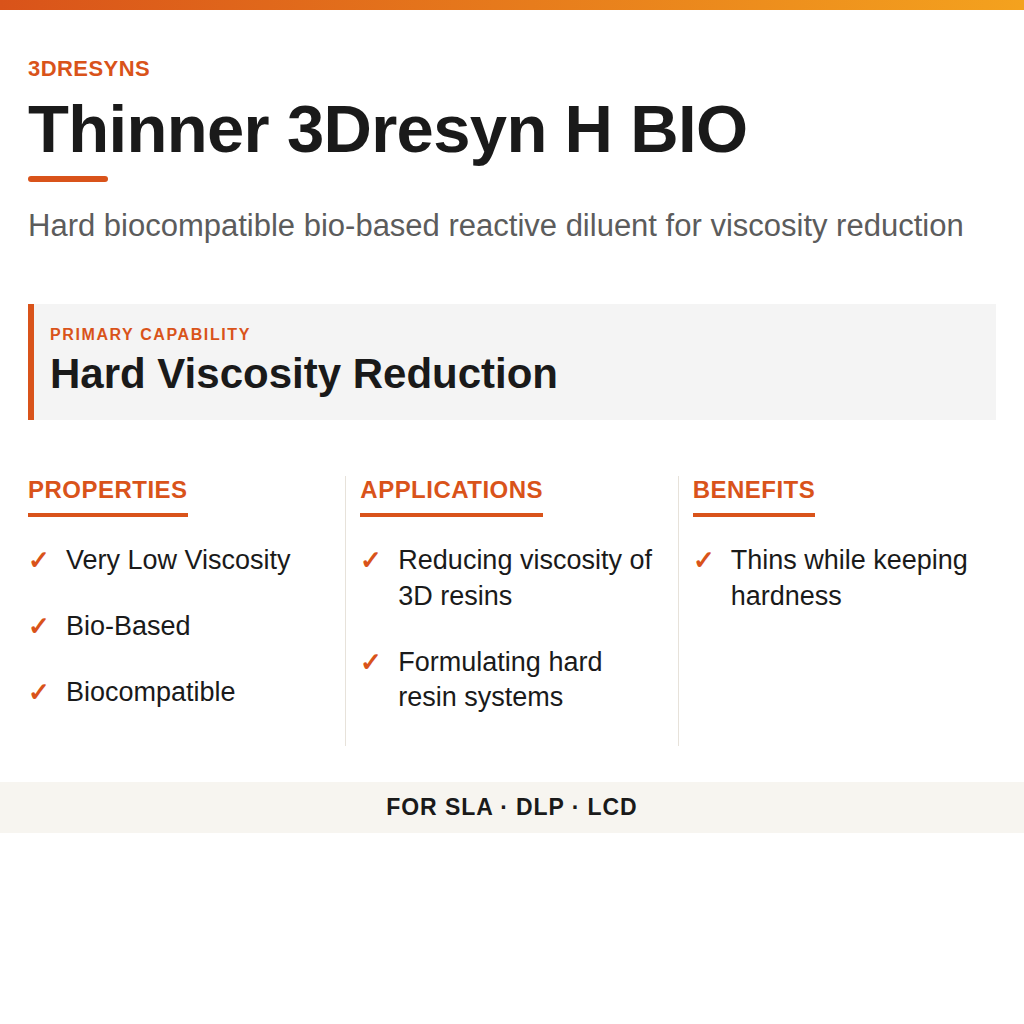
- Need hard behaviour → Thinner 3Dresyn H Bio
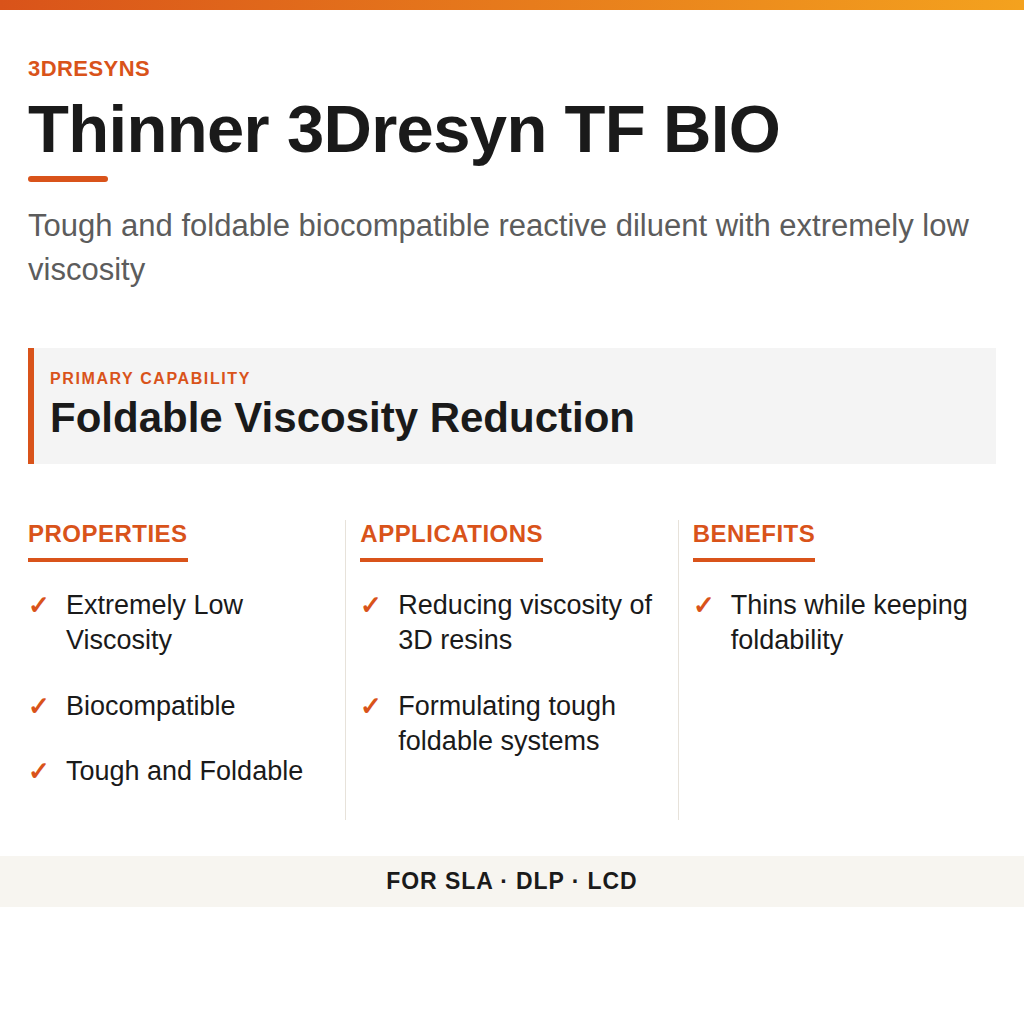
- Need tough and foldable contribution → Thinner 3Dresyn TF Bio
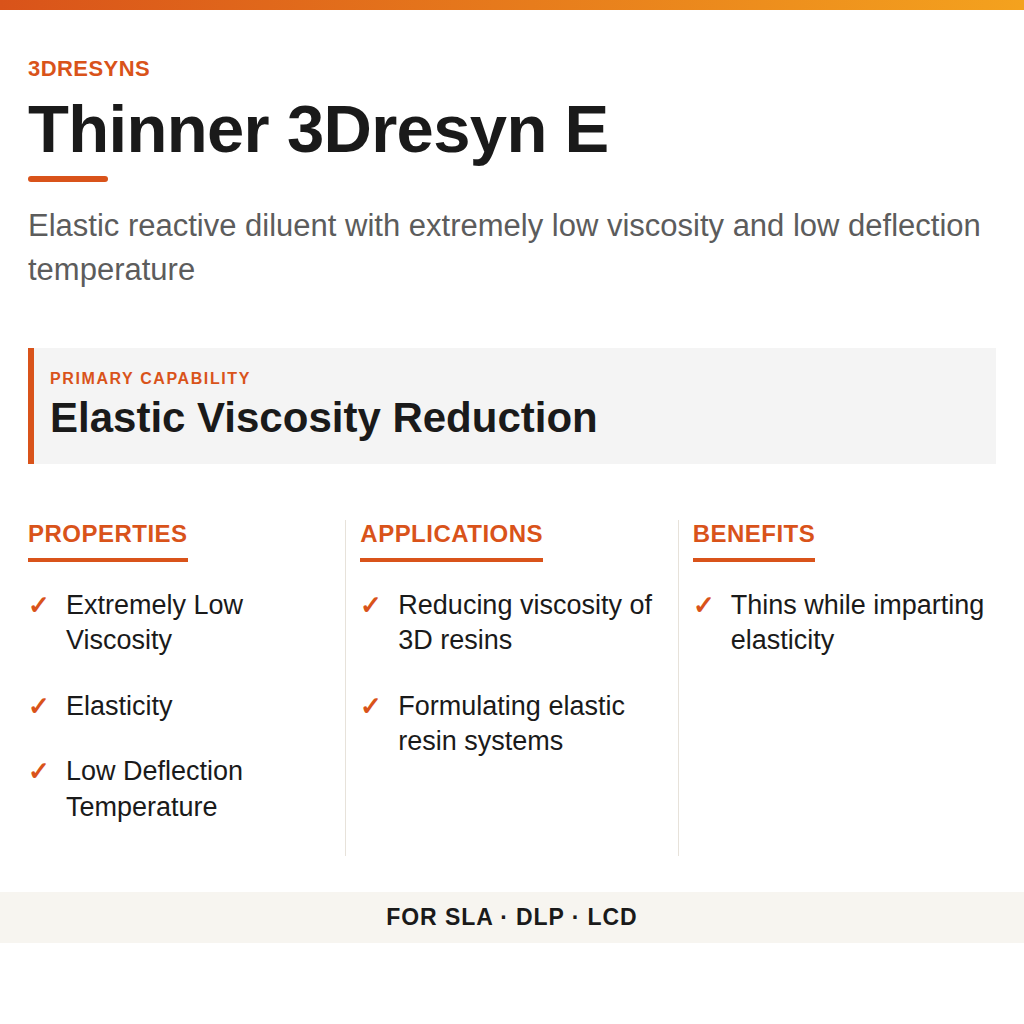
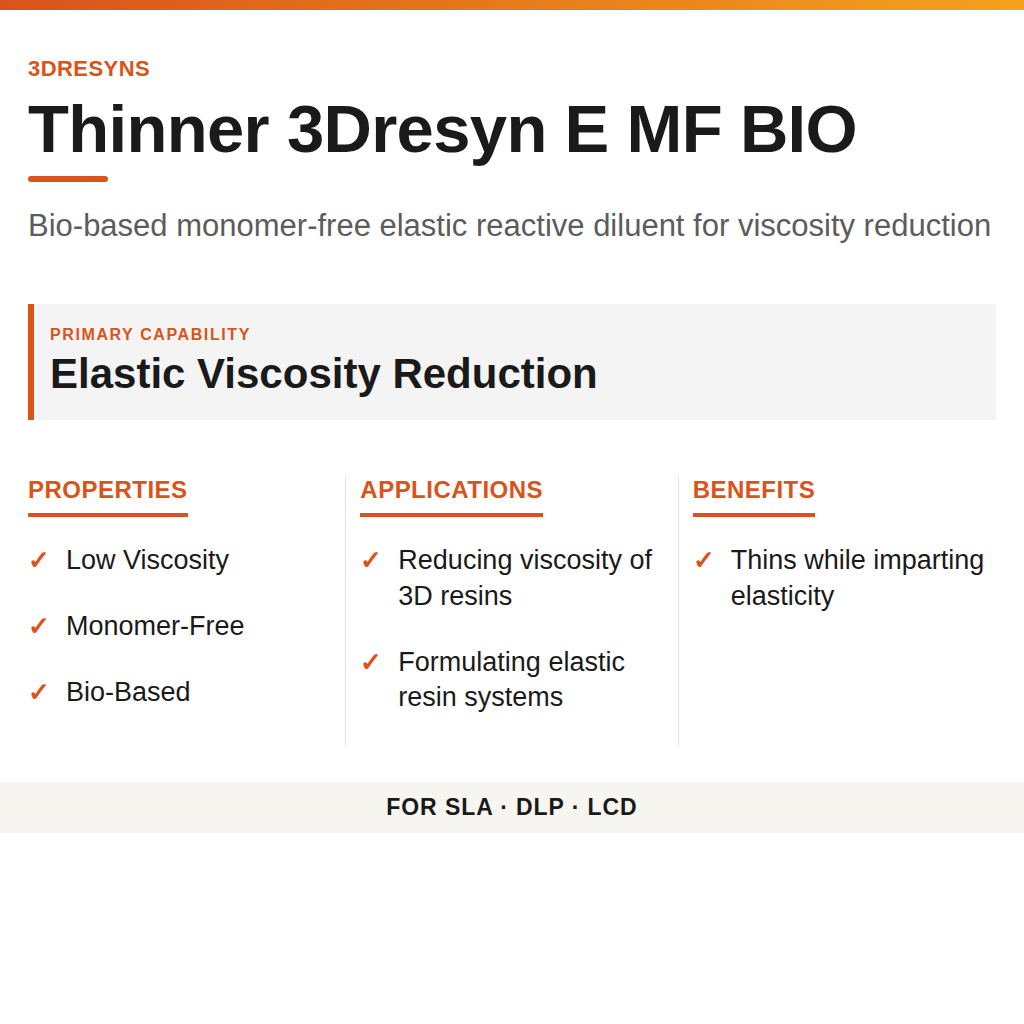
- Need elastic contribution → Thinner 3Dresyn E or Thinner 3Dresyn E MF Bio
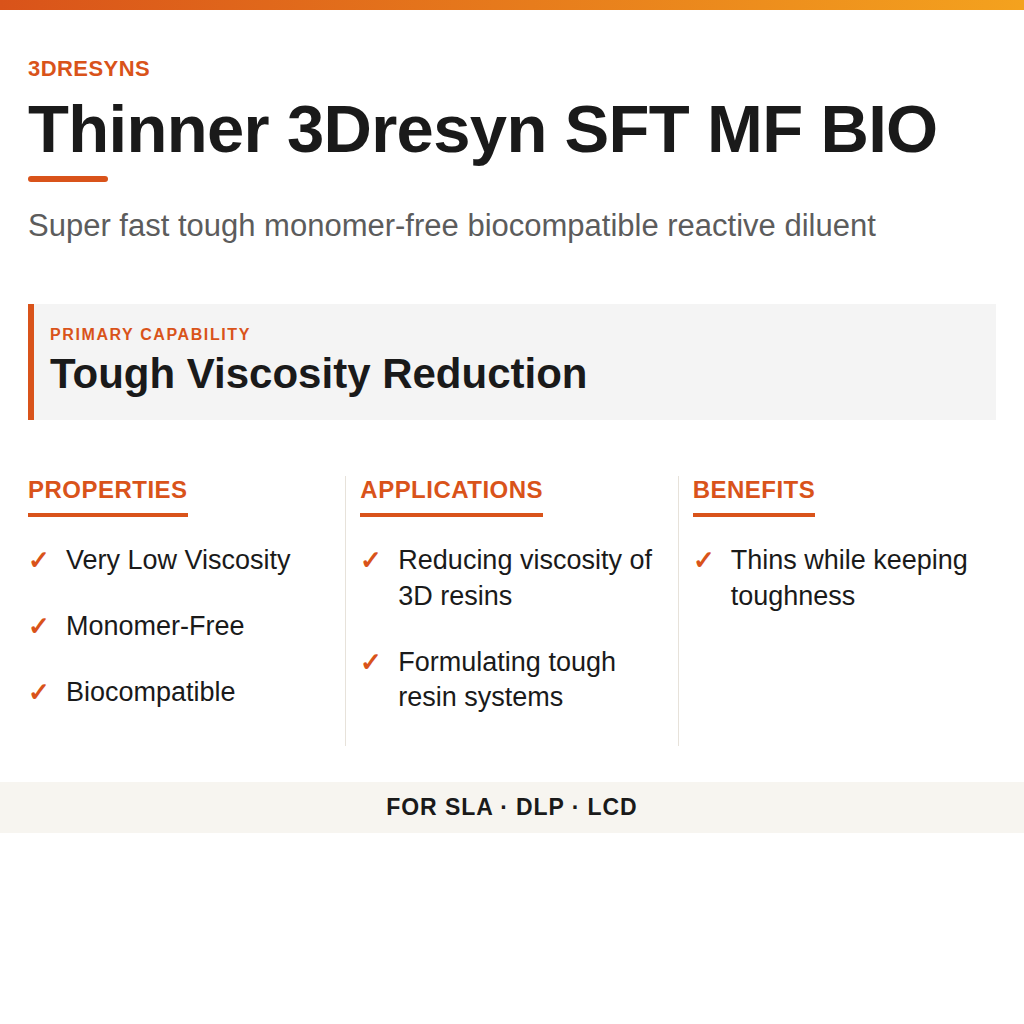
- Need monomer-free fast/tough or elastic route → Thinner 3Dresyn SFT MF Bio or Thinner 3Dresyn E MF Bio
- Prioritise biocompatible and bio-based positioning → choose Bio grades where available
- Prioritise monomer-free formulation logic → choose MF grades where available
- Prioritise maximum flow improvement → consider the lowest-viscosity route compatible with the target mechanical profile
Decision tree summary
Use this simplified logic before detailed formulation validation.
- Need higher-temperature rigid contribution → RHDT Bio
- Need rigid contribution → R Bio
- Need hard contribution → H Bio
- Need toughness and foldability → TF Bio
- Need elastic behaviour → E or E MF Bio
- Need monomer-free fast / tough route → SFT MF Bio
Then validate the final formulation under the intended printer, pigment/filler loading, temperature conditions, exposure window and post-curing protocol.
Products in this collection
Rigid and rigid high-temperature reactive diluents
For formulations that need strong viscosity reduction while preserving or introducing rigid behaviour, including a higher-HDT route where relevant.
Hard reactive diluent
For users looking to reduce viscosity while keeping the formulation on the hard side of the mechanical spectrum.
Tough, foldable and fast-tough monomer-free routes
For formulations where viscosity reduction needs to be combined with tougher, more foldable or faster-processing behaviour.
Elastic reactive diluents
For formulations requiring strong viscosity reduction while preserving or introducing elastic behaviour.
Monomer-free reactive diluent options
For users prioritising monomer-free formulation logic alongside viscosity tuning and controlled printability.
Technical overview table
Workflow-dependent performance
Viscosity reduction, resin flow, recoating, curing consistency and final part behaviour depend on the interaction between the diluent, the base formulation, printer conditions, temperature and post-curing protocol.
Successful implementation therefore requires alignment between diluent selection, base resin chemistry, process objectives and qualified printing parameters.
| Reactive diluent | Core profile | Main behaviour | Indicative formulation logic | Typical positioning | Target workflow |
|---|---|---|---|---|---|
| RHDT Bio | Rigid / high deflection temperature | Very low viscosity, rigid, high-HDT contribution | For strong viscosity reduction in rigid, higher-temperature formulations | Rigid and more thermally resistant formulation tuning | SLA / DLP / LCD resin optimisation |
| R Bio | Rigid | Rigid viscosity-reduction route | For rigid resin systems needing better flow and handling | General rigid formulation tuning | SLA / DLP / LCD resin optimisation |
| H Bio | Hard | Hard behaviour with viscosity reduction | For hard resin systems where controlled thinning is required | Hard-formulation process tuning | SLA / DLP / LCD resin optimisation |
| SFT MF Bio | Super fast & tough / monomer-free | Fast-processing tough route | For MF formulations needing viscosity tuning and faster/tougher behaviour | Monomer-free advanced formulation tuning | SLA / DLP / LCD resin optimisation |
| TF Bio | Tough & foldable | Extremely low viscosity, foldable and flexible contribution | For softer tougher systems needing strong thinning action | Tough and foldable formulation tuning | SLA / DLP / LCD resin optimisation |
| E | Elastic | Elastic contribution with viscosity reduction | For elastic resin systems or softer formulation routes | Elastic formulation tuning | SLA / DLP / LCD resin optimisation |
| E MF Bio | Elastic / monomer-free / bio-based | Elastic MF route | For MF elastic systems needing controlled flow improvement | Monomer-free elastic formulation tuning | SLA / DLP / LCD resin optimisation |
Mobile: scroll horizontally to view all columns. The first column remains visible while scrolling.
Portfolio overview
A formulation-tuning platform rather than a single-thinner approach
This collection is structured around behaviour-specific reactive diluents so users can tune viscosity without treating all thinning routes as equivalent.
- Rigid routes cover general rigid and higher-temperature rigid formulation logic.
- Hard route supports harder resin profiles where controlled viscosity reduction is needed.
- Tough / foldable route supports lower-viscosity flexible-tough formulation strategies.
- Elastic routes support elastic resin tuning, including a monomer-free bio-based option.
- MF routes help users prioritise monomer-free formulation pathways where available.
Workflow note
The right diluent depends on the base resin, not only on the target viscosity
Reactive diluents should be selected not just for how much they lower viscosity, but for how they influence curing response, flow behaviour, recoating, shrinkage and the final mechanical profile of the resin system.
In practice, the best route is to start from the target formulation behaviour, then validate the diluent level under the intended printer, temperature, exposure and post-curing conditions.
Technical and commercial support
Documentation, optimisation help and custom formulation support
Use the resources below to move from diluent preselection to formulation optimisation, process validation or project-specific technical support.
Final CTA
Select the right reactive diluent and validate the final resin workflow
Use the behaviour-based navigation above to identify the most relevant reactive diluent route, compare candidates in the technical overview table, and move forward with formulation-specific validation for SLA, DLP or LCD printing.
Related formulation-auxiliary routes
Explore closely related 3Dresyns collections
Use these links to move between closely related material, process or formulation families in the 3Dresyns catalogue.
Sort by
From prototyping to industrial production, performance depends on materials, calibration and process control