
Antimicrobial additives
Antimicrobial additives for photopolymer 3D resins, developed to support hygiene-focused workflows, contamination-control strategies and copper-containing or microorganism-growth-inhibiting functional formulations.
3Dresyns® materials in this collection are positioned for professional resin workflows where the objective is to introduce antimicrobial-related functionality concepts, microorganism growth inhibition support or copper-containing functional resin routes.
Navigate by: copper additive route, microorganism growth inhibitor route and formulation-selection logic.
This collection includes copper-based additives and microorganism growth inhibitor additives designed for professional additive manufacturing workflows where hygiene-oriented formulation concepts or bulk resin contamination-control strategies are important.
These materials are particularly relevant for healthcare-oriented prototypes, touch surfaces, lab tools, fixtures and other functional parts where contamination-control logic, hygiene management or copper incorporation may add value to the final workflow.
Key features & benefits
Choose your antimicrobial route
Use the routes below to navigate the collection by copper-based formulation strategy or microorganism growth inhibition support logic.
- Antimicrobial functionality concepts for professional resin workflows.
- Additive-driven support for hygiene-focused parts and handling strategies.
- Copper-based functional resin routes for compatible SLA, DLP, LCD and selected Inkjet systems.
- Microorganism growth inhibition support for liquid resin storage and bulk handling workflows.
- Grade-dependent route selection according to concentration, carrier system, dosage and application logic.
Typical applications
Typical use scenarios across the collection
This collection is suitable for workflows where hygiene management, contamination-control logic or copper-containing functional formulations are part of the technical objective.
- Healthcare-oriented prototypes: concept parts where hygiene-focused material strategies are being evaluated.
- Touch surfaces: functional surfaces where copper incorporation or contamination-control logic is relevant.
- Lab tools and fixtures: professional-use parts in controlled technical environments.
- Bulk resin storage workflows: reducing the risk of microorganism growth during storage and handling under controlled conditions.
- Antimicrobial concept validation: formulation screening before workflow-specific validation and regulatory assessment.
Why choose this collection
How to choose the right antimicrobial route
Select the most suitable route according to whether the main objective is copper incorporation into the printed part or supplementary microorganism growth control in stored liquid resin systems.
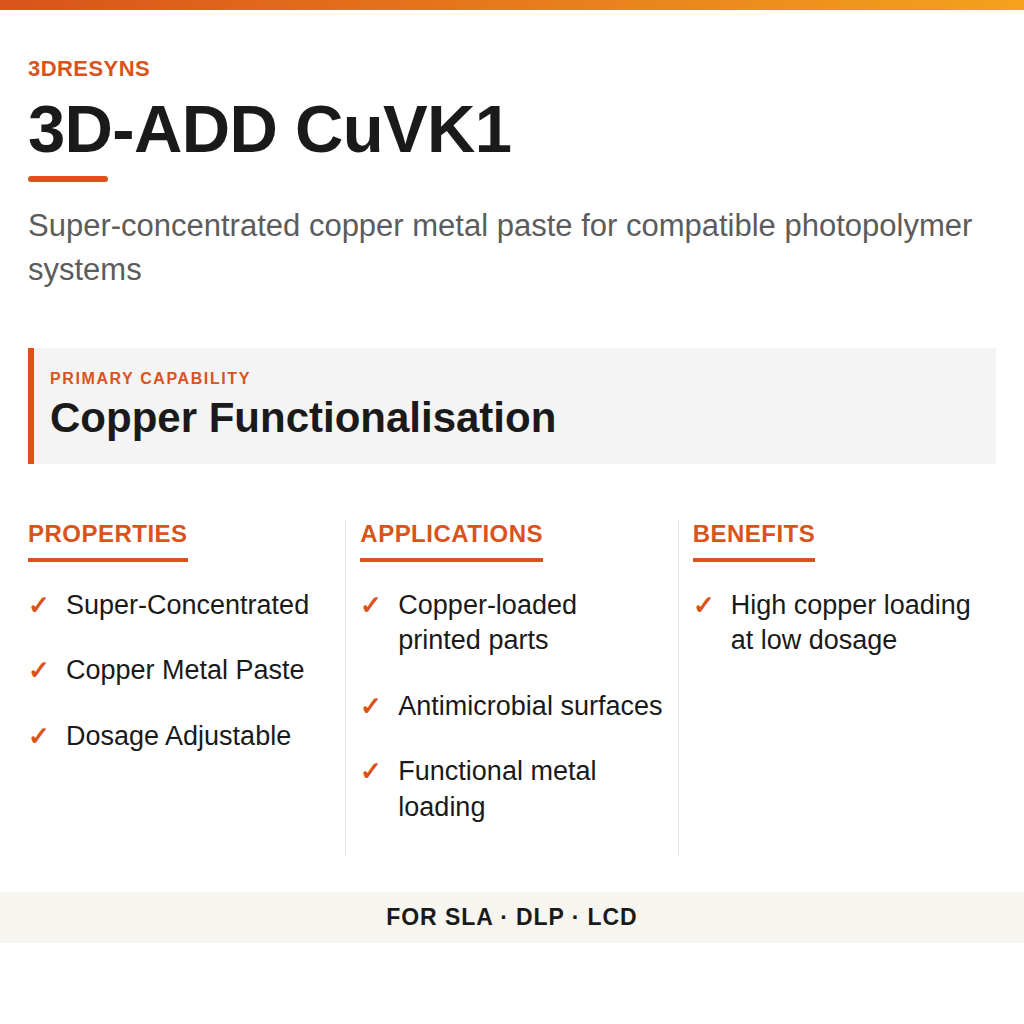
- Need the highest copper concentration in a paste route → choose 3D-ADD CuVK1
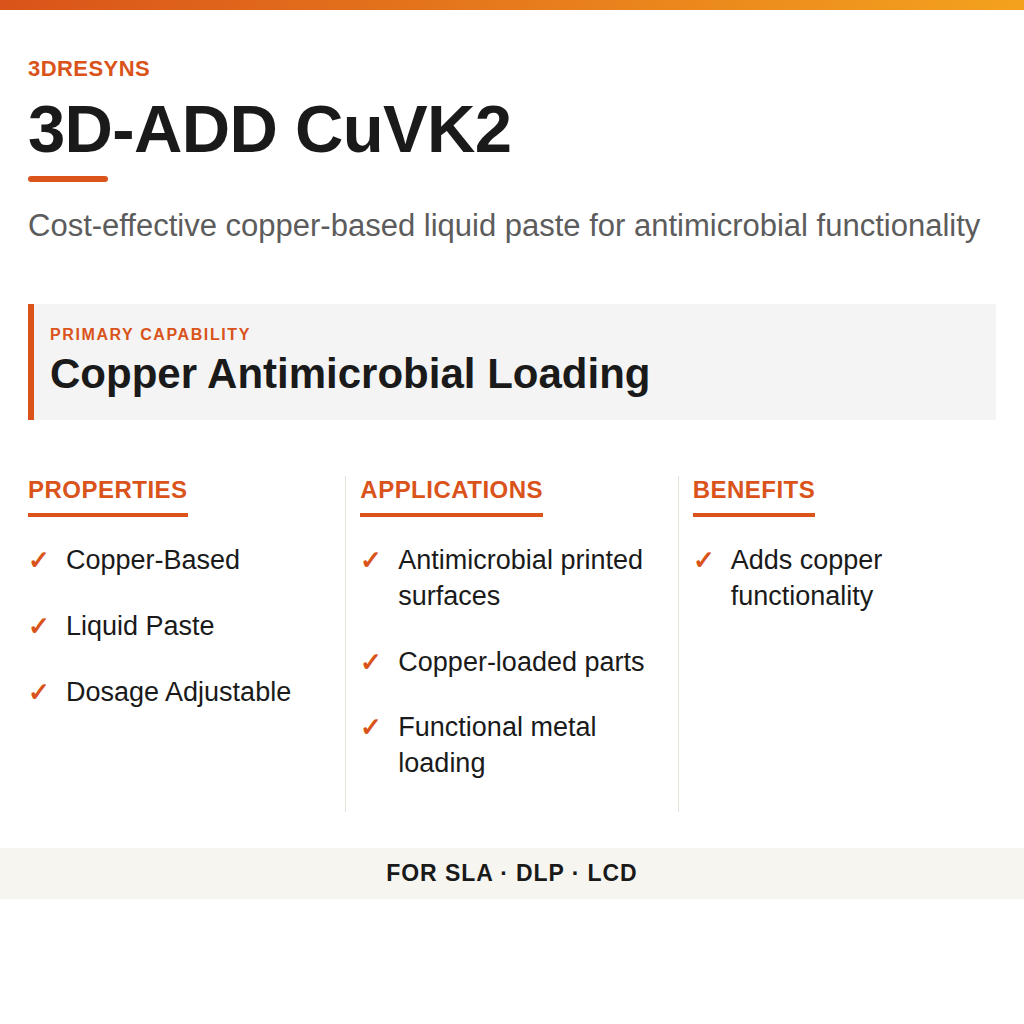
- Need a cost-effective copper route with liquid-paste handling → choose 3D-ADD CuVK2
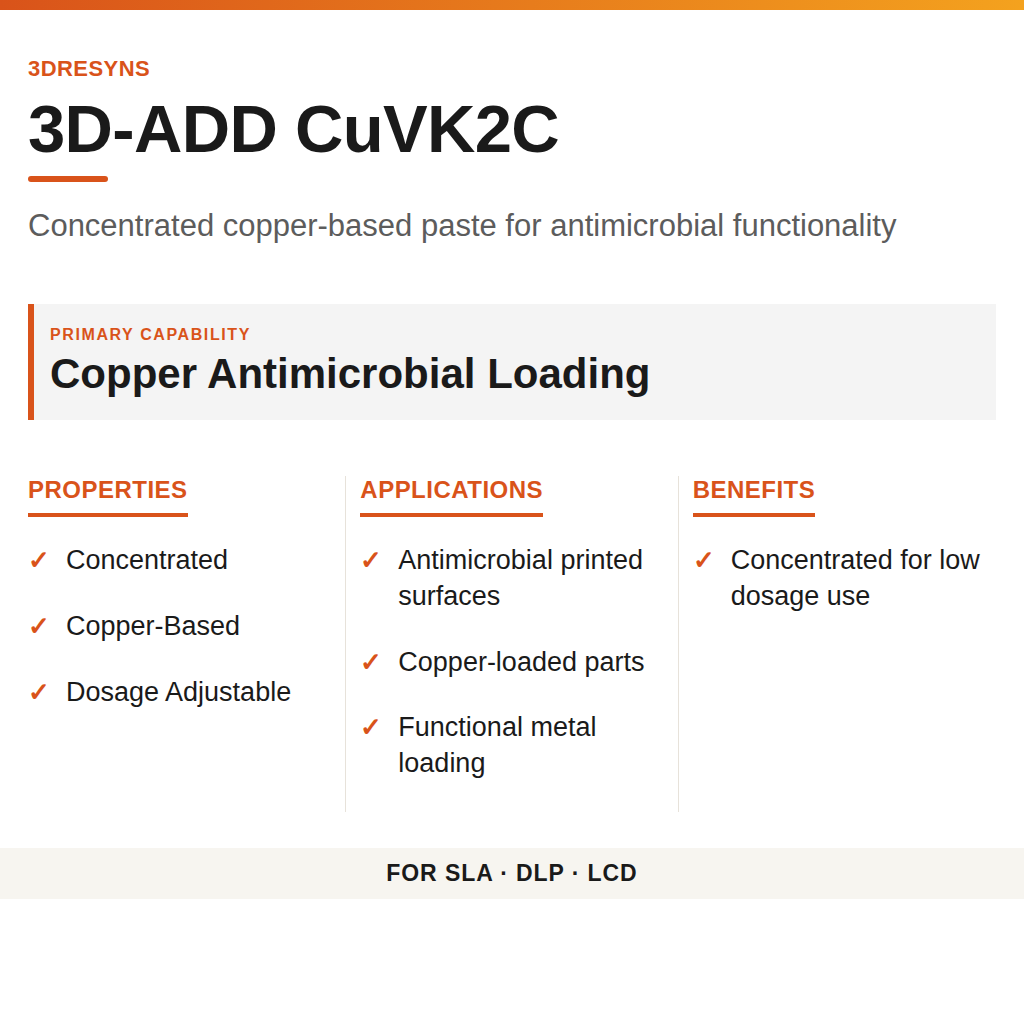
- Need a concentrated copper route with lower addition level → choose 3D-ADD CuVK2C
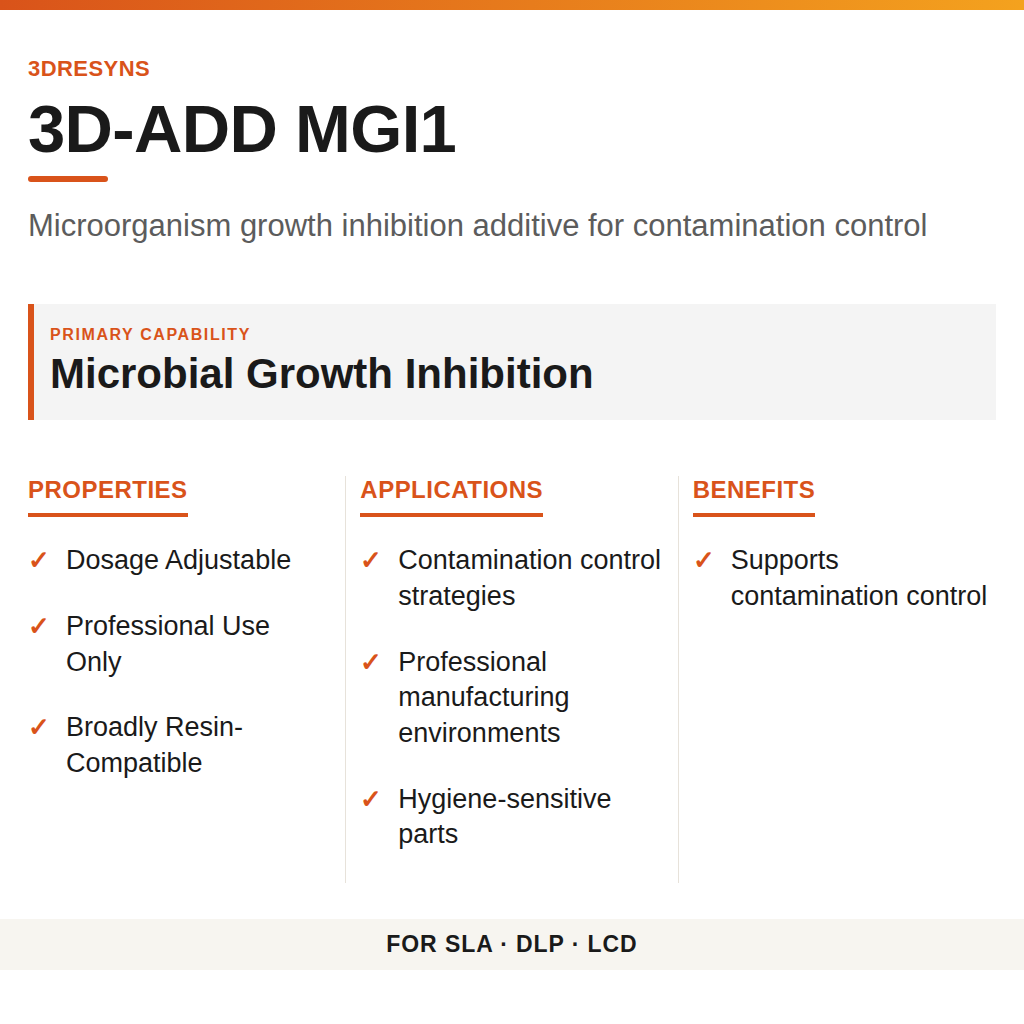
- Need supplementary microorganism growth control in stored liquid resins → choose 3D-ADD MGI1
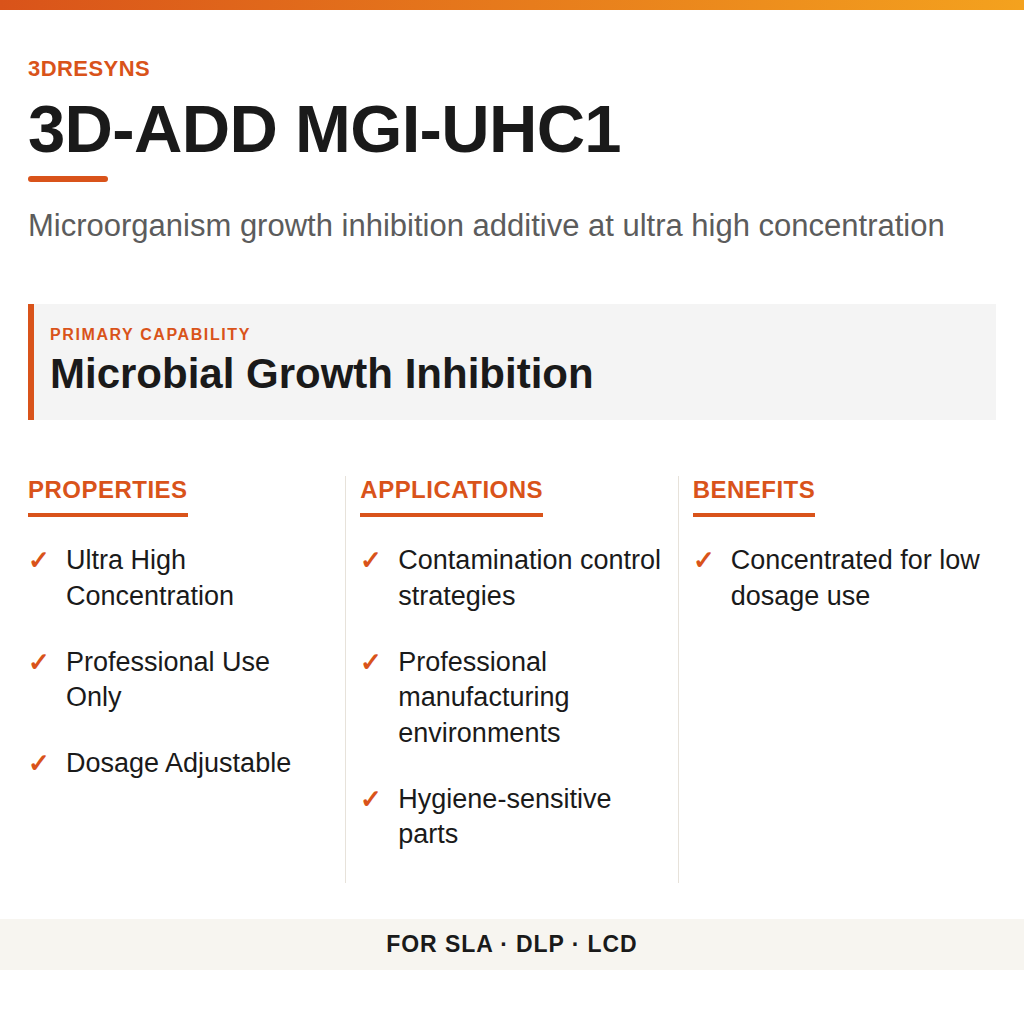
- Need the same contamination-control logic at ultra-high concentration → choose 3D-ADD MGI-UHC1
- Prioritise copper loading and metallic functional route selection → start with the CuVK grades
- Prioritise contamination-risk reduction during liquid resin storage → start with the MGI grades
- Prioritise lower dosage through higher concentration → compare CuVK2C and MGI-UHC1
Decision tree summary
Use this simplified logic before detailed formulation and validation work.
- Need copper-containing printed parts → select a CuVK grade
- Need supplementary microorganism growth inhibition in liquid resin workflows → select an MGI grade
- Need higher concentration to reduce the additive percentage → move to CuVK2C or MGI-UHC1
- Need final functional claims on printed parts → validate concentration, compatibility, process conditions and regulatory framework in the final workflow
Then confirm the final route under the intended resin family, additive loading, curing conditions, storage protocol and application-specific validation plan.
Products in this collection
Copper-based antimicrobial additives for functional resin development
For workflows requiring copper incorporation into compatible photopolymer systems before printing.
- CuVK1: super high pure copper metal content paste, brownish copper color, recommended addition dosage ≤ 1.7%.
- CuVK2: blue liquid paste, up to 20% copper content, hydrophobic carrier system, recommended dosage ≤ 5% by weight relative to the base resin.
- CuVK2C: blue viscous paste, up to 30% copper content, hydrophobic carrier system, recommended dosage ≤ 3.3% by weight relative to the base resin.
- CuVK2 and CuVK2C may benefit from improved dispersion stability when used with anti-sedimentation support.
- All copper grades are positioned for compatible SLA, DLP, LCD and selected Inkjet resin workflows.
Supplementary contamination-control additives for liquid resin workflows
For workflows requiring supplementary microorganism growth control in stored liquid 3D printing resins under controlled professional conditions.
- MGI1: recommended concentration 2–4% (v/v) added to compatible liquid 3D resins.
- MGI-UHC1: ultra high concentration route with recommended concentration 1–2% (v/v).
- Designed to support resin hygiene management and contamination-risk reduction in bulk resin handling workflows.
- Professional-use-only positioning for laboratory and industrial environments.
- These additives are supportive processing additives and do not replace validated sterilization, aseptic processing or regulated disinfection procedures.
Technical overview table
Workflow-dependent performance
Final antimicrobial-related performance, contamination-control benefit, copper integration, dispersion quality, compatibility and printed-part behavior depend on the interaction between the selected additive route, the base resin, additive concentration, storage conditions, process parameters and final part geometry.
Successful implementation therefore requires alignment between target function, additive route, dosage, resin compatibility, process validation and applicable regulatory framework.
| Material | Primary role | Core concept | Main format | Recommended dosage logic | Main behavior | Typical positioning | Target workflow |
|---|---|---|---|---|---|---|---|
| 3D-ADD CuVK1 | Copper additive | Super concentrated pure copper metal route | Brownish copper paste | Typically ≤ 1.7% addition | Introduces high-purity copper into compatible resin systems | Functional copper-containing parts, hygiene-focused prototypes, professional concept validation | Compatible SLA / DLP / LCD workflows requiring very concentrated copper addition |
| 3D-ADD CuVK2 | Copper additive | Cost-effective copper incorporation route | Blue liquid paste | Typically ≤ 5% by weight relative to base resin | Up to 20% copper content with hydrophobic carrier system | Cost-conscious copper-functional formulations, dark-resin systems, general copper additive route | Compatible SLA / DLP / LCD / Inkjet workflows needing copper incorporation with practical handling |
| 3D-ADD CuVK2C | Copper additive | Concentrated copper route with lower addition level | Blue viscous paste | Typically ≤ 3.3% by weight relative to base resin | Up to 30% copper content with hydrophobic carrier system | Higher-concentration copper formulations, reduced-addition workflows, functional copper integration | Compatible SLA / DLP / LCD / Inkjet workflows where more concentrated copper delivery is preferred |
| 3D-ADD MGI1 | MGI additive | Supplementary microorganism growth inhibition support | Additive solution | Typically 2–4% v/v | Supports contamination-control strategies in liquid resin storage and handling | Laboratory and industrial resin hygiene management, bulk resin storage workflows | Professional liquid photopolymer workflows requiring contamination-risk mitigation support |
| 3D-ADD MGI-UHC1 | MGI additive | Ultra-high-concentration microorganism growth inhibition support | Ultra high concentration additive solution | Typically 1–2% v/v | Supports contamination-control strategies at lower addition levels | Professional resin hygiene management where higher concentration and lower dosage are preferred | Professional liquid photopolymer workflows requiring concentrated contamination-risk mitigation support |
Mobile: scroll horizontally to view all columns. The first column remains visible while scrolling.
Portfolio overview
A focused antimicrobial platform rather than a generic additives page
This collection is compact and clearly structured around two complementary routes: copper-containing additive systems and microorganism growth inhibitor additive systems.
- CuVK1, CuVK2 and CuVK2C cover the copper-functional route.
- MGI1 and MGI-UHC1 cover the contamination-control support route for liquid resins.
- Together, they support hygiene-focused functional formulation strategies across different concentration, handling and workflow requirements.
Workflow note
The right antimicrobial route depends on the function target and compliance framework
These materials are most useful when the objective is defined first: copper-containing printed parts, contamination-risk reduction during resin storage, lower-dose concentrated additive routes or hygiene-focused concept validation.
In practice, the correct path is to define the intended use first, then validate the chosen route under the intended resin family, additive concentration, storage protocol, processing conditions and applicable regulatory requirements.
Technical and commercial support
Documentation, technical selection help and workflow support
Use the resources below to move from antimicrobial-route preselection to formulation planning, compatibility validation or broader technical support.
Final CTA
Select the right antimicrobial route and validate the final workflow
Use the route-based navigation above to identify the most relevant additive strategy, compare candidates in the technical overview table, and move forward with formulation-specific validation for hygiene-focused parts, copper-functional systems or contamination-controlled liquid resin workflows.
Sort by



From prototyping to industrial production, performance depends on materials, calibration and process control