
Non yellowing, antidegradation and stability additives
Non-yellowing, anti-degradation and stability additives for photopolymer 3D resins, developed to improve long-term appearance, optical stability and resistance to degradation mechanisms.
3Dresyns® additives in this collection are positioned for clear or appearance-critical parts, light-exposed components and formulation projects where long-term visual stability matters.
Navigate by: non-yellowing route, UV-protection route and in-can stabilization route.
This collection groups 3Dresyns® additives developed to reduce yellowing, improve optical stability and support better long-term appearance in printed parts.
These routes are intended for formulation protection, anti-aging support and stability enhancement in both clear and colored parts depending on the selected system.
Key features & benefits
Choose your non-yellowing or stabilizer route
Use the routes below to navigate the collection by the type of stability or protection logic you want to introduce.
- Reduced yellowing and improved optical stability.
- Anti-aging protection and better long-term appearance depending on system.
- Improved resistance to degradation mechanisms.
- Stability enhancement for clear and colored parts.
Typical applications
Typical use scenarios across the collection
This collection is suitable for material systems where long-term visual appearance and degradation resistance are important selection criteria.
- Clear or appearance-critical parts: where yellowing or optical drift must be minimized.
- Long-term prototypes: where retained appearance matters over time.
- Light-exposed components: where UV-related aging is a concern.
- Optical and display applications: where clearer and more stable appearance is relevant.
- Stability-focused formulation development and validation: where additive tuning is part of the workflow.
Why choose this collection
How to choose the right non-yellowing or stabilizer additive
Select the most suitable route according to whether the project needs yellowing control, UV protection or in-can stability support.
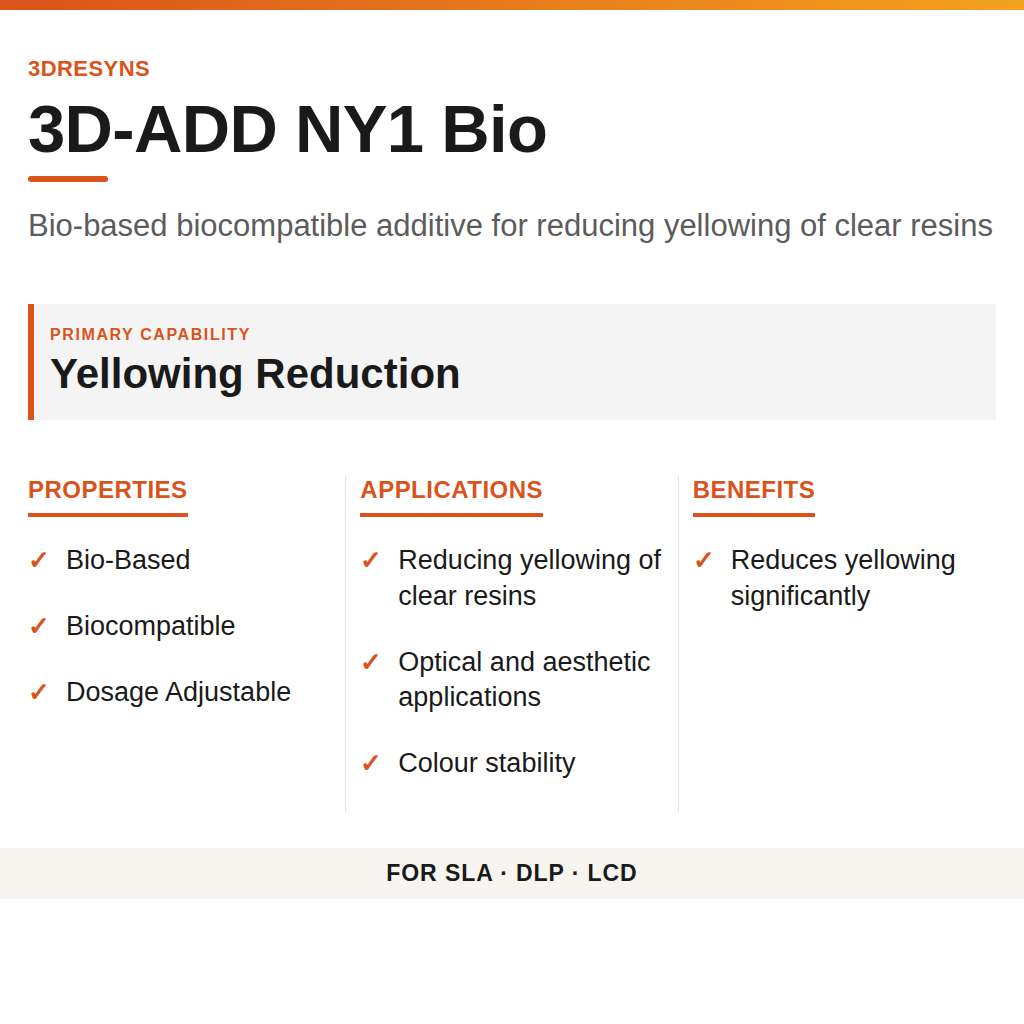
- Need a bio-based and biocompatible non-yellowing route → choose 3D-ADD NY1 Bio
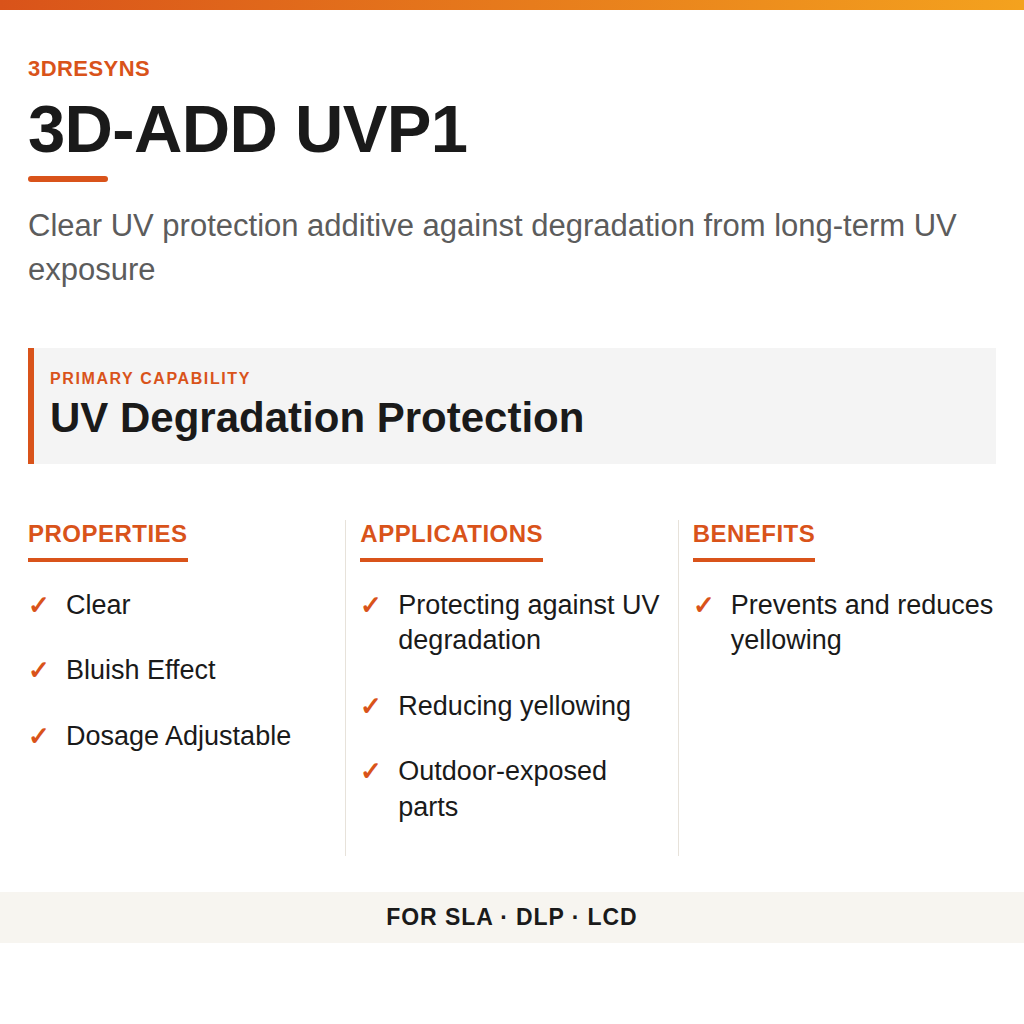
- Need clear UV protection → choose 3D-ADD UVP1
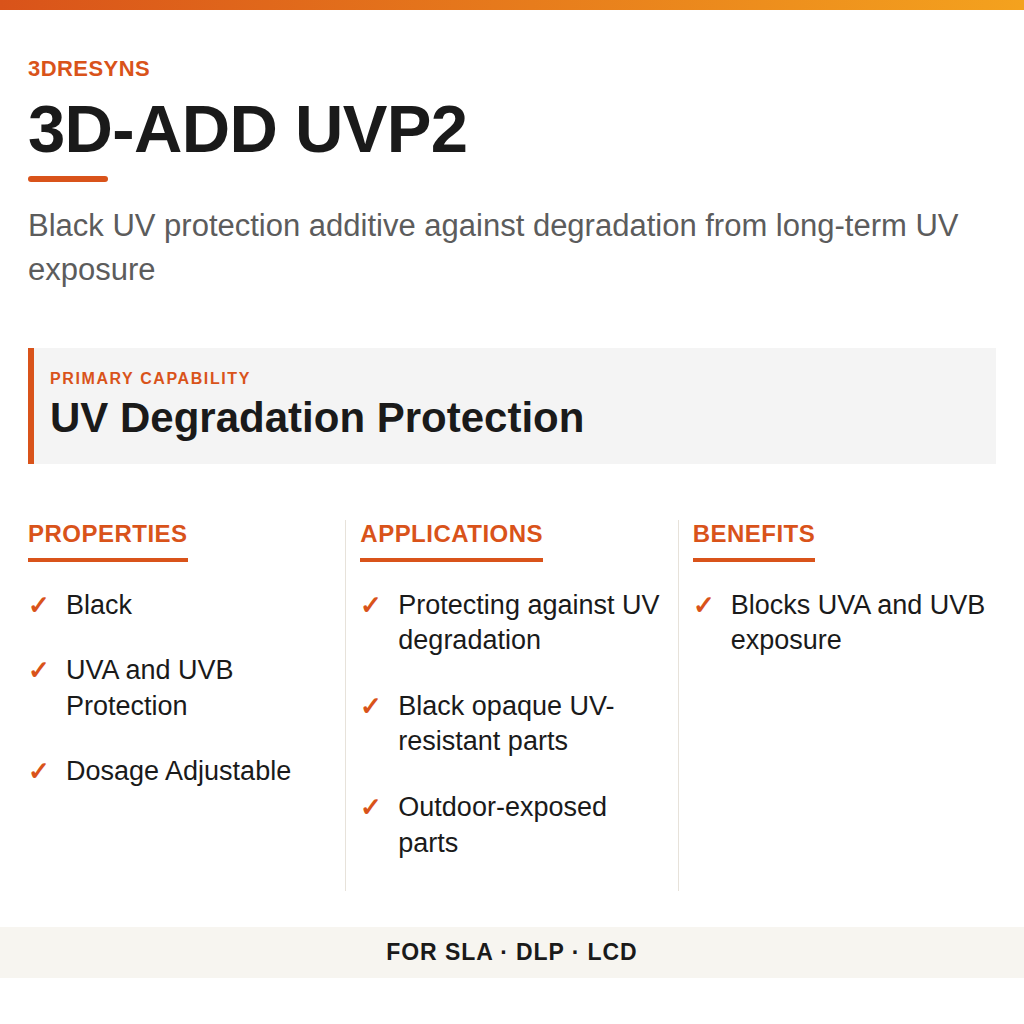
- Need black UV protection → choose 3D-ADD UVP2
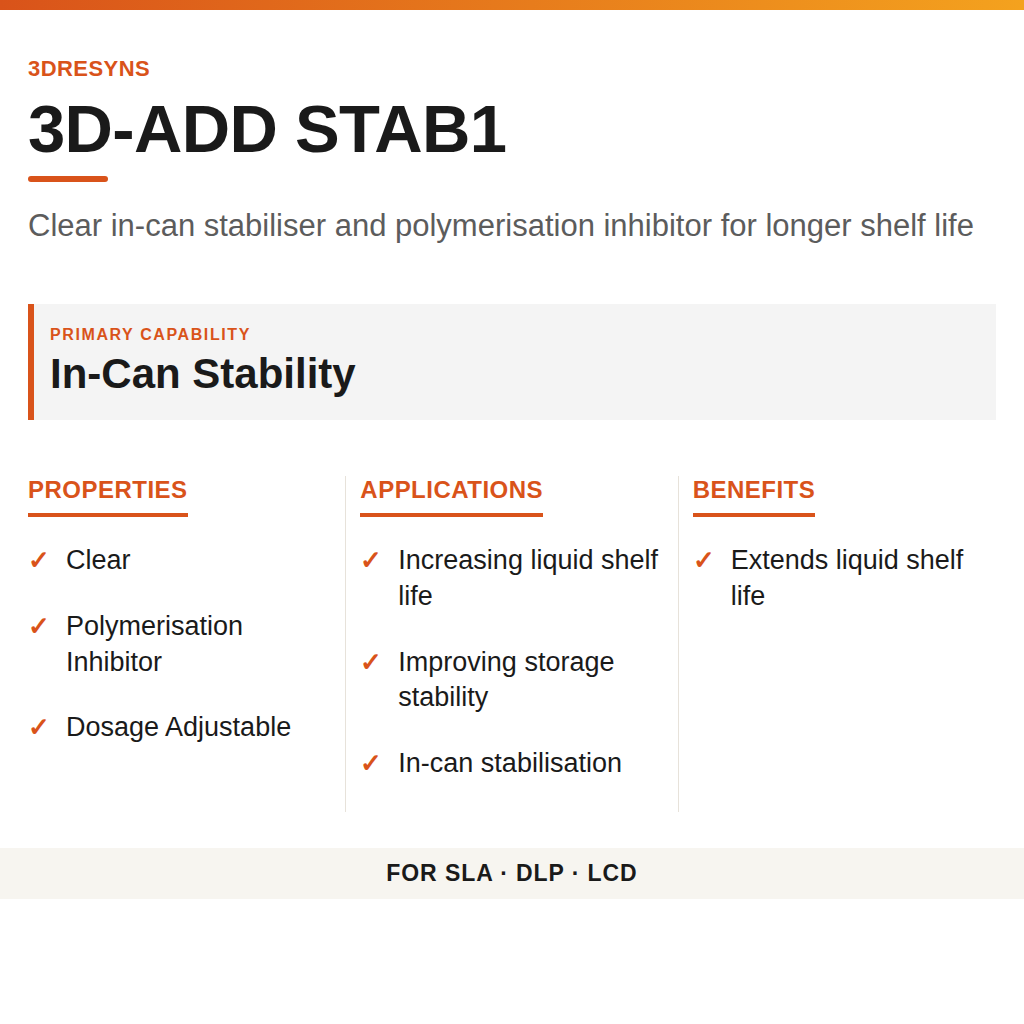
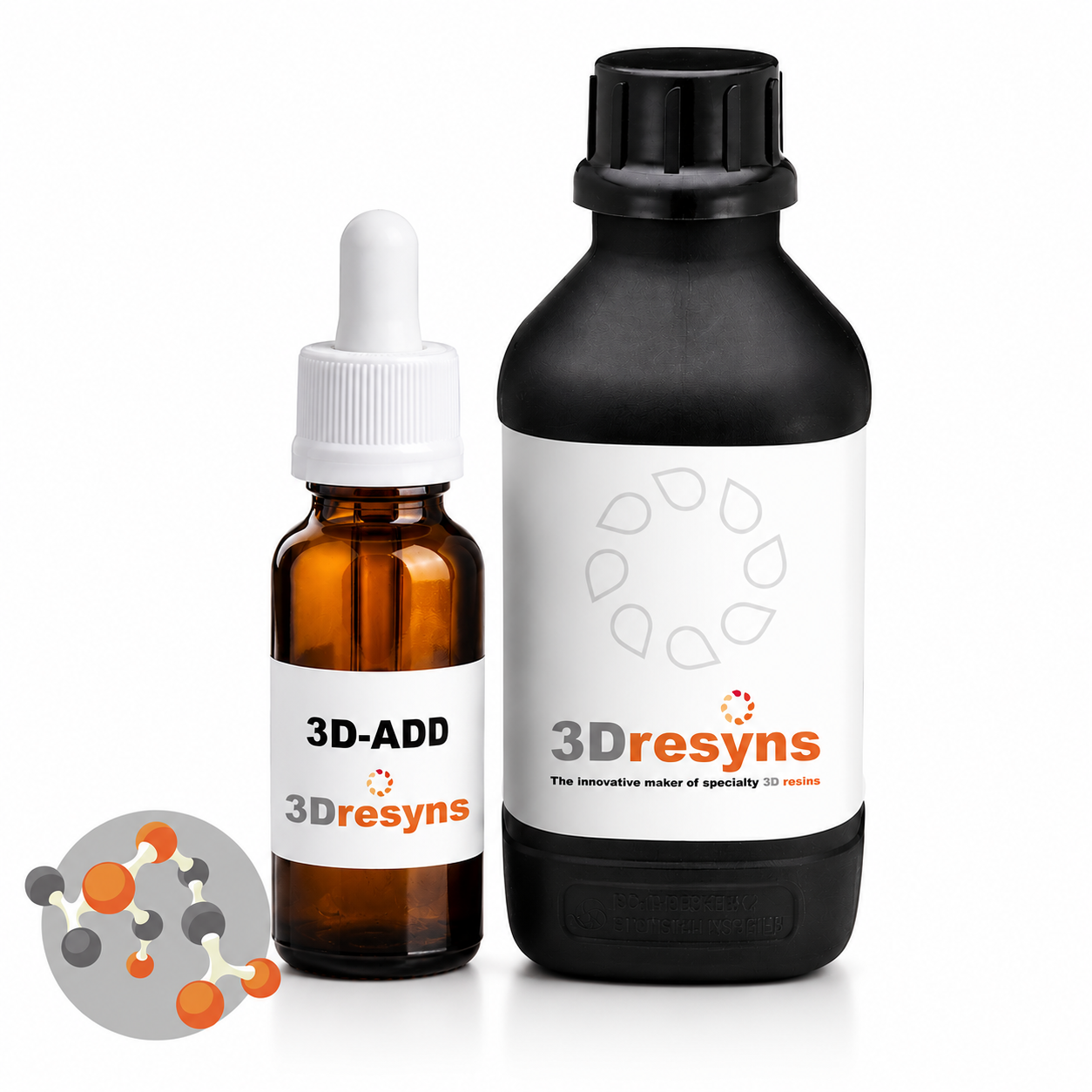
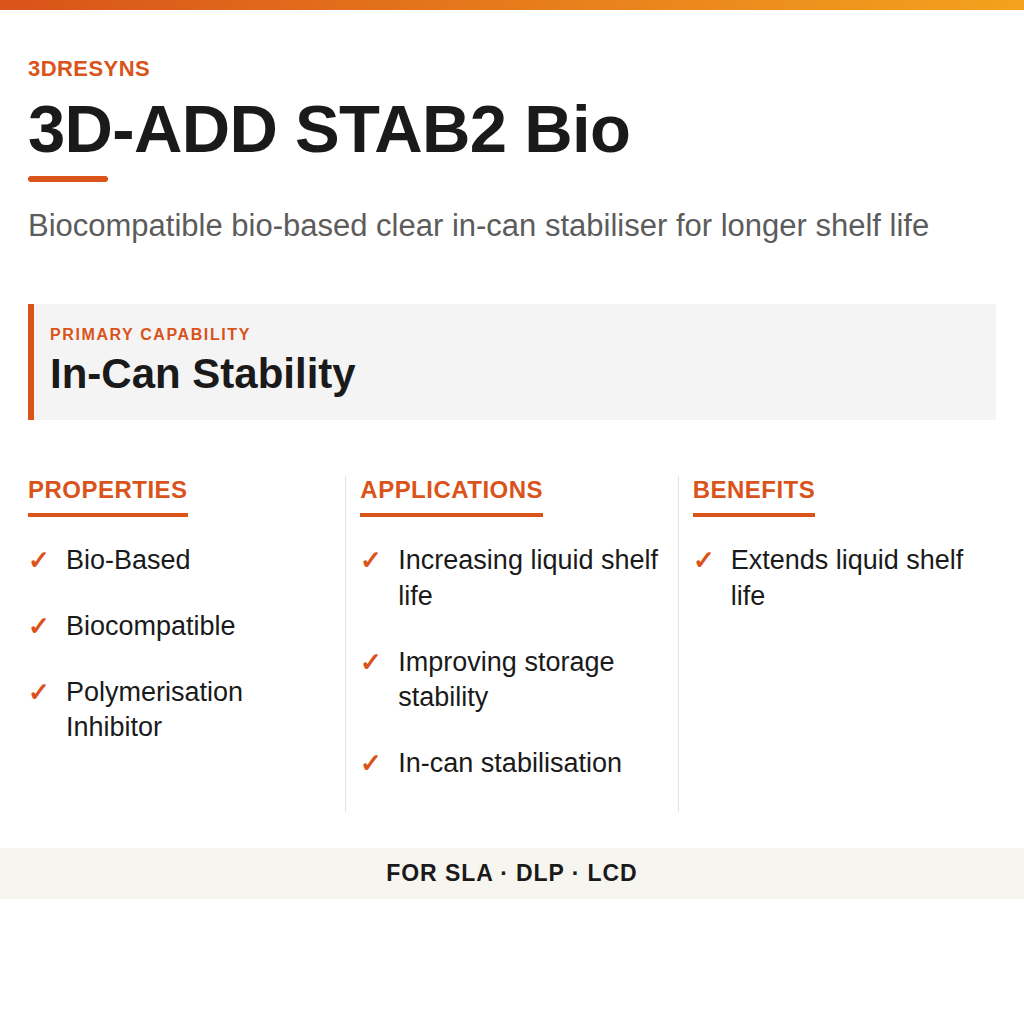
- Need in-can stabilization → choose 3D-ADD STAB1 or 3D-ADD STAB2 Bio
- Prioritise optical clarity and reduced yellowing → start with NY1 Bio or UVP1
- Prioritise dark UV-shielding route → start with UVP2
- Prioritise storage and resin stability in the bottle/can → start with STAB1 or STAB2 Bio
- Prioritise bio-based and biocompatible positioning → compare NY1 Bio and STAB2 Bio
Decision tree summary
Use this simplified engineering logic before detailed formulation validation.
- Need non-yellowing → NY1 Bio
- Need clear UV protection → UVP1
- Need black UV protection → UVP2
- Need in-can stabilization → STAB1 / STAB2 Bio
Then validate the final route under the intended resin family, additive loading, exposure conditions and storage workflow.
Products in this collection
Bio-based and biocompatible non-yellowing additive
For projects that require reduced yellowing and improved long-term appearance in clear or appearance-critical printed parts.
Clear and black UV-protection additives
For formulations that require added UV-protection logic to support long-term appearance or degradation resistance.
Stabilizer additives for resin storage stability
For workflows requiring in-can stabilization of 3D resins, including a bio-based and biocompatible route.
Technical overview table
Workflow-dependent performance
Yellowing resistance, optical stability, storage stability and final durability depend on the interaction between the selected additive, the base resin, additive concentration and the intended exposure or storage conditions.
Successful implementation therefore requires alignment between additive selection, stability objective, formulation strategy and qualified workflow conditions.
| Material | Primary role | Core concept | Main behavior | Typical positioning | Target workflow |
|---|---|---|---|---|---|
| 3D-ADD NY1 Bio | Non-yellowing additive | Bio-based and biocompatible anti-yellowing route | Reduced yellowing and improved long-term appearance | Clear or appearance-critical parts and stability-focused formulation work | Engineering, medical and healthcare-oriented resin formulation tuning |
| 3D-ADD UVP1 | UV-protection additive | Clear UV protection | Supports optical stability while keeping a clear route | Clear parts, optical and display applications | Light-exposed clear resin systems |
| 3D-ADD UVP2 | UV-protection additive | Black-color UV protection | Supports UV-protection with dark color route | Colored or shielded parts with UV-related stability targets | Light-exposed colored resin systems |
| 3D-ADD STAB1 | In-can stabilizer | Storage stability route | Supports improved resin stability in storage | Formulation stability enhancement before printing | In-can stabilization of 3D resins |
| 3D-ADD STAB2 Bio | In-can stabilizer | Bio-based and biocompatible storage stability route | Supports in-can stabilization with bio-based and biocompatible positioning | Medical, healthcare and bio-positioned resin-stability workflows | In-can stabilization of 3D resins |
Mobile: scroll horizontally to view all columns. The first column remains visible while scrolling.
Portfolio overview
A stability-focused platform rather than a single appearance modifier
This collection is structured around three complementary stability logics: reduced yellowing, UV protection and in-can stabilization.
- NY1 Bio covers the non-yellowing route.
- UVP1 and UVP2 cover clear and black UV-protection routes.
- STAB1 and STAB2 Bio cover in-can stabilization routes.
Workflow note
The right route depends on where the stability problem appears
These additives are most useful when the stability objective is clearly defined first: reduced yellowing in the final part, UV-related protection during service life, or resin stabilization during storage before printing.
In practice, the correct path is to define the failure mode first, then validate the additive under the intended resin chemistry, loading and exposure or storage conditions.
Technical and commercial support
Documentation, technical selection help and workflow support
Use the resources below to move from additive preselection to formulation planning, stability validation or broader technical support.
Final CTA
Select the right stability additive and validate the final long-term appearance workflow
Use the route-based navigation above to identify the most relevant non-yellowing, UV-protection or stabilization additive, compare candidates in the technical overview table, and move forward with formulation-specific validation for clearer and more stable printed parts.
Related stability routes
Explore closely related 3Dresyns collections
Use these links to move between closely related material, process or formulation families in the 3Dresyns catalogue.
Sort by
From prototyping to industrial production, performance depends on materials, calibration and process control