Functional additives organized for targeted tuning of printability, optical behavior, conductivity, stability, release force, flame resistance, radio-opacity, UV protection and specialty performance in advanced photopolymer formulations.
This collection is built around real additive functions rather than generic formulation theory. The visible products cover conductive fillers, antistatic additives, non-yellowing additives, dispersants, anti-sedimentation additives, release-force modifiers, blowing agents, radio-opaque concentrates, magnetic-response concentrates, flame-retardant additives and UV-protection additives.
Navigate by: electrical function, optical control, rheology and stability, release and processing behavior, specialty functional response or end-use enhancement.
These products are formulation additives and not ready-to-print resins. Proper compatibility testing, dispersion control and process validation are required before use.
Formulation toolbox based on real functional roles
This collection is unusually broad: it mixes conductivity additives, optical stabilizers, release modifiers, rheology-control additives and specialty concentrates that change the final function of a printed part.
Selection must therefore start from the exact problem to solve: conductivity, ESD behavior, yellowing, sedimentation, adhesion, radio-opacity, foaming, UV resistance, magnetic response or flame resistance.
Quick selection by additive function
Functional navigation
Choose your additive route
Select the additive family according to the real behavior you want to introduce into the formulation.
Typical routes
Key features & benefits
Collection logic
Each additive solves a different formulation bottleneck
This collection should not be read as a homogeneous family. Some products modify electrical behavior, others stabilize color, others prevent sedimentation, others reduce release force, and others create entirely new end-use functions such as flame resistance, radio-opacity or foaming.
Main capabilities across the collection
- Introduce conductivity or antistatic behavior
- Reduce yellowing and protect optical appearance
- Improve dispersion and reduce sedimentation
- Reduce release force and improve processing
- Add radio-opacity, magnetic response, flame resistance or foaming capability
- Support custom application-driven resin development
Collection overview
Products in this collection
Products in this collection are shown below.
This collection currently includes: 3D-ADD GrapEK1-GNP Bio, 3D-ADD ESDA Clear, 3D-ADD ESDA Black, 3D-ADD NY1 Bio, 3D-ADD NSA1, 3D-ADD Disper-All1, 3D-ADD ASC1, 3D-ADD EKC, 3D-ADD AA1, 3D ADD HRI1 White, 3D-ADD CBA1 Bio, 3D-ADD UVP2, 3D-ADD ROC1, 3D-ADD MHC, 3D-ADD FRA1 Clear and 3D-ADD Disper-All2.
Included products and technical roles
Route 01
Conductive and antistatic additives
This route includes products intended to introduce electrical function rather than only adjust mechanics or optics.
Included products
-
3D-ADD GrapEK1-GNP Bio — graphene nanoplatelet additive positioned for electrically conductive formulations
-
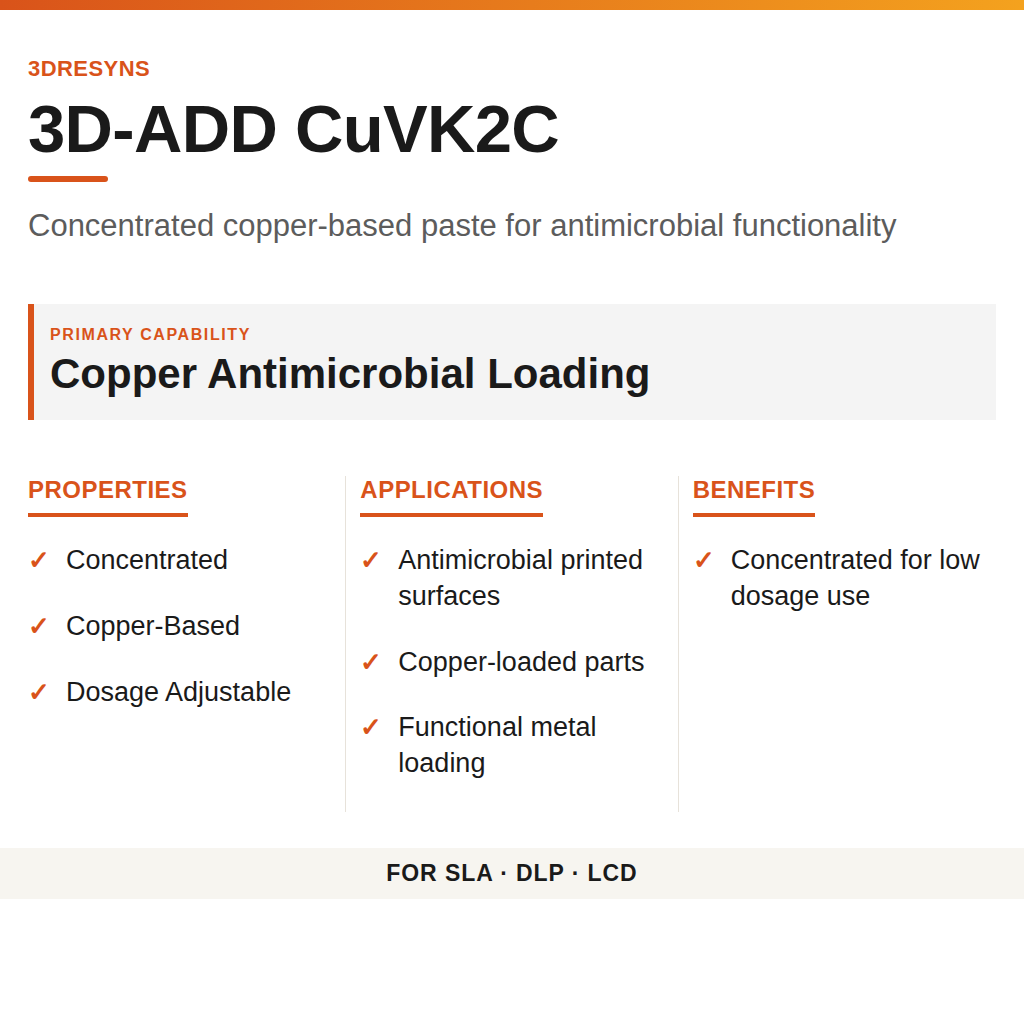
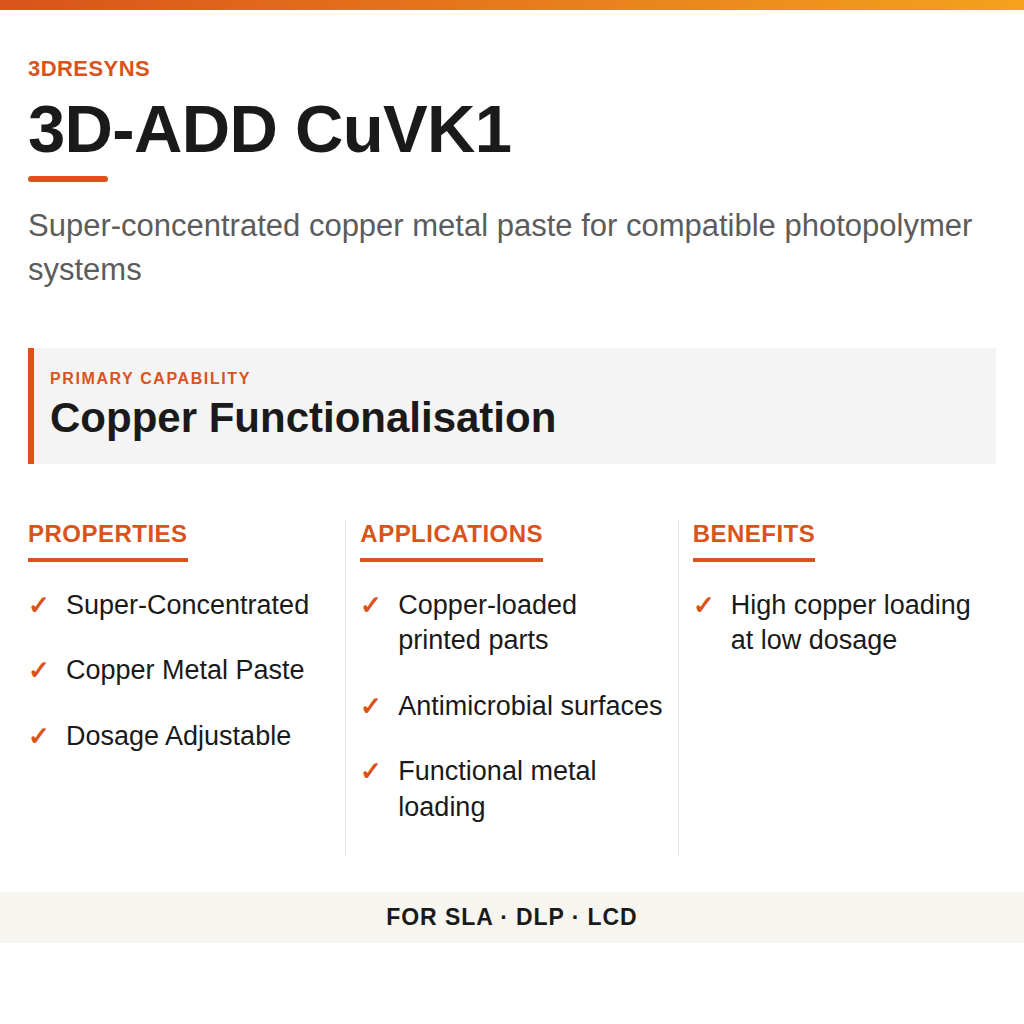
3D-ADD EKC — silver nanowire additive for designing clear and colored conductive 3D resins
-
3D-ADD ESDA Clear — clear antistatic ESD additive
-
3D-ADD ESDA Black — black colored antistatic ESD additive
What each one really does
- GrapEK1-GNP Bio introduces conductive graphene-based behavior into a resin system
- EKC targets conductive formulations using silver nanowires and is explicitly suitable for both clear and colored systems
- ESDA Clear is the antistatic route when transparency or a clear base appearance matters
- ESDA Black is the antistatic route when black coloration is acceptable or desirable
Best for
- Conductive formulations
- ESD and antistatic tuning
- Electronics-related resin development
- Selecting between conductive vs antistatic-only strategies
Route 02
Optical stability, refractive tuning and UV control
This route groups additives that change how the printed part looks optically, ages optically or interacts with light.
Included products
-
3D-ADD NY1 Bio — non-yellowing bio-based and biocompatible additive
-
3D ADD HRI1 White — high refractive index white additive
-
3D-ADD UVP2 — black UV protection additive
What each one really does
- NY1 Bio is an optical stability additive: it targets yellowing behavior, especially relevant in clear or color-sensitive systems
- HRI1 White is a refractive-index-oriented additive, useful where optical response and whiteness are part of the final design objective
- UVP2 is a black UV-protection route, meaning it is not just a colorant but a protective optical additive
Best for
- Reducing yellowing
- Protecting UV-sensitive systems
- Optical and refractive design workflows
- Appearance-sensitive parts
Route 03
Process stability, release-force control and formulation robustness
This route includes additives that do not primarily add a new end-use function, but instead stabilize or improve the manufacturing process.
Included products
-
3D-ADD NSA1 — non-stick additive for reducing release force
-
3D-ADD Disper-All1 — ultra effective dispersant
-
3D-ADD Disper-All2 — fast-curing ultra effective dispersant
-
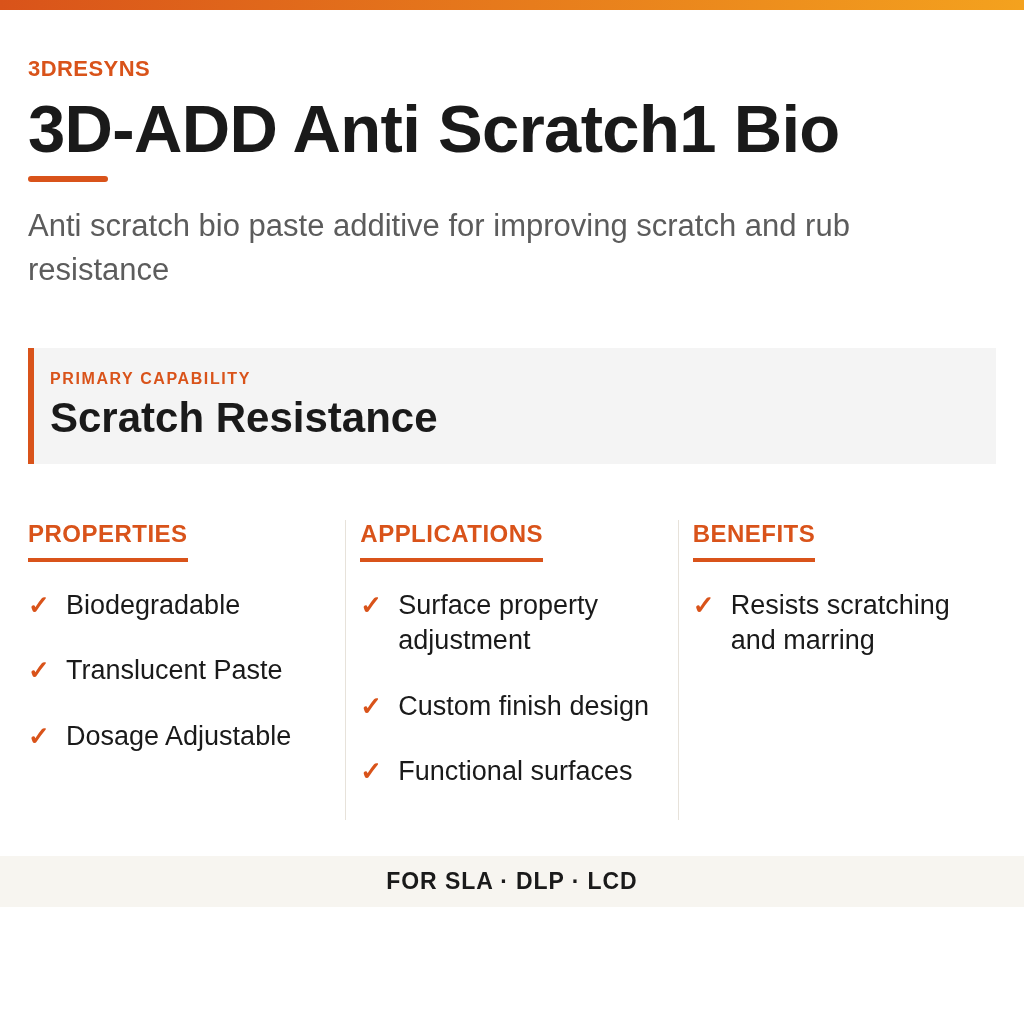
3D-ADD ASC1 — anti-sedimentation additive
-
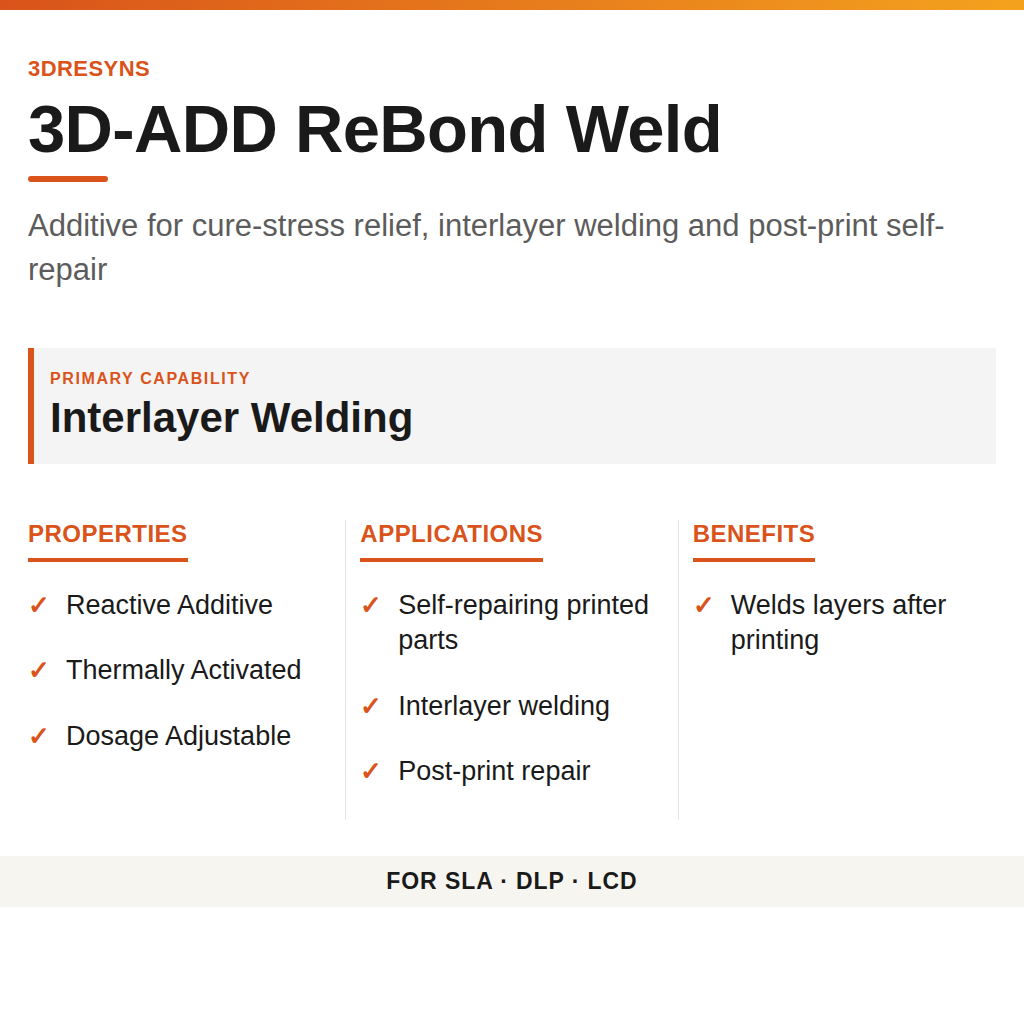
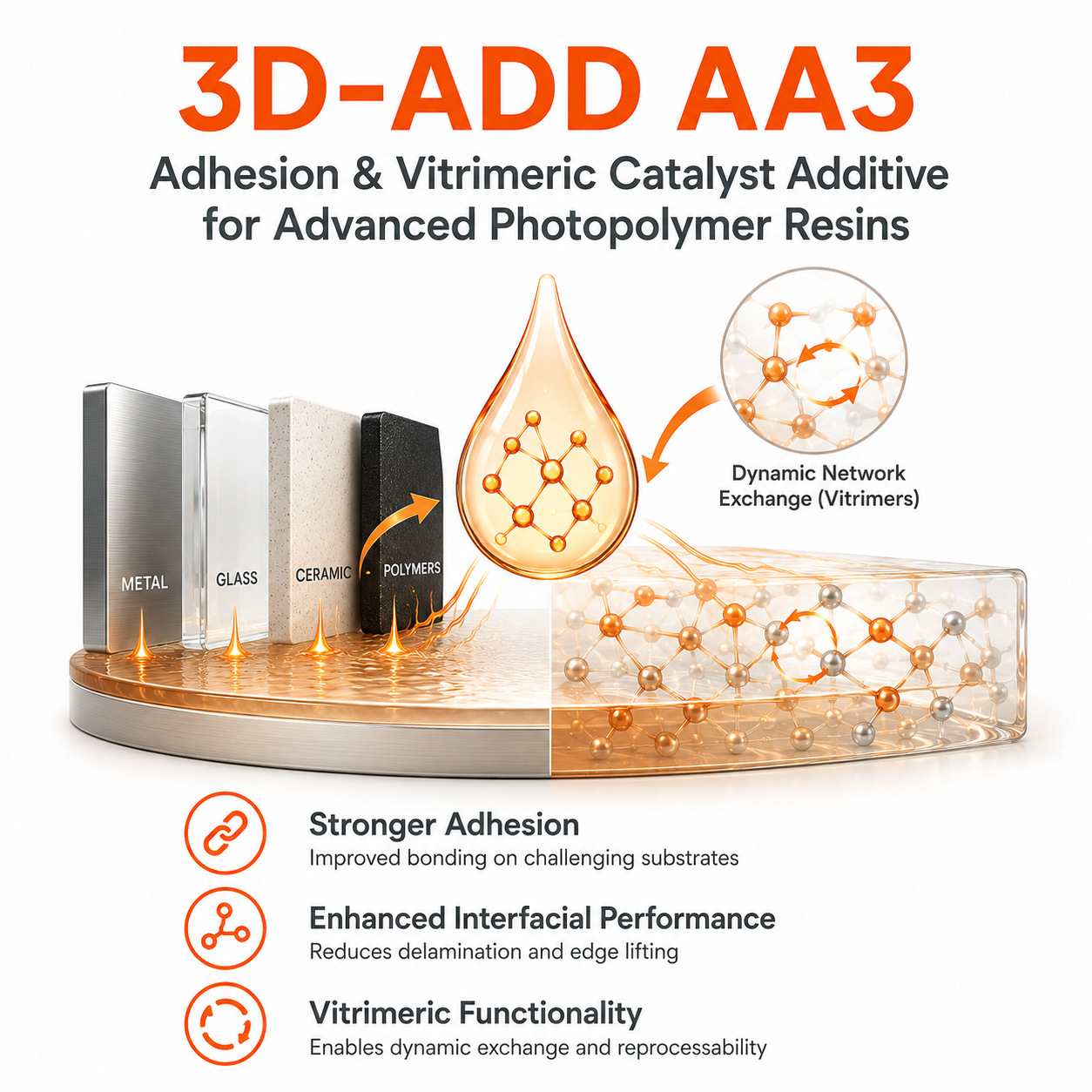
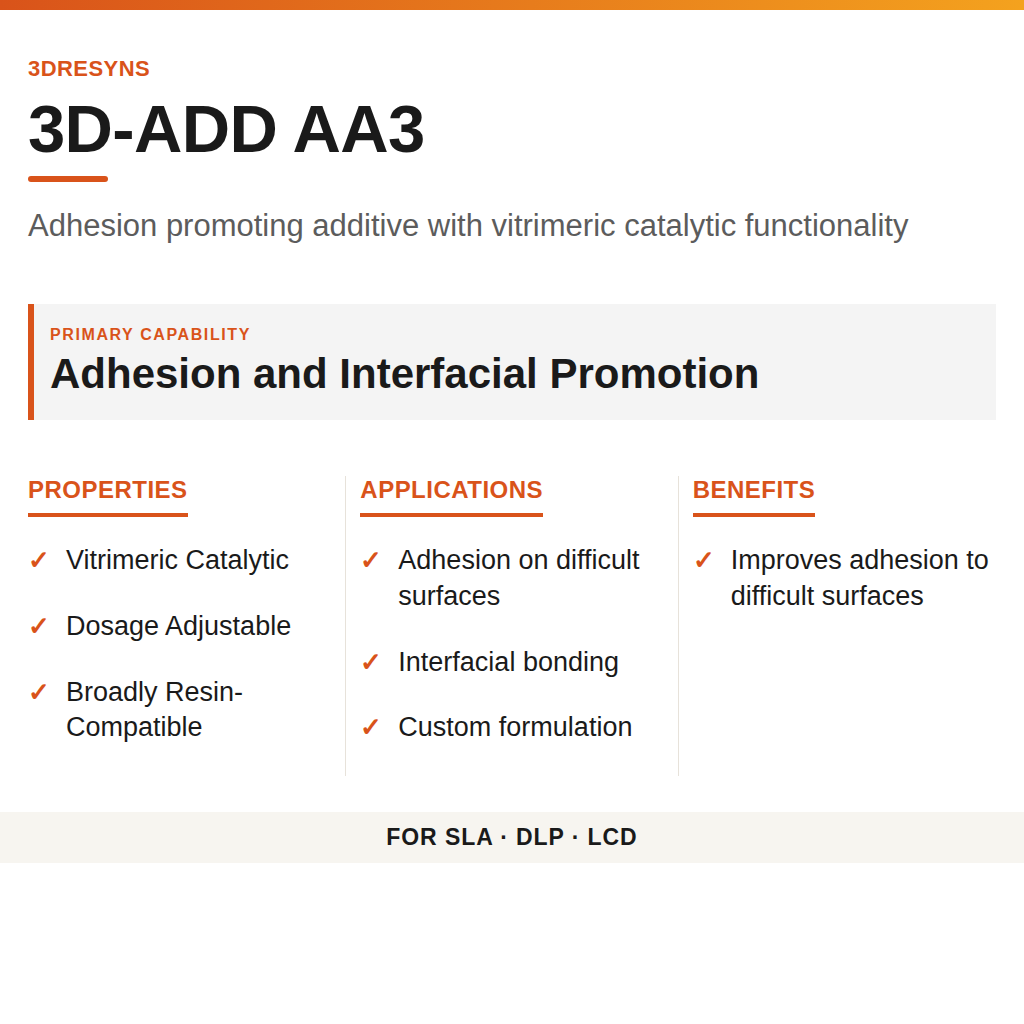
3D-ADD AA1 — adhesive additive for adhesion on difficult surfaces
What each one really does
- NSA1 directly addresses release force, which is a process bottleneck rather than an end-use property
- Disper-All1 is the broad dispersant route for improving filler or additive distribution
- Disper-All2 adds the extra logic of fast-curing compatibility, making it more relevant where dispersion and cure rate must be balanced together
- ASC1 is specifically about preventing sedimentation, especially important in loaded systems
- AA1 is an adhesion-promotion route for difficult surfaces, pointing to interfacial performance rather than bulk resin performance
Best for
- Reducing peeling or release-force issues
- Improving filler dispersion
- Preventing sedimentation in loaded resins
- Enhancing adhesion to difficult substrates
- Improving formulation robustness under real process conditions
Route 04
Specialty functional concentrates
This route includes additives that introduce a distinct end-use behavior beyond printability improvement.
Included products
-
3D-ADD CBA1 Bio — biocompatible chemical blowing agent for foaming 3D prints
-
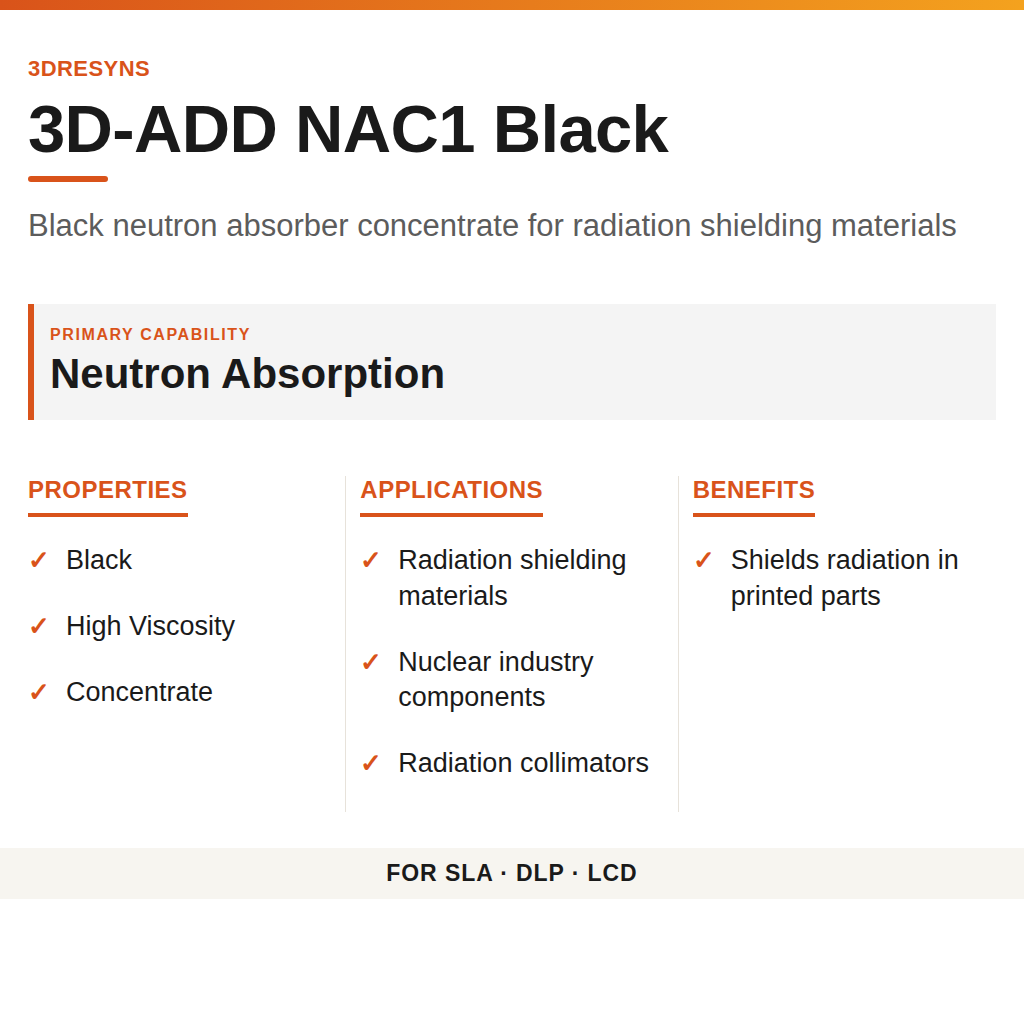
3D-ADD ROC1 — radio-opaque concentrate bio
-
3D-ADD MHC — magnet holder concentrate to promote magnet properties
-
3D-ADD FRA1 Clear — clear fire and flame resistant additive
What each one really does
- CBA1 Bio is not a general modifier: it is a blowing-agent route for creating foam or cellular structures after appropriate processing
- ROC1 adds radio-opacity, making it relevant for imaging-visible devices or prototypes
- MHC promotes magnetic functionality, which is a highly specific application-driven property
- FRA1 Clear adds flame-resistance behavior while remaining positioned as a clear additive route
Best for
- Foamed or cellular printed structures
- Radio-opaque devices and prototypes
- Magnet-related functional systems
- Fire- and flame-resistant formulation development
Selection logic
Decision guide
How to choose the right functional additive
Start from the real bottleneck or target property, not from the broad label “functional additive.”
Decision guide
-
Need conductivity or antistatic behavior → use conductive or ESD additives
-
Need better optical stability or UV control → use NY1, HRI1 or UVP2 routes
-
Need better process stability → choose NSA1, Disper-All, ASC1 or AA1 according to the exact issue
-
Need a new end-use function → choose specialty concentrates such as CBA1, ROC1, MHC or FRA1
Engineering rule
Do not mix process additives and end-use additives conceptually
Some products in this collection are about improving processability, while others are about adding a completely new function to the final part. Treating them as a single generic family leads to poor formulation logic.
The right question is always: am I solving a manufacturing problem, an optical problem, an electrical problem or an end-use functional problem?
Final formulation behavior depends on additive concentration, compatibility with the base resin, filler content, photoinitiator system, pigment load, curing conditions and post-processing workflow.
These products should be understood as a true formulation toolbox where each additive has a specific role. Final suitability must always be validated within the complete formulation and intended application workflow.