
Free hints of injection units for Indirect Additive Manufacturing AM
Injection units and machines for Indirect Additive Manufacturing (Indirect AM)
Different injection units and machines can be used for Indirect Additive Manufacturing, depending on the required precision, production volume, and budget.
Typical injection equipment options
| Injection system | Typical cost | Applications & benefits |
|---|---|---|
| Manual / micro syringes | < 50 € | Micro-injection, R&D, prototyping, low volumes. High precision using borosilicate glass syringes or stainless steel syringes . |
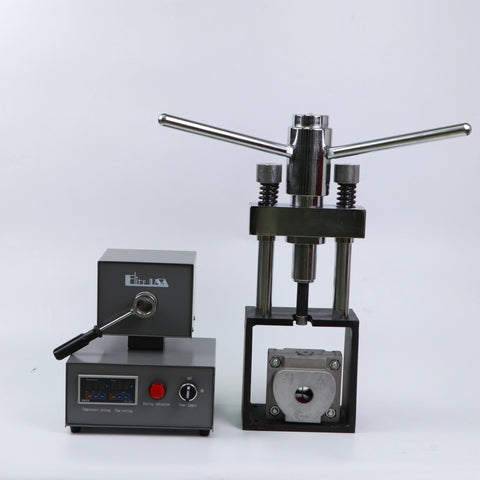
| Manual injection machines | 300 – 3,000 € | Dental and small-series production using compact manual injection equipment . Ideal balance between cost, control, and throughput. |
| Automatic injection machines | 3,000 – 7,000 €+ | Higher productivity, improved repeatability, suitable for semi-industrial and industrial workflows. |
Injectable materials for Indirect AM
These injection systems can be used with a broad range of materials, including:
- Injection molding resins
- CIM and MIM feedstocks for producing fully dense ceramic and metal parts
- Nano- and micron-scale exotic materials
After injection into 3D printed molds, the manufacturing workflow consists of:
- Injection into sacrificial or durable 3D printed molds
- Binder removal using eco-friendly binders
- Thermal debinding (two-step debinding)
- Sintering to obtain fully dense parts
All materials can be supplied as solid feedstocks at room temperature, packed in 25 mm external diameter metal cartridges, allowing direct use with low-cost manual injection machines such as:

Eco-friendly binder technology
3Dresyns ceramic and metal slurries are based on eco-friendly solid binders that are solid at room temperature and become low-viscosity injectable pastes at injection temperature.
- Partial water solubility enables controlled water debinding by forming micropores
- Subsequent thermal debinding removes the remaining binder
- An insoluble binder fraction preserves shape and dimensional stability throughout the process
Additional equipment for Indirect Additive Manufacturing
- Free printer recommendations for printing injection molds using affordable SLA, DLP or LCD printers (typical printer cost: 100 – 1,000 €)