
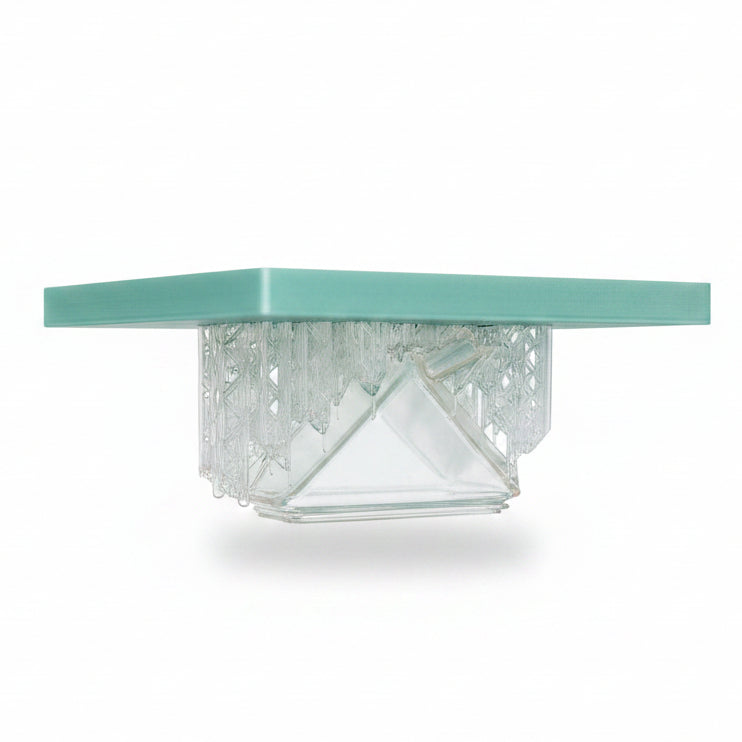
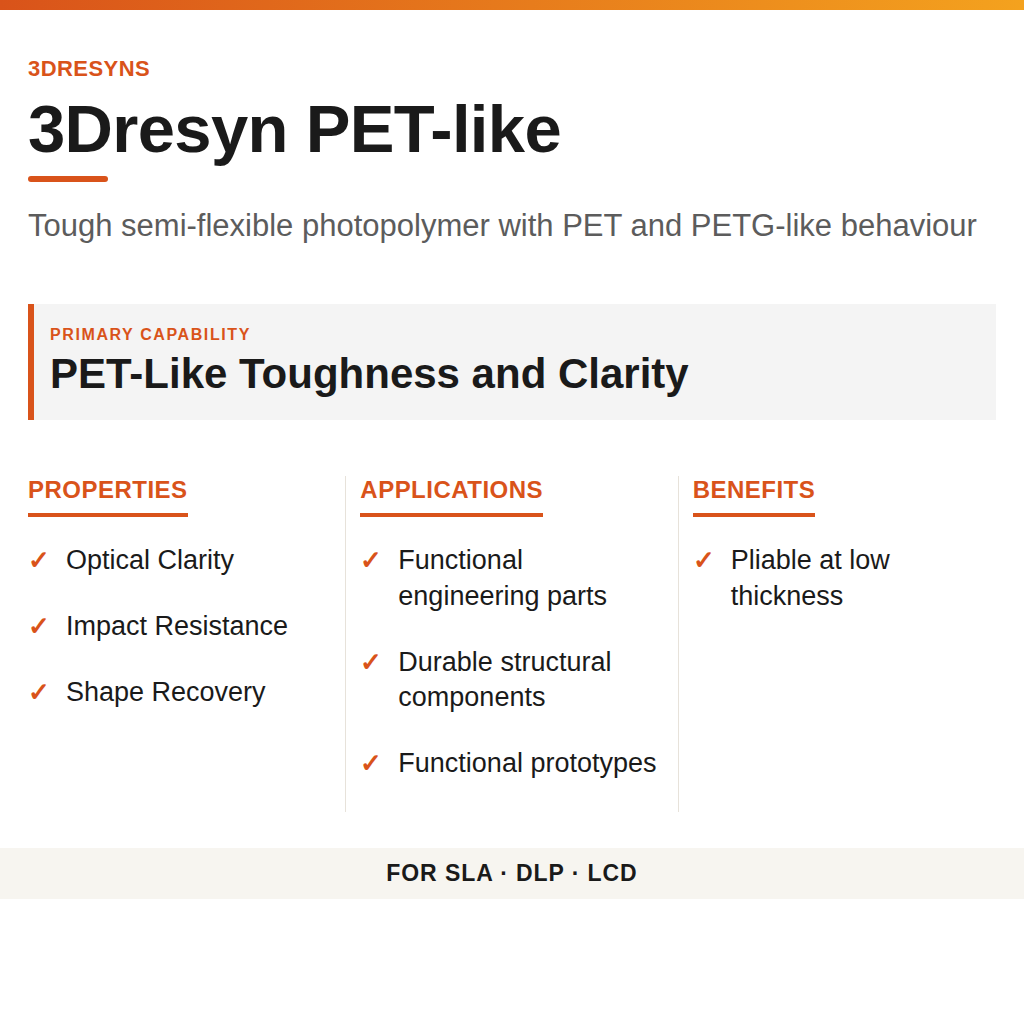
3Dresyn® PET-like is a high-performance photopolymer engineered to replicate the mechanical behaviour of PET and PETG, offering a balanced combination of toughness, flexibility and moderate rigidity. The material exhibits pliable behaviour at low thickness with shape recovery, making it suitable for functional and transparent components. It provides excellent optical clarity with slight yellowing and incorporates bio-based content from renewable sources. It is available in HV (higher mechanical performance) and LV (lower viscosity) versions for compatibility with SLA, DLP and LCD printing systems.
3Dresyn PET-like PETG-like Tough Engineering Resin
Tough semi-flexible biocompatible 3D printing resin with PET/PETG-like mechanical behaviour, combining clarity, impact resistance and moderate stiffness.
Download TDS (PDF)Product description
Application framework
Intended for professional use in vat photopolymerization (SLA, DLP and LCD) additive manufacturing.
Final suitability of printed parts must be validated by the user according to the specific application, processing conditions and applicable regulatory requirements.
Typical applications
- Transparent functional parts and housings
- Impact-resistant components with moderate flexibility
- Containers and fluid-contact components
- Packaging prototypes and consumer product parts
- Biomedical and food-contact oriented applications (subject to validation)
Mechanical properties
- Tensile strength: <30 MPa (typical) (ISO 527-1 / ISO 527-2)
- Flexural strength (break): <50 MPa (typical) (ISO 178)
- Young’s modulus: <1000 MPa (typical) (ISO 527-1 / ISO 527-2)
- Elongation at break: ~40–60% (typical) (ISO 527-1 / ISO 527-2)
- Impact resistance (Notched Izod): >70 J/m (typical) (ISO 180)
- Shore hardness: D60–70 (ISO 868)
Physical properties
- Density: ~1.0–1.1 g/cm³ (typical) (ISO 1675)
- Water absorption: ultra low (ULWA ≤32 µg/mm³) (ISO 62)
- Water solubility: ≤1.6 µg/mm³
- Printing shrinkage: no measurable dimensional shrinkage after calibration under validated processing conditions
- Resolution capability: up to 20 µm (process-dependent)
- Color: clear with slight yellowing unless color is added
- Bio-based content: >20% from renewable sources
- Hydrophobic behaviour
Thermal properties
- Glass transition temperature (Tg): <35 °C (typical) (ISO 11357-2)
Processing and handling performance
- Printing technologies: SLA, DLP and LCD
- Wavelength range: 385–405 nm
- Compatible with open-parameter vat photopolymerization systems
- LV (~lower viscosity): optimized for unheated printers or ambient temperatures below ~25 °C
- HV (~higher viscosity): optimized for heated systems and improved mechanical performance
- Follow 3Dresyns IFU for exposure, washing and post-curing to achieve target properties
Biocompatibility & regulatory framework
- Biocompatible formulation platform
- Food-contact oriented formulation (subject to application-specific validation)
- Biocompatibility must be evaluated on the final printed and post-processed device according to ISO 10993
- Manufacturing aligned with ISO 13485 quality management systems
- Metal-free and organo-tin free formulation
Testing & processing disclaimer
Material properties are measured on printed and post-processed specimens and may vary depending on the selected material version, printer type, printing parameters, build orientation, post-curing conditions and test specimen preparation. Reported values are indicative and provided for reference only.
Why choose 3Dresyn® PET-like
- PET/PETG-like balance of toughness, clarity and flexibility
- Good impact resistance with moderate stiffness
- Transparent material with controlled optical behaviour
- Bio-based content from renewable sources
- Ultra low water absorption (ULWA) and hydrophobic behaviour
- Food-contact and biomedical-oriented formulation platform (validation required)
- Very low shrinkage and good dimensional stability
- Available in LV and HV versions for broader processing flexibility
- Open-system compatibility (385–405 nm) across SLA/DLP/LCD workflows
Related engineering material references
For PET/PETG-like engineering applications, compare adjacent engineering resin routes when the required balance of toughness, rigidity and flexibility changes.
Technical Documentation System
Part of the 3Dresyns® Technical Documentation System
This technical datasheet should be used together with the relevant processing, calibration, safety and workflow documentation available in the 3Dresyns® Resources section.
Choose options
3Dresyn PET-like PETG-like Tough Engineering Resin
Sale price€200.00